


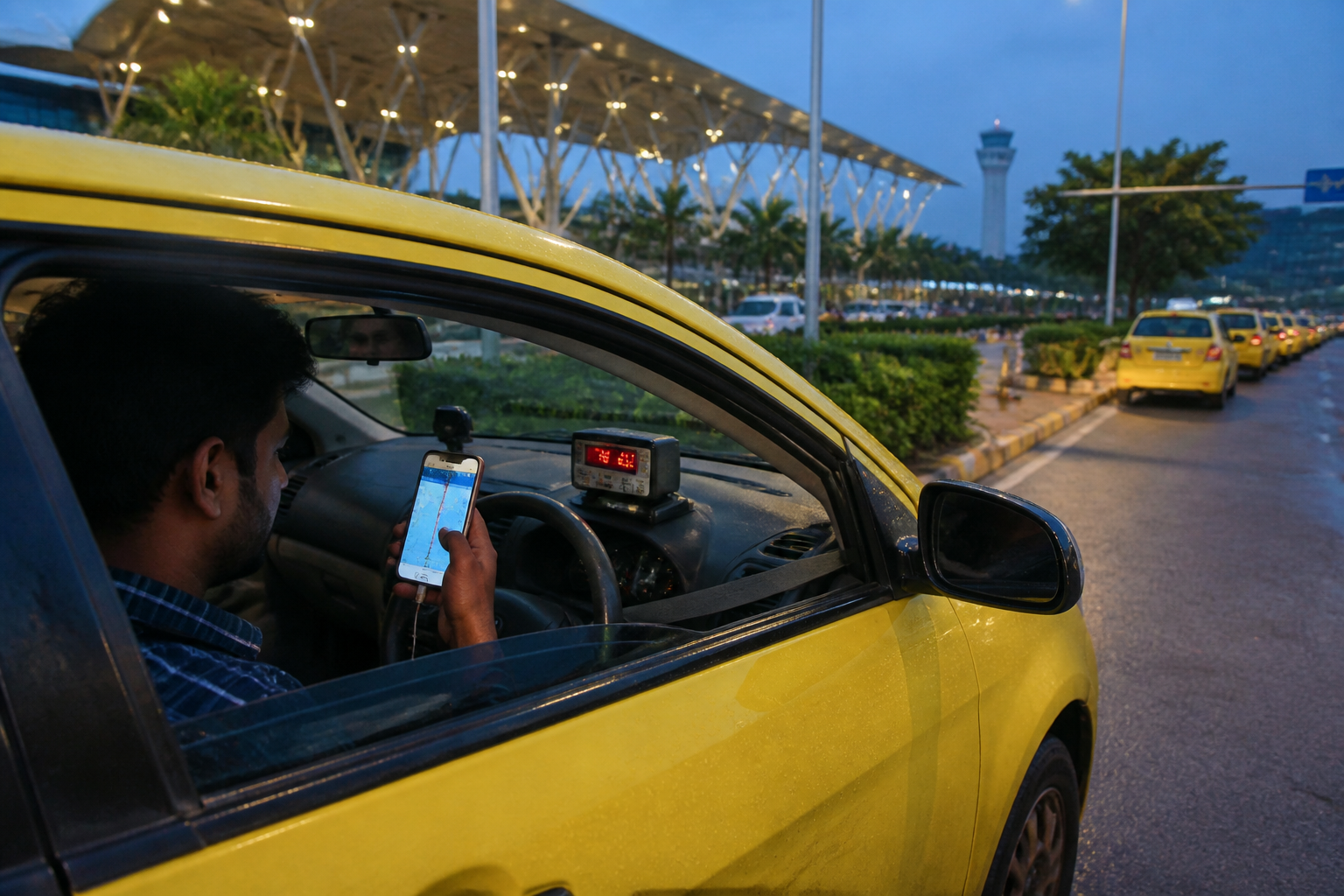
Bengaluru’s latest push to make digital meters and government-fixed fares mandatory for taxis is meant to bring transparency to a market shaped by app-based surge pricing, airport tariffs and street-level bargaining. Instead, the proposed system has exposed a deeper problem: the city does not have one clearly defined fare regime for all the vehicles carrying passengers under the broad label of a taxi.
The regulatory question is not simply whether a cab should display a meter. It is who has the authority to determine the fare, which category of vehicle the fare applies to, and what happens when a government-notified rate conflicts with the price shown on an aggregator app. Until those questions are resolved, a digital meter could add another layer of dispute rather than eliminate existing confusion.
The Karnataka Transport Department’s recent directives link taxi fares to vehicle valuation. Vehicles valued below Rs 10 lakh would charge a minimum of Rs 100 for the first four kilometres and Rs 24 for each additional kilometre. Vehicles valued between Rs 10 lakh and Rs 15 lakh would charge Rs 115 for the first four kilometres and Rs 28 per additional kilometre. For vehicles valued above Rs 15 lakh, the minimum would be Rs 130 for the first four kilometres, followed by Rs 32 per kilometre.
The guidelines also provide for waiting charges after a five-minute grace period and a 10% night surcharge between midnight and 6 am. The structure is intended to replace arbitrary bargaining with a visible, standardised calculation. But it assumes that the vehicles covered by the rule operate under a common legal and commercial framework. Bengaluru’s taxi market, according to representatives cited in the report, does not.
## One city, several taxi systems
The distinction between city taxis, airport taxis, all-India permit vehicles and aggregator-linked cars is central to the dispute. Hamid Akbar Ali, president of the Karnataka Taxi Owners and Drivers Association, said airport taxis considered city taxi services operate under a different fare structure from aggregator vehicles.
He said the existing airport taxi rates are Rs 18 per kilometre for non-air-conditioned vehicles and Rs 24 per kilometre for air-conditioned vehicles, with an additional 10% surcharge after 11 pm. The association has sought an increase to Rs 24 and Rs 26, saying the scheduled revision has not taken place for three or four years.
Airport taxis also operate differently from app-based cabs. Ali said they pick up passengers through a queue system at arrivals, participate in tenders and generally include the return journey in their pricing because the vehicle may return empty after dropping a passenger in the city. Aggregator vehicles, by contrast, charge for a one-way trip and may obtain another passenger after completing the ride.
This difference in operating models explains why a single fare cannot be designed only around the vehicle’s valuation. It also shows why passengers may see apparently different prices for trips that begin at the same airport. For the taxi operator, the fare reflects a queue-based service and the possibility of an empty return. For the passenger, however, multiple rates at the same terminal can look like inconsistent enforcement or selective pricing.
Ali has called for one airport taxi category and one declared rate. His argument is that companies should not be allowed to decide which fare applies at the airport on a particular day. The association has submitted a representation seeking a clearly defined range and a uniform system.
## The meter-app conflict
The proposed digital meter is entering a market where Ola, Uber and newer compliance-focused platforms such as Nagara use dynamic pricing. These systems adjust fares according to demand and supply. During congestion on routes such as Silk Board and the Outer Ring Road, higher prices may be used to attract drivers to difficult or time-consuming trips.
That creates a direct conflict with a static government-notified meter. If the meter is the legally controlling instrument, the price displayed on an app may not be enforceable. If the app price prevails, the meter risks becoming a formal display with little practical authority. If the two systems show different amounts, passengers and drivers may not know which figure can be challenged or who must resolve the dispute.
An expert cited in the report described this as an accountability gap. The problem is administrative as much as technological. A passenger complaint could involve the driver, the aggregator, the Transport Department, the airport operator or the authority responsible for weights and measures, depending on whether the dispute concerns the fare, the vehicle category, the app display or the meter’s calibration.
The market’s earlier experience with auto-rickshaw meters adds to the concern. Mechanical meters were gradually abandoned amid complaints about poor calibration, tampering and fares that did not keep pace with operating costs. App aggregators subsequently became the more visible source of price information, while street-side bargaining continued in parts of the market. Introducing digital meters without a clear enforcement chain could reproduce the same institutional failure in a newer format.
## Permits make enforcement harder
Rudra Murthy, general secretary of the Auto Rickshaw Drivers’ Union in Bengaluru, said the directive may not apply uniformly because taxis operate under different permit categories. According to him, city taxis are required to use meters, while vehicles holding All-India permits may not be subject to the same requirement.
He said many vehicles operating through Ola and Uber have All-India permits rather than city taxi permits. A city taxi, in his description, is restricted to Bengaluru’s limits, while an All-India permit vehicle can operate in the city under a broader permit arrangement. If this distinction is correct, enforcement cannot be achieved simply by announcing one fare table. Inspectors would first need to establish which vehicles fall within the rule and which do not.
The permit issue also reveals why the city’s taxi regulation has become difficult to administer. Bengaluru’s passengers experience one mobility market, but the state’s regulatory system recognises several vehicle categories, operating models and licensing arrangements. The difference may be legally important, yet it is not always visible to the person trying to book or hail a ride.
The same problem appears in auto fares. Murthy said Bengaluru’s auto fare was fixed in August 2025 at Rs 36 minimum and Rs 18 per subsequent kilometre. He argued that the fare does not adequately reflect operating conditions and sought a revision to Rs 40 minimum and Rs 20 per kilometre. He also said fares suitable for Mangaluru should not automatically be applied to Bengaluru because vehicle concentration, demand and passenger volumes differ between cities.
His comments point to another weakness: fare policy is being discussed as a statewide administrative exercise even though the economics of urban travel vary sharply by city. Bengaluru’s traffic conditions, trip lengths and demand patterns create operating costs that may not match those in other urban areas.
## The institutional question
The report attributes responsibility for fare-setting to the Deputy Commissioner, the Transport Department and the Legal Metrology Department. Murthy argued that these authorities should coordinate on rates, meter use and enforcement. The issue is not only whether a tariff is legally notified but whether the agencies responsible for transport permits, fare measurement and consumer protection are working from the same rulebook.
A functional meter system would require more than installation. It would need reliable calibration, a method for updating rates, visible information for passengers, a process for resolving differences between app prices and meter readings, and penalties that can be applied consistently across permit categories. It would also need clarity on whether waiting charges, night surcharges, airport fees and return-trip costs can be added to the displayed fare.
The airport dispute demonstrates why this matters. A passenger may be offered an aggregator fare, an airport taxi fare or a city taxi rate, each based on a different operating model. Without a single disclosure standard, the passenger may not know whether the difference reflects a lawful category distinction, a return-trip cost, a demand-based surcharge or an improperly applied charge.
The state’s directive therefore faces two separate tests. The first is legal: whether the notified fares and meter obligations apply to each relevant class of vehicle. The second is operational: whether agencies can identify vehicles, inspect meters, monitor app displays and resolve complaints quickly. A failure on either front would limit the practical value of the reform.
## What Bengaluru’s fare dispute reveals
Bengaluru’s taxi debate is ultimately about the transition from a regulated street-hail model to a platform-based mobility market. The city now combines government-notified fares, private algorithms, airport tender systems, city permits and All-India permits. Each system solves a different problem, but passengers encounter them as one journey from one location to another.
The proposed digital meter is valuable only if it becomes the authoritative and understandable record of the fare. If it operates alongside an app price without a clear hierarchy, the reform may shift confusion from verbal bargaining to a dispute between two screens. Drivers may avoid trips they consider unviable, while passengers may face inconsistent quotations or limited availability during periods of heavy traffic.
The evidence supplied in the report confirms that Bengaluru has a fare standardisation problem, but it does not establish how the Karnataka Transport Department will reconcile the competing categories or enforce the new rules. The next significant developments will be the department’s clarification of the applicable permit classes, the response to airport taxi associations’ representations, and the creation of a coordinated enforcement mechanism involving transport and legal metrology authorities.
