


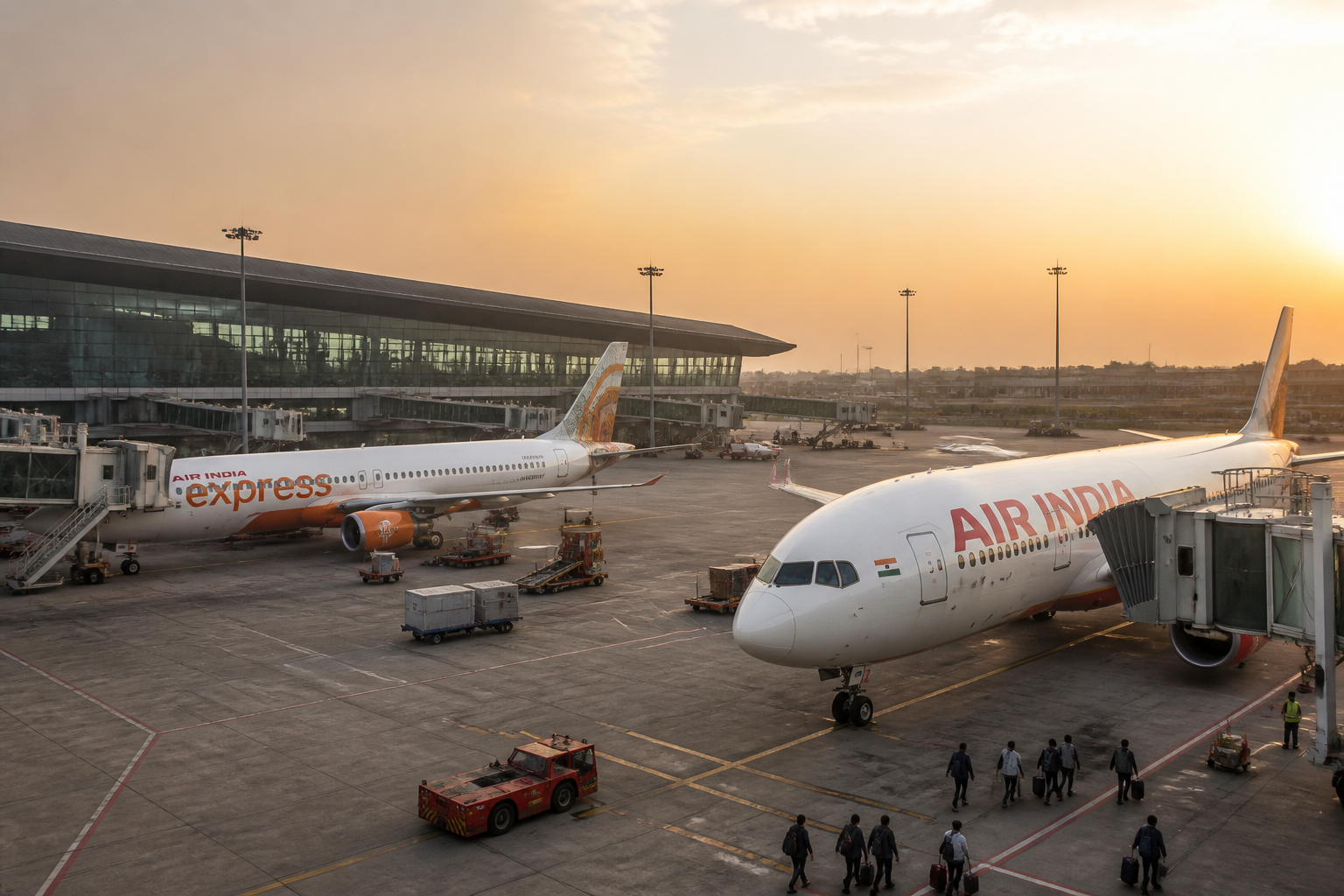
Air India is considering folding its budget unit, Air India Express, into the parent airline as incoming chief executive officer Tewolde Gebremariam seeks to reduce costs and simplify a group that has reported a loss of ₹22,000 crore for the year ended March, according to a Business Standard report citing people familiar with the matter. The proposal remains at an early stage and has not been publicly confirmed by Air India.
The reported plan would combine the two companies while retaining the Air India Express brand. It would also require approval from the supervisory board, according to the report. Tewolde, who officially joined the company this month, still requires approval from local regulators to serve as chief executive because he is a foreign national.
The issue is significant because the proposed change is not simply a brand or corporate-structure exercise. The two airlines currently operate as separate companies with separate operating permits. According to the people cited in the report, Tewolde has questioned the need to maintain two airline companies and has argued that a single airline group could reduce regulatory requirements and avoid duplicating management, engineering and administrative functions.
Air India has not responded to an email seeking comment, according to the report. That leaves the central question unresolved: whether the discussions represent an internal efficiency review or a formal plan that will be placed before the board and regulators.
The reported deliberations come after a series of structural changes in the Tata Group’s airline portfolio. Air India merged with Indian Airlines in 2007. After the Tata Group acquired Air India in 2022, four airline brands were reorganised into two, resulting in the current structure centred on Air India and Air India Express. The possible integration described in the report would represent another change to that post-acquisition architecture.
The distinction between a full corporate merger and operational coordination will be important. A merger could reduce the need for two sets of senior managers, engineers and administrative teams, as the report says Tewolde has suggested. It could also alter how the group manages regulatory compliance and operating permits. But the supplied report does not establish how the integration would be implemented, how employees would be affected, whether aircraft and route planning would change, or whether the two brands would have separate customer-facing roles after any combination.
The immediate public-interest issue is therefore less about a confirmed merger than about the institutional mechanics of restructuring a large airline group. Any change would need to pass through the supervisory board and the relevant regulatory process. Until those steps occur, the proposal remains an internal consideration rather than an approved transaction.
The reported loss provides the financial context for the review. Air India posted a loss of ₹22,000 crore in the year through March, according to the report. The figure has increased pressure on the airline’s management to identify inefficiencies and reduce the cost of operating a complex group. The report also says that Tata Sons, Air India’s parent, is dealing with a power struggle over the extension of the Tata chairman’s tenure and a regulatory push to list. The supplied material does not provide further details on either matter.
The airline’s challenges extend beyond corporate structure. The report identifies the closure of Pakistani airspace to Indian carriers and the conflict in the Middle East as factors that have disrupted travel and increased fuel costs. It also says Air India is facing a probe after a pilot involved in a flight that experienced a sudden altitude drop tested positive for illegal drugs. The report does not state the outcome of that probe.
Tewolde’s earlier discussions with employees reportedly focused on other operational issues as well. He raised concerns about Air India’s low cargo-load utilisation and asked staff to prepare a plan to reduce maintenance problems, according to the report. His record at Ethiopian Airlines Group, where he was selected in part because of his role in turning the carrier into one of Africa’s largest and most profitable airline groups, is presented as part of the rationale for his appointment.
The focus on cargo is relevant to the broader restructuring question because it shows that the reported review is not limited to removing duplicated corporate functions. The internal discussions described in the report also involve the use of aircraft capacity, maintenance performance and the operating model. However, no cargo utilisation figure, maintenance target or implementation timetable is provided in the available material.
For passengers, the immediate effect of the reported proposal is uncertain. Air India Express would retain its brand name in a combination, according to the people cited. The report does not indicate whether fares, schedules, loyalty programmes, aircraft allocation, cabin products or airport operations would change. It also does not establish whether the two airlines would continue to serve different market segments after a corporate integration.
For employees, the possible reduction in duplicated managerial, engineering and administrative functions could have organisational consequences. The report does not specify the number of roles involved, whether staff transfers are being considered, or whether any workforce consultation has begun. Those questions would become material if the proposal moves from internal deliberation to a board-approved plan.
The regulatory dimension is equally important. The proposal is reportedly linked to the existence of separate operating permits, but the report does not identify which approvals would be required beyond supervisory-board approval and Tewolde’s pending regulatory approval as chief executive. It also does not say whether the operating permits would be consolidated, amended or replaced. These details would determine how quickly any integration could proceed.
The reported plan also illustrates the tension between airline branding and airline administration. Keeping the Air India Express name while combining the companies could allow the group to preserve a distinct market identity while reducing back-office duplication. Whether that structure would deliver the intended savings would depend on the regulatory, operational and staffing arrangements ultimately approved. The available report does not provide projected savings or a financial model.
The Tata Group’s equity partner, Singapore Airlines, would welcome a successful streamlining of Air India, according to the report, as it faces political backlash for supporting the airline’s loss-making operations. The report does not provide a statement from Singapore Airlines or quantify its exposure to the losses.
What is established at this stage is limited but consequential. Air India’s incoming chief executive has questioned the need for two separately permitted airline companies; a possible integration of Air India Express into Air India is being considered; the budget carrier would retain its brand under the reported approach; and any combination would require further approval. What is not established is whether the proposal will reach the supervisory board, whether regulators will approve it, or how passengers and employees would be affected.
The next formal milestones are the regulatory decision on Tewolde’s appointment and any supervisory-board consideration of the proposed structure. Until Air India, the board or the relevant authorities issue a statement, the reported merger plan should be treated as an unconfirmed internal deliberation rather than a completed corporate decision.

