


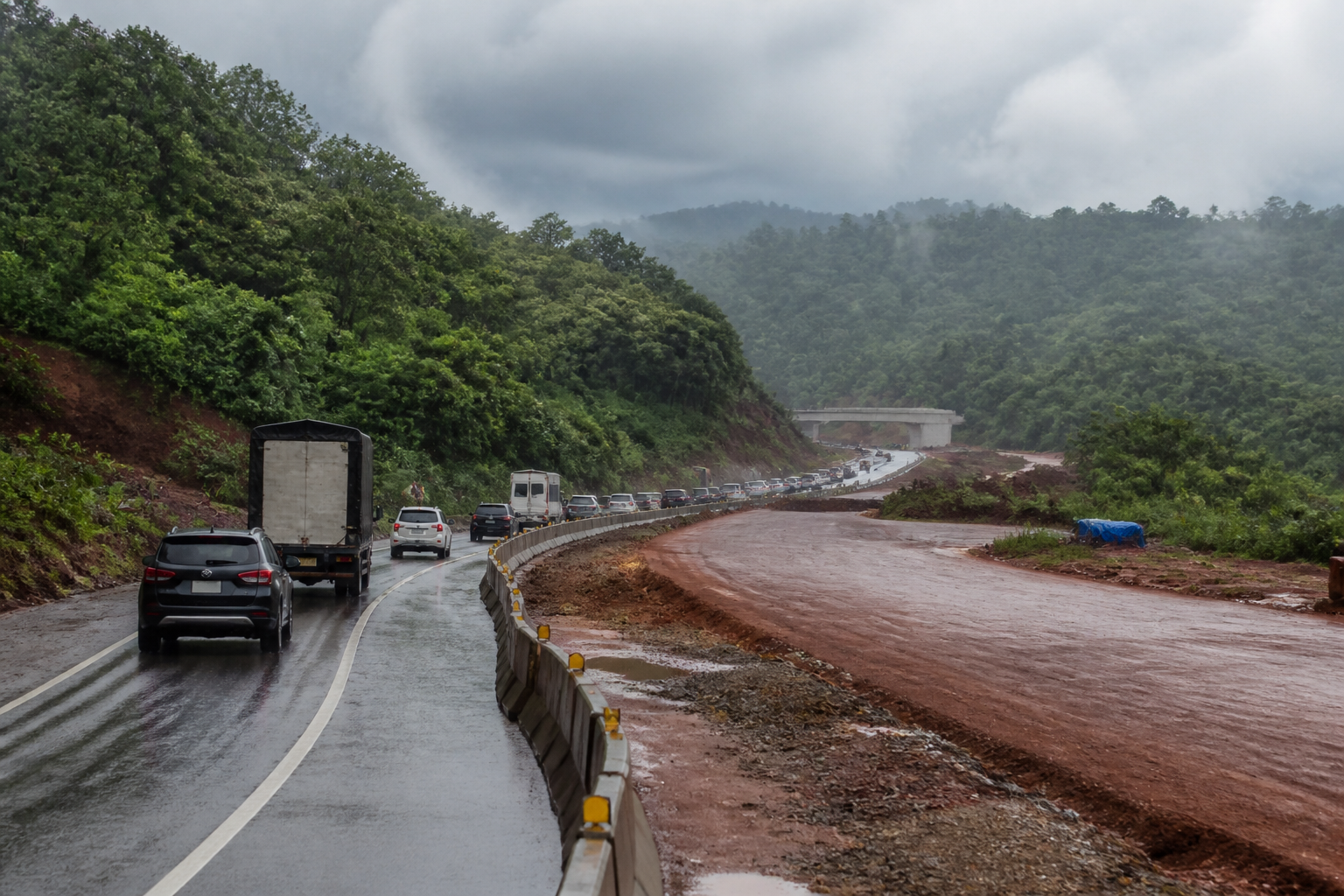
The Mumbai-Goa Highway has become a measure of how India’s road projects can expand in cost while remaining incomplete on the ground. An RTI response cited by Loksatta shows that the approved cost of the 355-kilometre four-laning project has risen from ₹11,499 crore to ₹16,909 crore, a 48% increase, even as major sections remain unfinished after years of construction.
The figures were provided by the Union Ministry of Road Transport and Highways in response to an application filed by Jitendra Ghadge of The Young Whistleblowers Foundation. They cover 10 packages of the highway project, which is intended to connect Mumbai with Goa through the Konkan region. The original report says approval for the four-laning came 17 years ago, while the project has remained substantially incomplete for nearly 15 years.
That combination—higher expenditure, extended timelines and unfinished road sections—makes the highway more than a delayed transport project. It raises a central question about the way large public works are administered: when a project is divided into packages and assigned to different agencies, who is responsible for maintaining cost discipline, resolving bottlenecks and explaining delays to the people who depend on it?
The answer is not straightforward in the Mumbai-Goa case. According to the report, the Panvel-Indapur section is being executed by the National Highways Authority of India, while the remaining sections in Maharashtra have been assigned to the state Public Works Department. The project is being implemented under the national highway programme, but its execution is split between a central road agency and the state department.
This institutional arrangement matters because a highway is experienced by users as one continuous corridor. A traveller does not encounter separate administrative packages; they encounter a sequence of completed, narrowed, diverted or unfinished stretches. For freight operators, inter-city commuters and the large number of visitors travelling towards Konkan destinations, the practical quality of the route depends on the weakest section rather than on the aggregate length completed.
The RTI figures also show that cost growth has not been uniform across the project. The Parshuram Ghat–Aaravali package in the Chiplun-Ratnagiri area has reportedly increased from ₹983 crore to ₹2,226 crore. That is a 126% rise, the highest among the packages cited in the report. The package’s revised cost is therefore more than twice its original approved amount.
The available material does not establish the precise reasons for each package-level increase. It does, however, establish the scale of the divergence between initial approvals and current costs. Across the 10 packages, the project’s approved value has increased by ₹5,410 crore. The revised figure is also higher than the project’s original sanctioned budget, while substantial portions are still incomplete.
This is the central public-finance problem exposed by the highway’s numbers. A cost revision can be legitimate when land acquisition, design changes, construction conditions or material and labour costs change. But a revision of this scale, accompanied by prolonged incompletion, requires a clear administrative account of what changed, when it changed and which institution was responsible for responding.
The report does not provide a package-by-package explanation from the ministry or the implementing agencies for the revisions. It also does not establish whether all the revised expenditure has translated into corresponding physical progress. Those gaps are important. Financial progress and physical completion are related, but they are not identical measures of delivery. A project can absorb large sums while critical links, structures or difficult sections remain unfinished.
The Parshuram Ghat–Aaravali figure illustrates why corridor-level averages can conceal localised problems. A 48% increase across the project is already substantial, but a 126% increase in one package points to a more concentrated implementation challenge. The source material does not identify the specific cause of that package’s escalation, so it would be incorrect to attribute it to a particular failure without further documentation. What can be said is that the package warrants closer scrutiny because its cost movement is markedly different from the project-wide increase.
The highway’s role in the Konkan region adds a direct mobility and safety dimension. Loksatta reports that some incomplete portions have repeatedly become dangerous and that lakhs of travellers heading towards Konkan face significant inconvenience every year. Incomplete four-laning can leave traffic moving through constrained sections, temporary arrangements or roads that do not offer the capacity and consistency expected from a national highway upgrade.
For residents and businesses along the corridor, the issue is not limited to holiday-season congestion. A long-delayed highway affects the reliability of movement between Mumbai, towns in the Konkan region and Goa. It can complicate the movement of goods, lengthen travel times and make access to employment, markets and services less predictable. The supplied report does not quantify these effects, but it clearly identifies recurring inconvenience and safety concerns for road users.
The split in implementation responsibility also highlights a broader feature of Indian infrastructure delivery. National highways may be part of a centrally sponsored or nationally framed programme while construction responsibility is distributed among agencies with different capacities, procedures and reporting structures. Such division can be administratively workable, but only when there is a strong mechanism for corridor-wide coordination and public reporting.
In the Mumbai-Goa project, the available information leaves unanswered how performance is being monitored across the 10 packages, whether the same completion standards apply to both implementing agencies and how delays in one section affect the operational usefulness of the entire route. It also does not indicate whether a single public dashboard or review mechanism reports physical progress, revised costs and pending obstacles across the corridor.
These are not procedural details separated from the traveller’s experience. They determine whether a road project functions as a connected transport system or as a collection of partially completed works. When agencies report package-level progress without explaining the corridor-level outcome, the public may see expenditure and construction activity without receiving a clear answer on when the promised connectivity will actually be available.
The project’s timeline makes that question more urgent. The original report says 17 years have passed since approval for four-laning, while the highway has remained incomplete for nearly 15 years. This is not a short-term construction disruption. It is a prolonged delivery cycle in which the original cost estimate has lost relevance and the public benefit remains only partly realised.
The RTI disclosure therefore provides two distinct kinds of information. The first is financial: the approved cost has risen from ₹11,499 crore to ₹16,909 crore. The second is institutional: despite this expansion in the financial envelope, major sections remain incomplete and responsibility is divided between the National Highways Authority of India and Maharashtra’s Public Works Department. The significance lies in the relationship between these facts, not in either number alone.
A complete assessment would require the ministry and implementing agencies to publish the current physical status of each package, the reasons for every major cost revision, the expenditure incurred to date, outstanding land or contractual issues and the completion milestones for unfinished sections. The supplied report does not include those details, so the present evidence cannot establish which specific administrative decisions produced the escalation.
What it does establish is a persistent mismatch between the project’s intended role and its delivery record. The Mumbai-Goa Highway was planned as a 355-kilometre four-laning project connecting Mumbai and Goa, but its users continue to encounter incomplete stretches. At the same time, the project’s approved cost has increased by nearly half overall, with one package more than doubling in value.
The larger urban and regional question is how public authorities measure success when a corridor remains incomplete for years. Approval, tendering, expenditure and package execution are necessary stages, but they are not the same as a functioning highway. For citizens, the relevant outcome is a safe and dependable route. For the public exchequer, it is delivery within a defensible cost and time framework. The RTI figures show that both outcomes need closer examination in this case.
The next stage of scrutiny should focus on the package-level explanations and updated completion commitments from the Ministry of Road Transport and Highways, the National Highways Authority of India and Maharashtra’s Public Works Department. Until those details are made clear, the available evidence points to a highway whose financial commitments have expanded substantially while its promised corridor-wide connectivity remains unfinished.
