


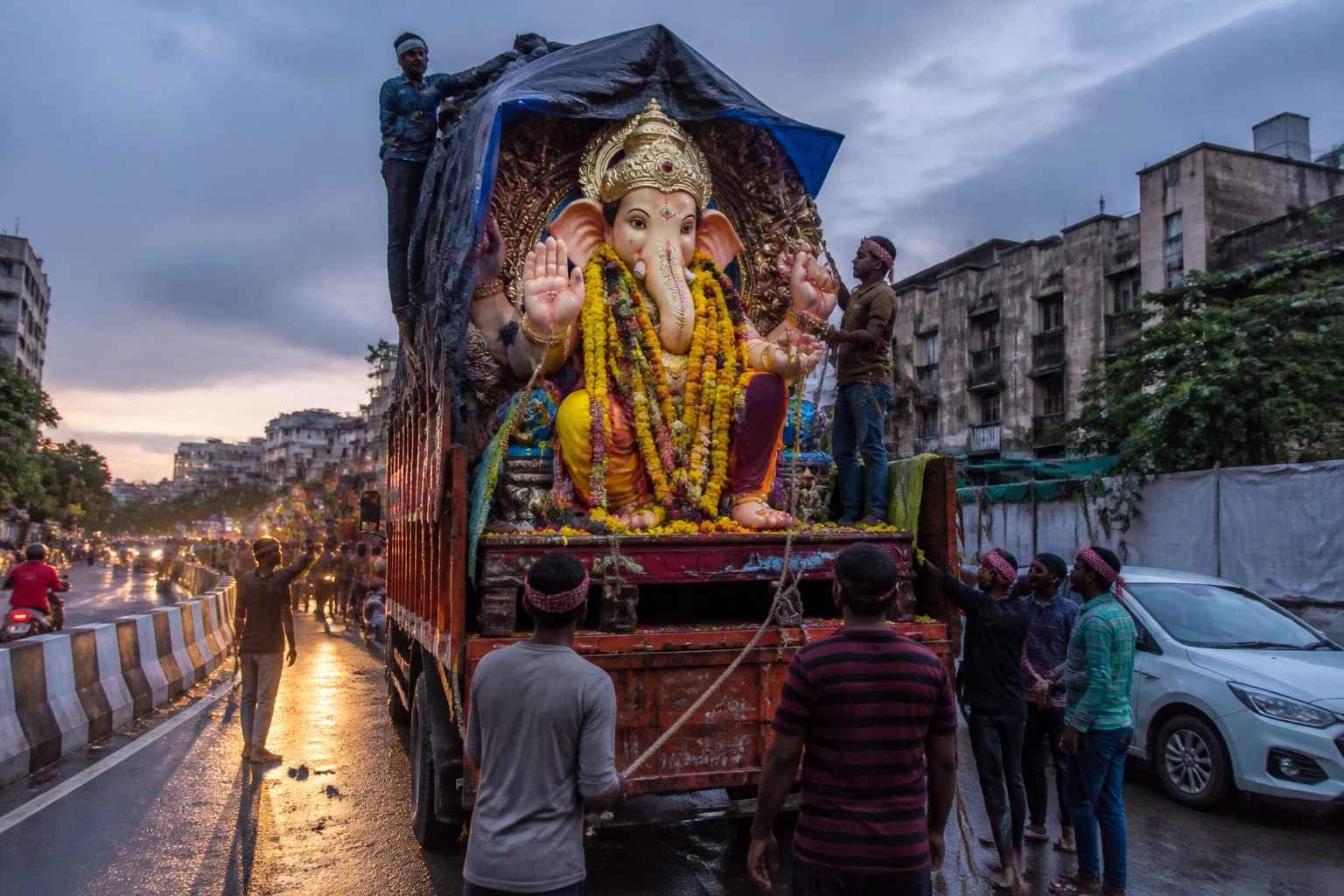
The Hyderabad Ganesh festival remains a major seasonal marketplace for informal workers, but this year’s business outcomes show that a large public event does not distribute economic opportunity evenly. Idol transporters reported stronger bookings, while DJ operators, brass bands and decoration contractors said police restrictions, higher costs and changing organiser choices reduced demand.
The pattern is significant because the festival economy depends on a wide network of workers operating outside the formal event industry. Idol-makers, transporters, sound providers, musicians, decorators and flower sellers do not experience the festival as a single market. Their earnings depend on where processions move, when immersion takes place, what permissions are available, how long vehicles remain stuck in traffic and how organisers allocate limited budgets.
According to a report by Deccan Chronicle – South, one idol transport operator with a fleet of five vehicles received about 30 bookings this season and earned Rs 8 lakh. Bookings began largely from the fifth day of Ganesha Chaturthi and were around 40 per cent higher than last year. The operator’s charges ranged from Rs 15,000 to Rs 30,000 depending on the immersion day, while the highest-paying trip brought in Rs 40,000 for transporting an idol from Hyderabad’s Old City to Shamirpet.
The higher revenue, however, came with higher operating pressure. Vinod, a manager for the operator, said driver costs had increased because traffic on immersion days could make a single trip last more than 24 hours. The vehicle therefore became more than a transport asset: its earning capacity was tied to the duration of the city’s traffic restrictions and the amount of time drivers and vehicles remained committed to one booking.
This illustrates one of the defining features of temporary urban economies. Demand may rise, but income does not automatically improve at the same rate. A longer trip can increase the price charged to an organiser while also raising labour costs, reducing the number of trips a vehicle can complete and increasing the operational burden on the provider.
The experience was not shared by all transport operators. Sameer Khan, a provider from Musheerabad, said demand for his vehicles was lower than last year because some organisers were hiring tractors from suburban areas. His charges ranged from Rs 8,000 to Rs 14,000. The difference between the two operators points to the importance of location and vehicle choice in determining who benefits from festival demand.
A citywide rise in immersion activity can therefore coexist with weaker business for individual operators. The transport market is shaped not only by the number of idols being moved but also by the distance of the route, the availability of lower-cost vehicles, the location of organisers and the restrictions affecting movement on particular days.
The sharpest contraction was reported by businesses dependent on sound and public performance. A DJ and event-services provider received around 20 bookings worth Rs 12 lakh, with single-pin DJ setups starting at Rs 10,000 and larger packages, including sound boxes, truss structures, lighting and DJ equipment, costing up to Rs 75,000. The highest-value booking was worth Rs 2 lakh.
Despite those sizeable individual bookings, providers said the number of orders had fallen because of restrictions on DJ permissions during immersion processions. The business model is especially sensitive to permission rules because equipment has value only when it can be used at a specific location and time. A restriction on sound equipment can remove an entire booking rather than merely reduce its value.
Brass and pad band operators reported a similar decline. S. Anil of Sri Suraj Music Brass and Pad Band in Musheerabad said the number of workers engaged by his group had fallen from 120 last year to around 70 this year. Charges ranged from Rs 5,000 to Rs 1 lakh depending on the number of bands and the requirements of the organiser.
The reduction in the number of workers is an important indicator of how regulatory decisions can travel through informal labour markets. A restriction imposed on processions may be experienced by the public as a change in sound levels or movement management. For a band operator, it can mean fewer musicians hired, fewer working days and a smaller seasonal income for workers who depend on festival bookings.
Decoration contractors also saw a decline in both the volume and average value of work. P. Vinay Kumar, who operates in West Marredpally and Gandhi Nagar, said he had decorated around 20 pandals last year, with each order worth about Rs 1 lakh. This year, he secured work for six pandals, with orders averaging Rs 70,000 to Rs 80,000.
The figures suggest a contraction at two levels: fewer projects and lower average order values. That may reflect changes in organiser spending, but the supplied report does not establish the precise share of the decline attributable to police restrictions, input costs or household and community budgets. What it does establish is that decoration contractors experienced a materially smaller season than the previous year.
Flowers followed a different trajectory. Vendors reported steady sales, with Bhaskar of Monda Market describing business as slightly better than last year despite increased competition. Marigold was priced at Rs 100 to Rs 150 per kilogram, while chrysanthemum sold at Rs 350 to Rs 400 per kilogram. He sourced flowers from Gudimalkapur and Karnataka.
The flower trade also demonstrates how timing affects income. Demand peaks at the beginning of the festival and during immersion days, according to Bhaskar, while unsold stock can result in losses. Unlike sound equipment or transport vehicles, flowers are perishable inventory. A vendor cannot carry unsold stock into the next season, and a temporary mismatch between supply and demand directly affects earnings.
Taken together, these accounts show that the festival economy is organised around different kinds of urban risk. Transporters face traffic delays and rising driver costs. DJ operators and bands face permission-related uncertainty. Decorators face fluctuations in the number and value of orders. Flower vendors face competition, price variation and the risk of spoilage. The same festival creates demand, but the form of that demand determines which workers gain and which absorb the disruption.
Police restrictions are central to this year’s account, but the report does not present them simply as an economic policy. Immersion processions require authorities to manage traffic, movement, sound and public order across several locations and time periods. A decision intended to control one aspect of the event can affect connected livelihoods that depend on the same procession route or celebration schedule.
The transporter’s experience shows the operational consequences of traffic management. When a trip takes more than 24 hours, the restriction affects vehicle availability, driver deployment and the cost of fulfilling a booking. For DJ and band operators, permissions determine whether their services can be used at all. For decorators, the number and size of pandals determine demand. These are different business effects arising from the same urban event-management system.
The report also reveals that informal businesses are responding to cost pressure and substitution. Some organisers hired tractors from suburban areas instead of using established transport providers. This indicates that organisers were not choosing only between competing firms; they were also choosing between different types of vehicles and operating arrangements. The effect was to create stronger business for one transport operator and weaker demand for another.
The available figures do not allow a citywide estimate of total festival spending, employment or losses. They are individual business accounts, and their experiences vary by location, service and customer segment. That limitation matters. The evidence supports a picture of uneven impact, not a claim that the entire festival economy expanded or contracted by a specific percentage.
It also means that headline revenue figures need to be read alongside labour and operating costs. The transport operator’s Rs 8 lakh income was accompanied by longer trips and higher driver costs. The DJ provider’s Rs 12 lakh in bookings included packages with different equipment requirements and cannot be directly compared with the earnings of a flower vendor or band operator. The reported numbers show the scale and diversity of transactions, not uniform profit.
For city administrations, this is the governance challenge presented by large seasonal events. Authorities must regulate movement and public activity, but their decisions also reshape the informal economy around the event. The supplied accounts do not record any formal consultation process, compensation mechanism or dedicated support programme for affected workers. They do, however, show that the effects are visible in booking volumes, worker numbers, trip durations and inventory risk.
The festival’s economic geography is also distributed across Hyderabad. The report refers to the Old City, Shamirpet, Musheerabad, West Marredpally, Gandhi Nagar, Monda Market and Gudimalkapur, as well as flower supplies from Karnataka. This network links neighbourhood markets, suburban transport providers, procession routes and wholesale supply chains. The festival is therefore not confined to pandals or immersion points; it activates a wider urban system of movement, labour and trade.
The evidence ultimately points to a fragmented recovery rather than a single business story. Idol transport recorded stronger bookings, but not without higher costs and longer trips. Another transport provider lost demand to suburban tractor arrangements. DJ and band operators reported fewer bookings or fewer workers. Decoration contractors handled fewer and smaller orders. Flower vendors saw stable to slightly improved sales while carrying the risk of unsold stock.
What remains unclear is how many businesses across Hyderabad experienced each of these outcomes and how much of the change came from restrictions, inflation or altered spending patterns. What the reported accounts confirm is that the city’s festival economy is highly dependent on administrative rules, transport conditions and household-level spending decisions. Its informal workers absorb these changes quickly, often without the buffer available to formal businesses.
The next useful measure of the festival’s urban impact would be a broader assessment covering permits issued, procession routes, traffic delays, worker participation and business volumes across different neighbourhoods. Until such evidence is available, the individual accounts offer a grounded conclusion: Hyderabad’s Ganesh festival generated substantial economic activity, but its benefits and burdens were distributed unevenly across the workers who make the event possible.
