


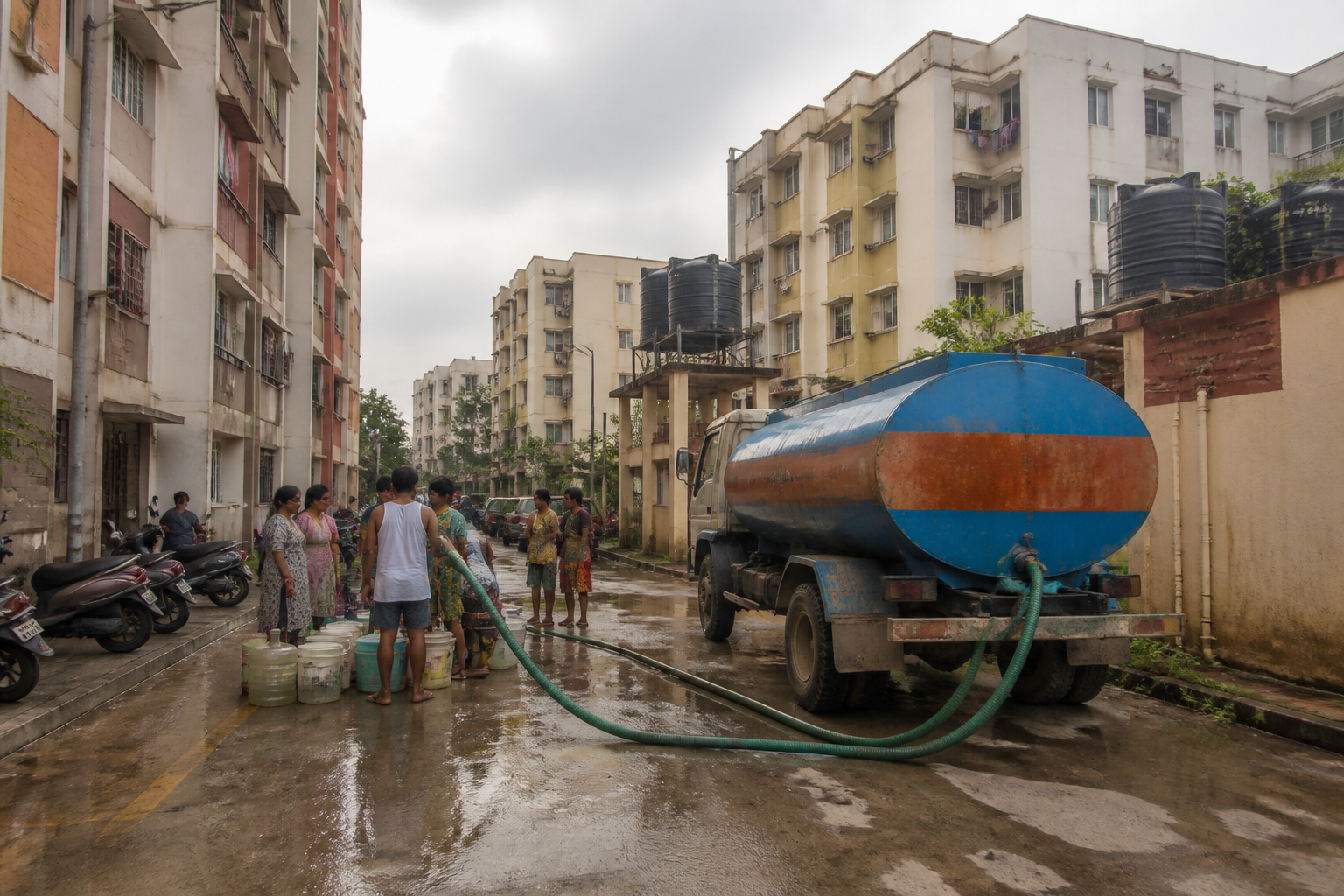
Visakhapatnam’s water shortage is no longer confined to the question of whether households can fill their tanks. In apartment complexes and gated communities across the city, unreliable supply is changing monthly maintenance bills, increasing dependence on private tankers and influencing where tenants are willing to live. The emerging housing signal is clear: water reliability is becoming a more important property attribute than several conventional amenities.
Residents in Maharani Peta, Seethammadhara, Maddilapalem, Shivajipalem, Yendada, Arilova, Pedda Rushikonda, Marikavalasa, PM Palem, Madhurawada, Mithilapuri Vuda Colony and Gajuwaka are reported to be facing shortages. The Greater Visakhapatnam Municipal Corporation has reduced water-supply timings, while residents say that even tankers booked through the civic body are often not delivered on time. Protests have taken place in several neighbourhoods.
The immediate problem is being experienced at the level of apartment operations. Borewells drilled to depths of 500 feet have failed in several locations, according to residents cited in the report. Attempts to reach 800 feet have produced only limited supplies. This has pushed large apartment complexes and gated communities towards tanker dependence, with some requiring 10 to 20 tankers a day. Each tanker is reported to carry between 10,000 and 12,000 litres.
That volume indicates the scale of the gap that private supply is being asked to fill. A community requiring 10 tankers a day would need between 100,000 and 120,000 litres daily from tankers alone; a 20-tanker requirement would double that range. These figures do not establish the total water demand of each community, but they show how quickly a supply disruption becomes an operational and financial problem when a neighbourhood depends on large buildings with shared storage systems.
The pressure is also visible in household budgets. M. Madhava Rao, a resident of an apartment in Seethammadhara, said his monthly water-related maintenance burden had risen sharply. “What used to cost Rs 1,000 has increased dramatically as we now have to pay for water tankers,” he said, adding that the additional expense was affecting retired residents.
This is an important distinction in understanding the housing impact. Water scarcity does not only affect the price of a tanker or the frequency of a municipal supply line. In apartment buildings, the cost is distributed through maintenance charges and therefore reaches residents who may have no control over the source of water. For households on fixed incomes, the same disruption that appears as an infrastructure failure at city level becomes a recurring affordability problem at home level.
The report also points to a weakening of groundwater as a parallel concern. Official data cited in the article places groundwater levels in Visakhapatnam district at 7.54 metres below ground level in 2023 and 7.8 metres in 2024. The level was reported at 7.65 metres in 2025 before declining to 11.51 metres in 2026. The figures, as presented, indicate that groundwater has become substantially deeper in 2026 than in the preceding years cited.
That trend matters because borewells are often treated as a private backup to public supply. In the affected apartment districts, however, the reported failure of borewells at 500 feet and limited output even after drilling towards 800 feet suggests that private backup is not automatically reliable. Once both the municipal line and local groundwater become uncertain, apartment societies have fewer immediate options beyond buying water from tankers.
The city’s reservoirs are also reported to be under pressure. Tatipudi, Mehadrigedda, Mudasarlova, Gambhiram and Gosthanee, which supply Visakhapatnam, have recorded declining water levels, according to the report. The combination of shrinking reservoir supplies, reduced municipal timings and weaker groundwater creates a layered supply problem rather than a single point failure.
Each source serves a different part of the urban water system. Reservoirs support bulk or municipal supply, groundwater is used by households and apartment communities as a supplementary source, and tankers fill short-term gaps. When all three become less dependable at the same time, the city’s formal and informal systems begin to overlap. Residents may book a tanker through the GVMC, rely on private operators or draw from a borewell, but none of those options guarantees predictable delivery.
The reported difficulty in obtaining even two tankers a day through the GVMC’s online booking system shows the institutional challenge at the point of service delivery. A booking platform can register demand, but it cannot by itself create additional water, tanker capacity or delivery reliability. Residents say officials were often unresponsive despite providing contact numbers for tanker services. The gap between a service being available in a system and being delivered when needed is therefore central to the crisis.
For large apartment complexes, timing is as important as volume. Water must reach the premises before storage tanks run dry, and a missed delivery can affect several hundred households at once. The article does not establish the population of each affected community or the exact municipal allocation by neighbourhood, but the reported tanker requirements show that the issue has moved beyond isolated household inconvenience.
The housing market is beginning to register these infrastructure conditions. Brokers in Seethammadhara told the newspaper that water availability had become a primary concern for tenants, ahead of parking and fitness facilities. Prospective renters are reportedly asking whether the GVMC line operates every day, whether the borewell is functional and whether the building has sump backup.
This changes how housing is evaluated. Apartment searches traditionally focus on rent, location, access, parking, security and amenities. In the affected areas, the operational reliability of water infrastructure is becoming part of the effective rent. A flat with a lower monthly rent but frequent tanker charges may cost more to occupy than a costlier flat with dependable supply. The report does not provide a comparative rent table, so the scale of the premium cannot be measured from the available evidence. It does, however, record a clear change in tenant questions and broker assessments.
Flats with assured water supply are reportedly being rented within a day, sometimes at higher rates, while homes without reliable water remain vacant despite lower rents. This is a significant market signal because it shows that water is influencing both demand and pricing. The market is not treating all apartments in the same locality as equivalent; it is differentiating between buildings according to the reliability of their water systems.
That differentiation can deepen inequality within the same city. Residents who can absorb higher rents, tanker charges or larger maintenance bills may be able to secure better-provisioned buildings. Others may accept lower-rent homes with less dependable supply and face greater uncertainty in daily life. The report does not quantify household income differences or the number of tenants affected, but the account of retired residents facing higher maintenance costs shows that vulnerability is not limited to one category of household.
The situation also exposes the limits of treating apartment water as a private management issue. Building-level solutions such as sumps, borewells and tanker contracts can help societies manage short-term shortages, but their effectiveness depends on the wider availability of water. When groundwater levels decline and reservoirs fall, individual buildings compete for the same constrained resource. The cost is then transferred from the public system to resident welfare associations, landlords and tenants.
For the GVMC, the challenge has at least three linked dimensions: maintaining municipal supply, managing tanker demand and communicating with residents when delivery fails. The source material records reduced supply timings, online tanker bookings and complaints about delayed delivery. It does not provide the corporation’s explanation, tanker fleet size, reservoir storage figures or a neighbourhood-wise distribution schedule. Those missing details are important for evaluating whether the central problem is water availability, delivery capacity, allocation, or a combination of these factors.
The groundwater figures raise a separate administrative question. The report cites district-level measurements, while the most severe complaints are associated with particular apartment clusters and suburbs. District averages can show a broad trend, but they do not reveal how conditions vary between neighbourhoods or whether some localities are drawing groundwater faster than others. The reported borewell failures make that local picture important, especially where new apartment construction has increased dependence on shared or private sources.
The available evidence therefore confirms the pressure but does not establish a complete causal account. Reservoir levels are declining, groundwater is reported to be deeper in 2026, municipal supply timings have been reduced and residents are turning to tankers. At the same time, the source does not provide rainfall data, current reservoir storage percentages, municipal supply volumes, tanker pricing, building approvals or the number of affected households. Those gaps should be addressed before drawing broader conclusions about the relative contribution of climate, demand growth, planning or distribution failures.
What is already visible is the way an urban utility problem is being capitalised into the housing market. Water reliability is influencing maintenance charges, tenant screening, vacancy periods and the premium attached to certain flats. The built form of Visakhapatnam—large apartment complexes and gated communities—amplifies the effect because a disruption must be managed collectively and at substantial daily volumes.
The larger urban question is whether water security is being incorporated into housing and infrastructure decisions before shortages become permanent market criteria. In the evidence supplied here, residents are already using water availability to judge buildings, while brokers are treating it as a leading rental concern. The next stage of the crisis will depend on the city’s ability to stabilise supply, improve tanker delivery and clarify how declining reservoirs and groundwater levels are being managed.
For now, the report establishes a city where water access is moving from a basic municipal service to a defining feature of housing value. The most important developments to monitor are the GVMC’s response to tanker delays and reduced supply timings, the condition of the named reservoirs, subsequent groundwater measurements and whether the rental premium for assured-water buildings persists across the affected neighbourhoods.
