


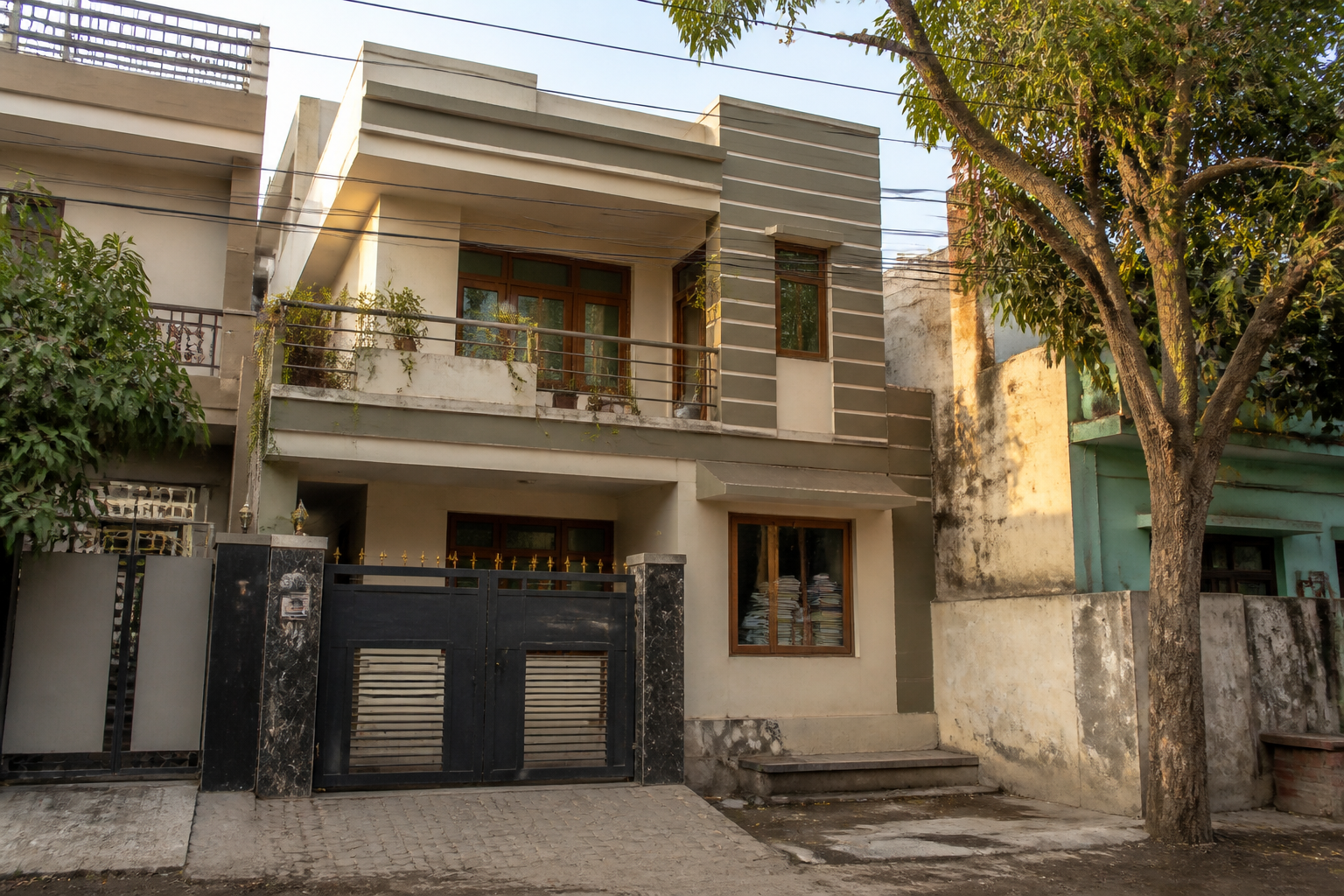
A Punjab property dispute involving a six-room house in Ludhiana has moved beyond a family disagreement and into a larger question about how ownership of urban property is established after the owner’s death. The Punjab and Haryana High Court ruled in favour of an adopted daughter after examining two Wills, an alleged agreement to sell, possession of the house and the role of the person who drafted and witnessed the later Will. The younger sister has challenged that ruling before the Supreme Court, where the matter remains pending.
The property is a house built on 79 square yards of land. It was owned by a childless widow identified in the case as Kaur. The property’s relatively small physical footprint does not reduce its legal or economic importance. In urban India, ownership disputes over compact residential plots can determine who controls an entire dwelling, who can occupy it, and whether the property can be transferred or inherited. In this case, the dispute also shows how succession law can interact with possession, adoption and documentary evidence.
The central issue was whether the house should pass under the woman’s later Will to her adopted daughter or be claimed by her younger sister on the basis of an earlier arrangement and possession. The woman originally intended to leave the property to her younger sister under a first Will. She revoked that Will on February 15, 2008. After her brother died in the last week of December 2009, she was living alone at the house. She later adopted her younger sister’s daughter as her own.
According to the woman’s case, she left the house locked in January 2010 while travelling to Mayya Da Dera in Phillaur to attend a function. She alleged that her younger sister and brother-in-law entered the property during her absence and took possession. They allegedly continued living there, while she was denied access. About five months later, she approached the court. The competing claim was also linked to an alleged agreement to sell, but the High Court found that this claim had not been established, according to the account of the proceedings.
During the litigation, the woman executed another Will on March 15, 2013. That document left the Ludhiana property to her adopted daughter after her death. The woman died before the High Court delivered its final judgment. On July 15, 2026, Justice Vikas Suri of the Punjab and Haryana High Court ruled in favour of the adopted daughter. The decision did not end the dispute: the younger sister subsequently filed a special leave petition before the Supreme Court, and the Supreme Court’s decision is pending.
The High Court’s reasoning matters because it treated the case as one involving testamentary succession rather than intestate succession. In simple terms, the court accepted that the property was to pass according to a valid Will, instead of applying the succession rules that would govern if the woman had died without leaving one. Jyoti Sinha, a partner at Khaitan & Co quoted in the report, said the woman’s ownership was supported by the records and that the later registered Will was proved through an attesting witness.
That distinction is important in urban property disputes. A person who dies intestate leaves heirs to establish their rights under the applicable succession framework. A proved Will can change the route by which the property passes. But a Will does not operate merely because a document exists. Its execution and attestation must be established in accordance with law, particularly when another claimant contests it.
The case also focuses on the difference between a scribe and an attesting witness. A scribe is the person who writes or drafts a Will. Merely preparing the document and signing it does not automatically make that person an attesting witness. The legal question is whether the person signed with the intention of attesting the Will.
In this matter, an advocate who drafted the later Will had also signed it as an attesting witness. The High Court did not treat the advocate as a witness simply because he had prepared the document. Instead, it found from the evidence that he had signed in the capacity of an attesting witness while also acting as the scribe. The court therefore held that there was no legal bar to the same person performing both roles when the evidence demonstrated the intention to attest.
The High Court relied on the Supreme Court’s judgment in Mathew Oommen versus Suseela Mathew, decided on January 3, 2006, in Civil Appeal No. 2034 of 2003 and reported in (2006) 1 SCC 519. That judgment established that a scribe can also be an attesting witness to a Will. At the same time, the High Court drew a precise distinction: a scribe cannot simply be treated as an attesting witness because the person wrote the document. The evidence must show that one of the required witnesses signed with the intention of attesting it.
This evidentiary distinction is significant because property litigation often turns on documents whose meaning depends on how they were executed. Registration may support a Will, but contested succession cases still require the court to examine the circumstances of execution and the testimony of witnesses. The High Court’s reasoning, as described in the supplied report, therefore did not make the drafting role sufficient by itself. It examined whether the advocate had also performed the legally relevant function of attestation.
The case further demonstrates that possession and ownership are not interchangeable. The younger sister and her husband were alleged to have taken possession after the owner left the house. Their occupation became part of the dispute, but possession alone did not displace the High Court’s finding on title and testamentary succession. The court also considered the alleged agreement to sell and concluded that the competing claim based on it had not been established.
For cities such as Ludhiana, where older homes and tightly held residential plots can carry substantial family and economic value, such distinctions have practical consequences. A dispute over one house can affect occupation, inheritance, redevelopment potential and the ability of a family to deal with the property. Yet the supplied account does not establish the property’s market value, the exact terms of the alleged agreement to sell or the detailed evidence presented by each side. Those matters remain separate from the legal principle identified in the High Court decision.
The adoption dimension adds another layer. The woman adopted her younger sister’s daughter before executing the later Will. The High Court’s ruling, as reported, allowed the adopted daughter to receive the property under that Will. The case therefore concerns not only the validity of the document but also the legal effect of the owner’s decision to redirect the property from her sister to the adopted daughter.
The pending Supreme Court proceedings mean that the High Court’s position is not the final word in the dispute. The younger sister’s special leave petition gives the Supreme Court an opportunity to examine the competing claims and the legal treatment of the Will. Jyoti Sinha said the legal position on the scribe also acting as an attesting witness is expected to be examined in the pending proceedings, although the outcome is not yet known.
The evidence currently establishes three separate points. First, the High Court accepted the woman’s ownership and rejected the competing claim based on an unproved agreement to sell. Second, it accepted the later registered Will after it was proved through an attesting witness. Third, it applied the principle that a person may act as both scribe and attesting witness when the evidence shows an intention to attest. What remains unresolved is whether the Supreme Court will agree with the High Court’s treatment of the evidence and the resulting transfer of the property to the adopted daughter.
The broader urban lesson is that property security depends not only on possession or family understanding but on a chain of legally recognised records and testimony. A house may be physically occupied by one person while the court examines ownership through title records, prior instruments, Wills, witness evidence and the circumstances in which possession changed. In compact urban settlements, where property is often inherited across generations and family arrangements are informal, the quality and clarity of documentation can become decisive.
The next significant development is the Supreme Court’s consideration of the special leave petition. Until that process is resolved, the High Court judgment remains the ruling described in the case, while the final legal position between the younger sister and the adopted daughter remains pending.
