


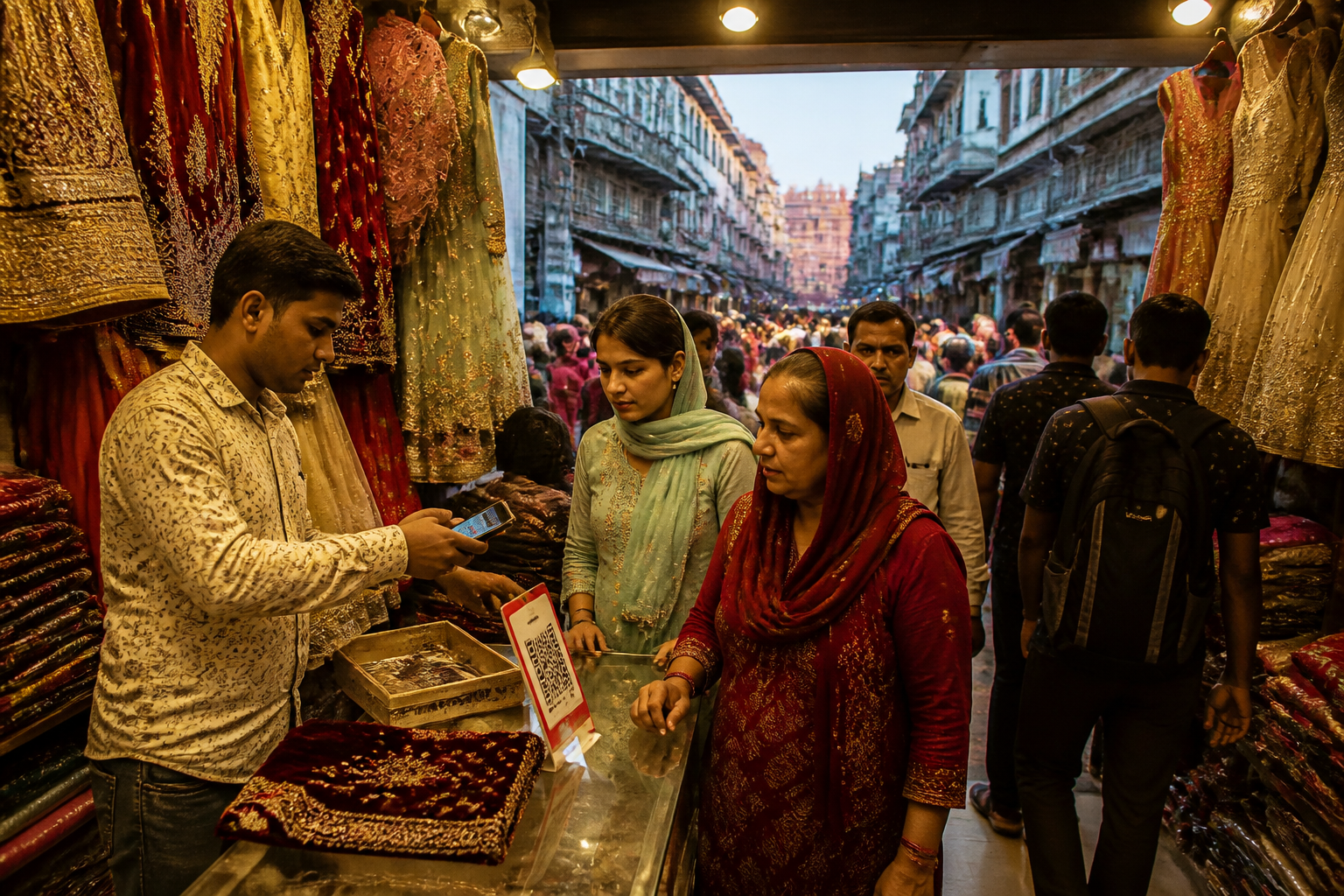
The proposed UPI charges on transactions above Rs 2,000 are exposing a difficult contradiction in Chandni Chowk’s retail economy: merchants have adapted to a payment system that customers now prefer, but the cost of maintaining that system may soon fall on the businesses that use it most. In the wedding market, where individual purchases commonly exceed the proposed threshold, even a small percentage charge can become a recurring operating expense.
The National Payments Corporation of India has announced that UPI transactions above Rs 2,000 will attract a fee of 0.4% from October 15. Traders quoted by The Indian Express in Chandni Chowk said the change would affect stores selling lehengas, sherwanis, sarees and other high-value wedding garments. At Novelty Creations, proprietor Rohit Khanna said products begin at Rs 10,000 and that most customers now pay through UPI. For such businesses, the issue is not whether digital payments are available, but who absorbs the cost when they become the dominant mode of payment.
That distinction matters because the transition to digital payments has changed the basic relationship between merchants and customers. A trader can theoretically ask a buyer to return to cash, but the practical conditions of a market determine whether that option exists. A manager at another wedding garment store, identified as Rakesh, told the newspaper that customers rarely carry substantial amounts of cash and that Chandni Chowk’s few functioning ATMs have long queues. The result is a form of payment dependence: digital payment is no longer merely a convenience that can be switched off at the shop counter.
The proposed charge therefore becomes more than a transaction-level question. It tests whether the infrastructure of digital commerce is being treated as a public utility, a commercial service, or a cost that individual merchants must negotiate on their own. The supplied report does not establish the full structure of the fee, including whether it will be passed directly to merchants in every transaction or how different payment providers will apply it. But the traders’ concern is clear: their business model has become dependent on UPI while their ability to avoid its charges is limited.
## A payment shift with uneven consequences
The 0.4% figure appears modest when viewed against a single sale. On a Rs 10,000 purchase, however, it represents Rs 40. For a shop handling many transactions above the threshold, the cumulative amount could become material over a trading season. The traders interviewed did not present a formal estimate of their expected annual burden, so the scale of the total impact cannot be established from the available evidence. Their accounts nevertheless show why a percentage-based charge is experienced differently by a small retailer than by a customer making one occasional purchase.
The impact is also shaped by the nature of Chandni Chowk’s commerce. Wedding garments are relatively high-value purchases compared with everyday retail items, and the businesses cited in the report sell products that routinely exceed Rs 2,000. This means the proposed threshold is not a marginal exception for these stores. It is likely to intersect with a large part of their ordinary sales, according to the traders’ descriptions of their businesses and customer behaviour.
For merchants, the charge arrives alongside other costs they say are already rising. Khanna referred to inflation, personal income tax and GST while describing what he called a severe mismatch between income growth and expenses. These comments are individual accounts rather than a sector-wide cost analysis, but they identify the central administrative issue: payment charges are added to a chain of existing obligations that small businesses must manage without the pricing power of larger retailers.
The traders’ response also reveals the limits of measuring digital inclusion only by adoption rates. A market can appear successfully digitised because customers and sellers use UPI for most transactions. Yet that success can conceal new dependencies and new costs. Once a customer expects to pay digitally, a shop cannot easily recover the bargaining power it had when cash was the default. A policy that changes the price of digital transactions consequently affects not only payment providers and merchants, but also the everyday organisation of urban retail.
## Why the cash alternative is weaker in a crowded market
The Chandni Chowk account is especially significant because it links payment policy to the physical conditions of the city. The availability of cash is not determined only by whether currency exists in the wider economy. It also depends on access to functioning ATMs, queues, travel time and the willingness of customers to carry large amounts through a busy commercial district. Rakesh’s account suggests that these local conditions make cash an unreliable fallback for high-value purchases.
This is where the story moves beyond a dispute over a fee. Payment systems operate through physical urban networks. Digital payments require connectivity, banking access and merchant acceptance; cash requires access to withdrawals, security and convenient handling. When one system becomes expensive and the other is inconvenient, the burden is transferred to the point where the transaction occurs: the shop, the customer or both.
The report also shows how a policy change can have different effects across retail categories. A transaction above Rs 2,000 is not equally significant for a small garment store, a large organised retailer and a low-value vendor. The same percentage can represent a minor processing expense for one business and a meaningful reduction in margin for another. The supplied material does not provide comparative data across these categories, but Chandni Chowk’s wedding retailers illustrate the importance of sector-specific exposure.
The timing adds another layer. Traders said the new charge would take effect before October 15, as the festive and wedding season approaches. Anoop Goyal of Anand Garments said one month could provide time for trader associations and the government to reach a consensus. The report does not confirm whether any such negotiations are underway or whether the announcement will be modified. It does establish that the implementation window is short for businesses preparing for a period they expect to be important for sales.
## The institutional question behind merchant charges
UPI has become part of the operating infrastructure of urban commerce, but the institutional responsibilities around that infrastructure are distributed. NPCI announced the proposed charge, while merchants experience it at the point of sale and customers decide whether to use the system. This separation can make accountability difficult for small businesses. The organisation making the payment-system decision may not be the same institution that understands the cost structure of a particular market or the practical availability of alternatives.
The concerns raised by Chandni Chowk traders also underline the importance of clear communication before implementation. The article identifies the announced rate and threshold, but it does not set out the complete operational rules, exemptions, settlement arrangements or dispute mechanisms. Those details would determine how the charge is experienced in practice. Without them, merchants are planning around a headline percentage rather than a fully understood payment framework.
Sanjay Bhargava, president of the Chandni Chowk Sarv Vyapar Mandal, described the timing as unfortunate and said the government could have introduced the measure in the next financial year with the budget. His position reflects a concern about predictability rather than opposition to digital payments alone. Businesses set prices, margins and seasonal purchasing decisions in advance. A new transaction cost introduced close to a major trading period can disrupt that planning even if the rate itself remains unchanged.
The source report also records some traders’ hope that the position may change before the directive takes effect. That expectation is not evidence that a revision will occur. It does, however, show that the implementation period has become a negotiation window for merchants who cannot easily abandon UPI and do not have a practical cash substitute.
## What the Chandni Chowk case reveals
The evidence presently available is local and qualitative. It consists of accounts from several traders and a market association representative, alongside the reported NPCI announcement. It does not establish the total number of affected merchants, the value of UPI transactions in Chandni Chowk, the aggregate cost to the market or the likely response of customers. Those gaps matter because the size of the policy effect cannot be responsibly calculated from individual complaints alone.
What the evidence does establish is the direction of the pressure. High-value wedding retailers say UPI is already central to their sales. Customers face practical obstacles to switching back to cash. Merchants expect the proposed charge to add to existing costs. The policy therefore reaches a market where digital adoption is advanced but the alternatives are weak.
That combination is relevant to the wider urban economy. Traditional commercial districts are often discussed through redevelopment, congestion, parking or heritage. Their payment systems are less visible, yet they influence how customers move, how shops transact and how small businesses absorb operating costs. A charge applied to digital transactions can become an urban business issue when it affects a dense market whose customers, workers and traders depend on reliable, low-friction payments.
The next stage will be determined by the final implementation of the announced charge and by the response of trader associations and authorities before October 15. Until those details are clarified, the Chandni Chowk experience should be read neither as proof that digital payments are failing nor as evidence that the fee is insignificant. It is a clear warning that a cashless retail system can create new vulnerabilities when adoption advances faster than the institutional arrangements governing its costs.
