


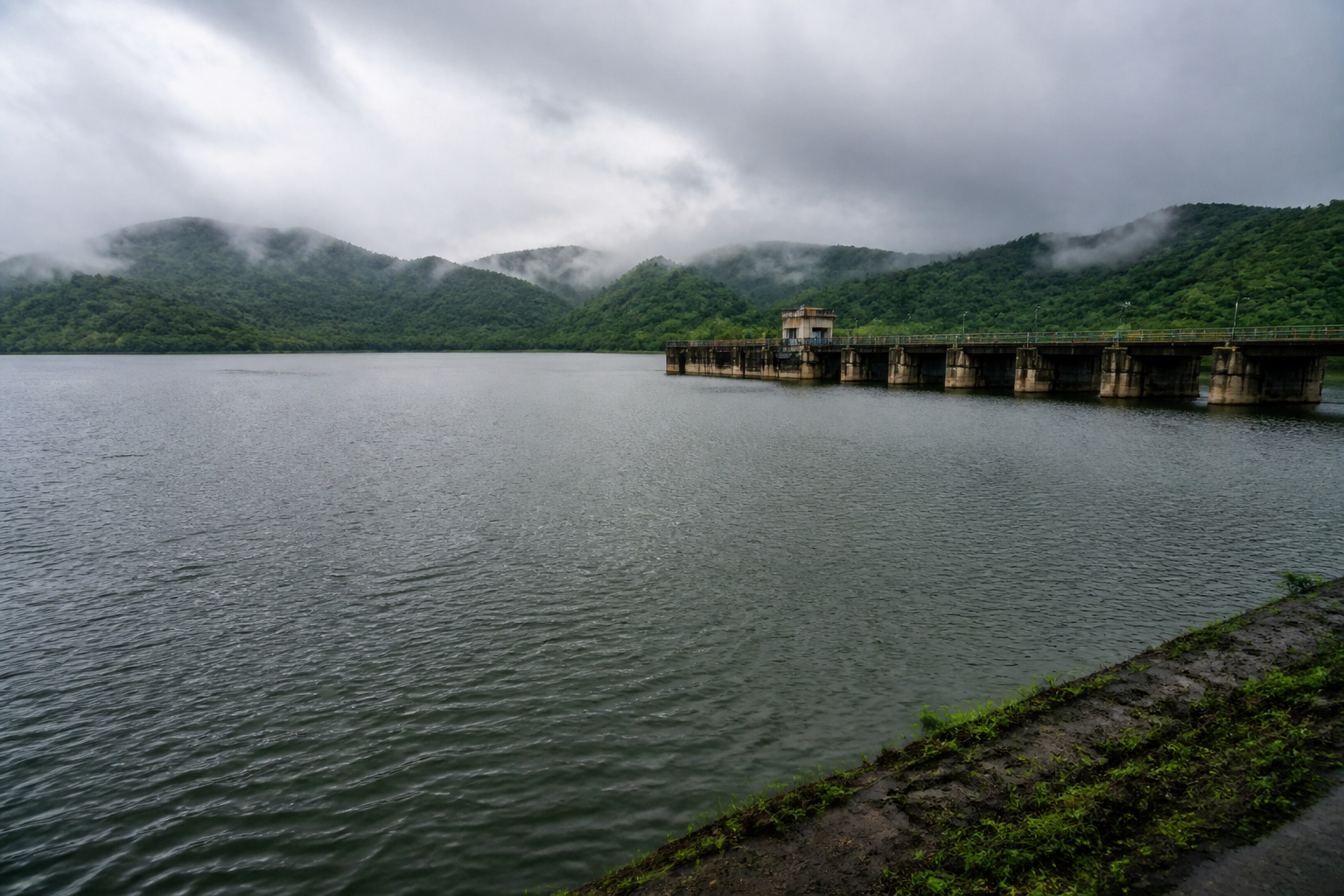
Mumbai’s seven drinking-water lakes were holding 97.55 per cent of their combined useful storage capacity on September 17, according to the latest data released by the Brihanmumbai Municipal Corporation (BMC), leaving the city’s reservoirs well stocked as the monsoon season nears its end.
The lakes contained 1,411,942 million litres (ML) of water against a combined useful capacity of 1,447,363 ML as of 6 am on Thursday. The level was marginally below the corresponding period in the previous two years, when the reservoirs stood at 98.87 per cent on September 17, 2025, and 98.64 per cent on the same date in 2024.
Vehar Lake was full at 100 per cent, with 27,698 ML stored against its useful capacity of 27,698 ML. Its water level fell by 0.03 metres over the previous 24 hours, during which no rainfall was recorded. The lake’s cumulative seasonal rainfall stood at 2,701 mm.
Tulsi Lake was at 99.87 per cent capacity, holding 8,035 ML against a useful capacity of 8,046 ML. Its level declined by 0.01 metres, with no rainfall recorded during the period. Tulsi’s seasonal rainfall total was 3,702 mm.
Bhatsa, Mumbai’s largest water source by capacity, held 709,630 ML against a useful capacity of 717,037 ML, placing it at 98.97 per cent. Its level remained unchanged despite receiving 12 mm of rain, while cumulative seasonal rainfall reached 2,682 mm.
Tansa stood at 99.02 per cent, with 143,652 ML stored against a useful capacity of 145,080 ML. Its level rose by 0.01 metres after 18 mm of rain, taking its seasonal rainfall total to 2,941 mm.
Middle Vaitarna recorded the sharpest rise among the seven lakes. It reached 98.69 per cent capacity, with 190,993 ML stored against a useful capacity of 193,530 ML. Its water level increased by 0.17 metres after 14 mm of rain, taking cumulative seasonal rainfall to 2,914 mm.
Upper Vaitarna had the lowest storage level among the lakes at 94.27 per cent, holding 214,029 ML against a useful capacity of 227,047 ML. Its level rose by 0.02 metres after 5 mm of rain. The lake recorded the highest cumulative seasonal rainfall total at 3,834 mm.
Modak Sagar was the second-lowest at 91.45 per cent, with 117,906 ML stored against a useful capacity of 128,925 ML. Its level fell by 0.16 metres, the steepest decline recorded among the seven lakes, despite 2 mm of rain. Its seasonal rainfall total stood at 3,237 mm.
The combined storage of Upper Vaitarna, Vaitarna, Tansa and Middle Vaitarna was 95.97 per cent of their useful capacity, with 666,579 ML held against 694,582 ML. The corresponding figure was 99.10 per cent on September 17, 2025, and 98.78 per cent in 2024.
The BMC data also records that several reservoirs overflowed earlier in the monsoon. Vehar began overflowing on July 7 at 9 pm, followed by Tulsi at 11.43 pm the same day. Tansa Dam overflowed from July 22 at 8.51 am, while Modak Sagar followed on July 23 at 2.07 am.
The Middle Vaitarna WSCPO gate was closed on July 6 at 2 pm, while the release from Upper Vaitarna was stopped at 10 am that day. The BMC’s next lake-level update will indicate how the city’s storage changes as the monsoon withdrawal progresses.
