


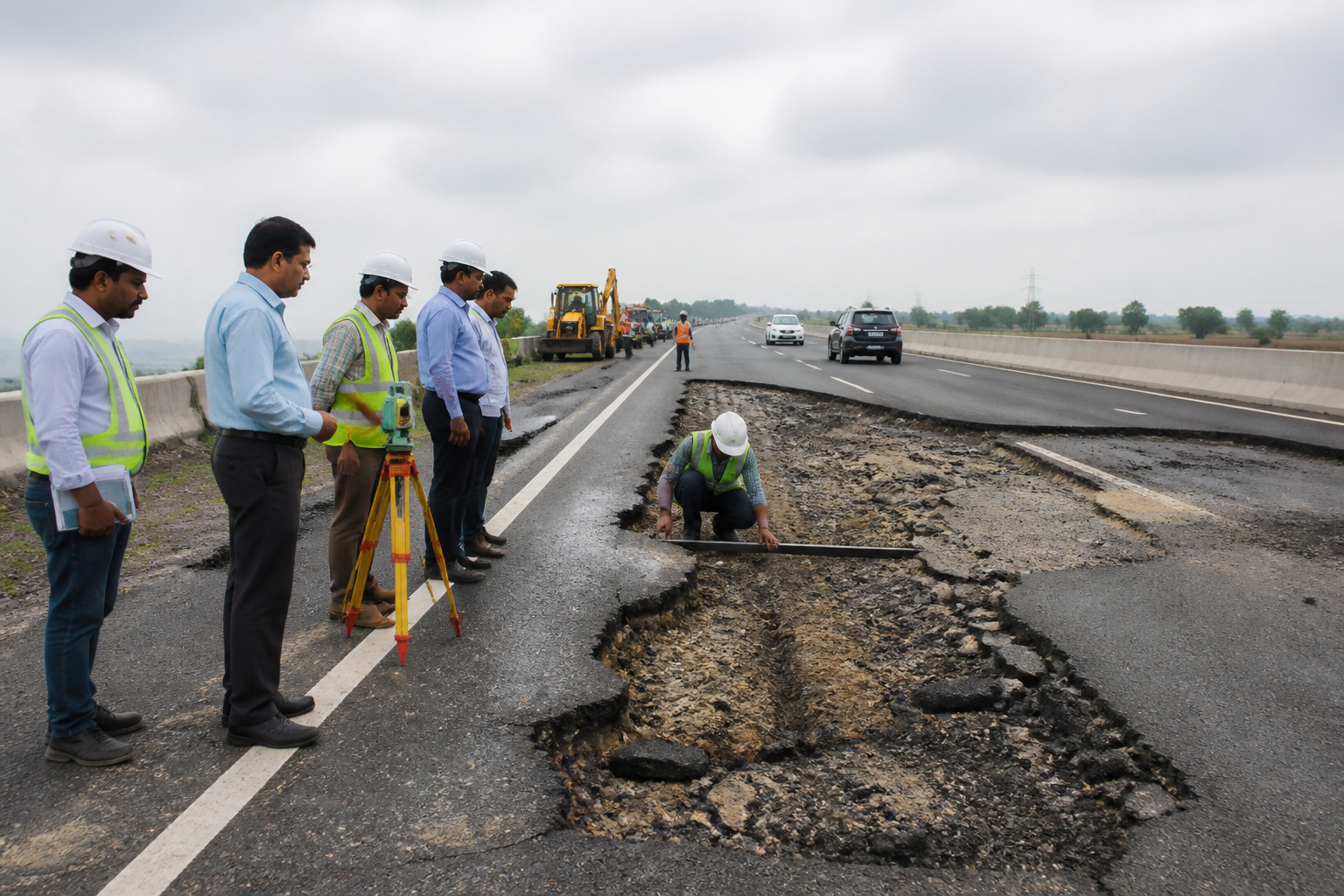
The Kanpur-Lucknow Expressway has become a serious test of how India plans, builds and supervises high-value road infrastructure after premature failures emerged within weeks of its inauguration. The National Highways Authority of India has barred project concessionaire PNC Infratech from bidding for its projects for three years, suspended toll collection across the entire corridor and required compensation estimated at around Rs 42 lakh a day until the expressway is fully ready.
The action is significant not only because a newly opened expressway has developed defects, but because it brings several stages of infrastructure delivery into the same question: whether the ground conditions were adequately understood, whether the design responded to them, whether construction quality was sufficient, and whether contractual safeguards can protect public money when a project fails soon after opening.
According to the report published by Economic Times, several sections of the Kanpur-Lucknow Expressway, also known as the Awadh Expressway, developed premature failures and slippages. Officials attributed failures in some stretches to design-related issues and said patchwork repairs would not be sufficient. An investigation commissioned by NHAI and conducted by a professor from IIT Kharagpur recommended complete reconstruction of the affected stretches.
A preliminary investigation also identified weak, highly plastic soil beneath parts of the expressway as one factor behind the failures. Such soil can change significantly in shape and behaviour when its moisture content changes. The supplied report does not establish the extent to which soil conditions, design decisions or construction execution individually contributed to the defects. It does, however, show that the problem was considered substantial enough to require more than routine maintenance.
That distinction matters for road infrastructure. A surface defect that can be addressed through ordinary maintenance is different from a failure linked to the underlying soil or the design of the road structure. When reconstruction is recommended, the financial and operational consequences extend beyond the cost of repairing asphalt. Traffic management, user safety, construction disruption and the credibility of the project’s opening certification can all become part of the public cost.
The NHAI action also reveals how accountability is structured under the project contract. PNC Infratech disclosed in a regulatory filing that NHAI issued the debarment order on September 11. The order stated that the company would not be able to participate in projects of the Ministry of Road Transport and Highways, NHAI and their agencies for three years. The company described the action as the maximum penalty permitted under the contract.
PNC Infratech and its concessionaire, Awadh Expressway Private Ltd, are evaluating legal remedies, according to the company’s disclosures. The company has also said that the debarment will not affect its existing projects or their operation and maintenance. This creates an important distinction between exclusion from future bidding and the continuing obligations attached to projects already awarded.
The compensation requirement adds another layer. Toll collection has been suspended across the expressway, and PNC Infratech is required to compensate NHAI for lost toll revenue. The amount has been estimated at around Rs 42 lakh per day until the full corridor is ready. The suspension means that the immediate failure is not being treated as a limited defect affecting only one section; the revenue consequences apply across the corridor during the period of reduced operational readiness.
The project was developed under the Hybrid Annuity Model, under which the private concessionaire has responsibilities related to road maintenance during the concession period. The supplied material does not provide the complete financial structure of this specific concession or explain how reconstruction costs will ultimately be allocated. It does show, however, that the contract contains mechanisms to penalise the concessionaire and recover revenue losses when the corridor cannot operate as intended.
The incident therefore draws attention to a recurring institutional challenge in infrastructure: a contract can specify penalties after failure, but penalties do not replace the value of reliable design review and construction supervision before opening. By the time a newly built road develops serious slippages, public agencies, contractors and users are already dealing with a sunk investment, disrupted mobility and possible safety risks.
The reported role of soil conditions is particularly relevant to expressway construction. Road engineering is not limited to laying pavement on a visible alignment. Subgrade behaviour, drainage, moisture variation and the interaction between soil and road structure determine whether a corridor can withstand traffic and weather over time. The report identifies highly plastic soil as a preliminary factor, but the supplied evidence does not establish whether the relevant site investigations were inadequate, whether the design failed to account for the findings, or whether execution differed from the approved design.
That uncertainty is important. Public discussion after infrastructure failure often moves quickly towards assigning blame to one contractor or one technical factor. A useful institutional review must instead establish the chain of decisions: what surveys were conducted, what risks were recorded, what design treatment was selected, who approved it, how the work was tested, and what conditions were accepted before opening. The reported IIT Kharagpur recommendation for complete reconstruction indicates that technical review has already become central to the response, but the supplied report does not provide the full investigation or its findings.
NHAI’s decision also sits within a wider official emphasis on action against poor-quality road work and delays. Union Road Transport and Highways Minister Nitin Gadkari recently said that strict action would continue against contractors and officials responsible for delays and substandard execution. He said he wanted to set a record for blacklisting contractors and taking action against officials within a year. Those remarks were made after the inauguration of a six-lane elevated road corridor at Porvorim near Panaji and were also linked to delays on the Mumbai-Goa Highway.
The minister’s comments establish the policy mood around enforcement, but they do not by themselves explain the Kanpur-Lucknow Expressway’s technical failure. The expressway case will depend on the findings of the relevant investigations, the contractual process behind the debarment and the steps taken to restore the affected stretches. The market reaction is another indicator of how infrastructure quality decisions can affect private concessionaires: PNC Infratech’s shares fell 20% on Tuesday after the company disclosed the NHAI action.
For road users, the immediate issue is practical. A corridor inaugurated for faster movement has entered a phase in which toll collection is suspended and sections require major intervention. The compensation amount indicates the scale of revenue being affected each day, while the decision to bar the concessionaire restricts its participation in future NHAI, MoRTH and agency projects. The supplied material does not state the exact length of affected stretches, the current traffic arrangements or the expected completion date for reconstruction.
That missing information will determine how the episode should ultimately be assessed. At present, the evidence confirms premature defects, a technical recommendation for reconstruction of affected stretches, a three-year debarment, a full toll suspension and a daily compensation obligation. It does not establish the final allocation of responsibility among design, soil conditions, construction execution, supervision or maintenance.
The next stage is therefore not simply the physical repair of the expressway. It is the release and implementation of the technical findings, the resolution of the concessionaire’s legal remedies, the restoration of the corridor and the demonstration that the replacement work addresses the underlying cause rather than only the visible damage. Until those steps are documented, the Kanpur-Lucknow Expressway will remain a case study in the limits of opening infrastructure before its long-term performance is secure.
