


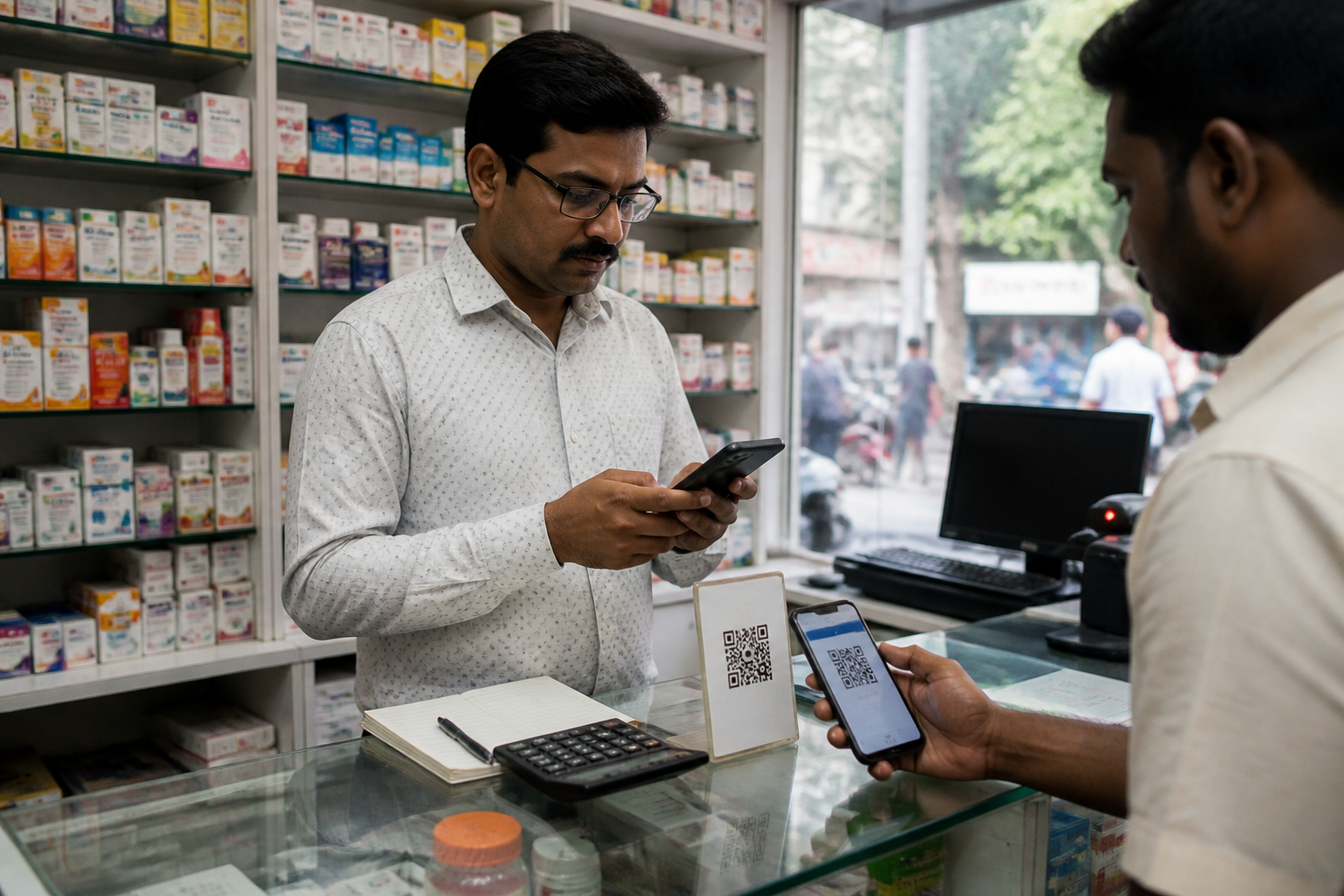
A proposed UPI MDR framework is forcing a difficult question for low-margin businesses: can a payment system built around convenience remain widely accepted when every large transaction begins to carry a direct cost? The concern has emerged from the pharmaceutical sector, where MPC Pharma Private Limited director Rahul Mammen has estimated that the proposed charge could cost his company about Rs 1.2 crore a year.
Mammen said in a LinkedIn post that his company manages approximately Rs 1 crore in UPI payments every day. On the basis of a proposed 0.4% merchant discount rate, or MDR, he calculated a daily charge of about Rs 40,000 and an annual impact of roughly Rs 1.2 crore. He said the additional cost could materially affect profitability and that the company may consider limiting UPI acceptance for large-value payments if the method becomes unprofitable.
The significance of the calculation lies not only in the size of the projected cost, but in the relationship between payment charges and operating margins. A Chartered Accountant, Kanan Bahl, who shared Mammen’s post, said a 0.4% MDR could affect businesses operating on margins of 2% to 3% by reducing gross profits by approximately 11% to 17%. That estimate is presented as an illustration of the pressure the charge could create; it is not a reported industry-wide measurement.
The issue therefore goes beyond whether a merchant pays a few paise on a transaction. For a business handling high volumes at thin margins, payment costs are linked directly to turnover. A charge that appears small as a percentage of sales can become significant when applied repeatedly across the year. In Mammen’s example, the reported daily UPI volume converts a fractional fee into a projected annual cost of Rs 1.2 crore.
This is particularly relevant to sectors such as pharmaceuticals, where the company cited in the report operates. The supplied report does not provide MPC Pharma’s total revenue, net profit, product mix or the share of UPI transactions in its overall collections. It is therefore not possible to establish the company’s actual profit impact from the available information. What the calculation does show is the exposure created when a business accepts a large volume of digital payments and has limited room to absorb new transaction expenses.
The proposed framework also appears to distinguish between different types and sizes of transactions rather than imposing one uniform cost on every UPI payment. According to the report, eligible person-to-merchant UPI transactions above Rs 2,000 would attract an MDR of 0.4%, subject to a maximum charge of Rs 300. Transactions below that threshold would not attract the charge under the described framework.
The report further states that merchants receiving up to Rs 1 lakh a month through UPI QR transactions would not have to pay MDR, irrespective of the individual transaction amount. It says this would keep 96% of merchants outside the charge framework. The supplied material does not identify the underlying methodology, merchant database or official notification supporting that percentage, so the figure remains a reported description of the revised arrangement rather than independently assessed data in this article.
The distinction between merchant count and transaction value is important. A framework may leave most merchants outside the charge while still affecting a smaller group that processes a substantial share of digital payment value. The report does not provide the total value handled by the exempt and chargeable groups, nor does it establish how many businesses in sectors such as wholesale pharmaceuticals would fall into each category.
The reported exemptions and concessional rates also indicate an attempt to differentiate payment use by sector. Railway, telecom, insurance and fuel transactions are described as attracting a flat charge of Rs 5 instead of the 0.4% MDR. Capital-market payments, including mutual funds, broker and equity-related transactions, are described as attracting a lower MDR of 0.02%, subject to the Rs 300 cap.
These different rates matter because digital payments do not serve one uniform commercial ecosystem. A small retailer, a fuel station, an insurer and a pharmaceutical distributor may all use UPI, but their transaction sizes, margins, settlement patterns and customer expectations can be very different. A single percentage-based fee will have different consequences depending on how much revenue a business processes digitally and how much profit remains after its other costs.
For merchants, the immediate institutional question is who ultimately absorbs the MDR. A business could treat it as a cost of accepting payments, negotiate with payment partners, change its preferred payment channels or attempt to pass the cost to customers, subject to the applicable rules and commercial practices. The supplied report does not establish which of these responses MPC Pharma or other affected businesses will adopt. Mammen’s statement only indicates that his company may limit UPI acceptance for large payments if the additional cost makes the channel unprofitable.
That possibility creates a tension within the digital-payments model. UPI has been promoted by businesses as an alternative to cash, cheques and bank transfers because it is convenient for customers and relatively easy to accept at the point of sale. Mammen said his company had encouraged customers to use UPI instead of NEFT, cash and cheques. If some merchants begin restricting UPI for high-value transactions, customers may be pushed towards other payment methods even when the digital infrastructure remains available.
The impact would not necessarily be uniform across cities. Urban businesses often combine retail, wholesale, healthcare, logistics and service transactions, with large differences in payment value and profit margins. The report does not provide city-level data or evidence of restrictions already being introduced. It does, however, identify a broader urban-economy issue: the cost of maintaining digital payment access can become a business decision when merchants operate at narrow margins.
The issue also highlights the difference between payment infrastructure and payment economics. A payment system may be technically efficient, widely used and convenient for customers, but its long-term merchant adoption depends on how the costs of operating that system are distributed. The available report attributes Mammen’s request for reconsideration to the National Payments Corporation of India, or NPCI. It does not state whether NPCI has responded or whether the described framework has been finally implemented through an official notification.
That distinction is important. The figures discussed by Mammen are estimates based on the proposed 0.4% rate and his company’s reported daily UPI volume. They describe a possible financial effect, not a confirmed annual loss. Similarly, the report says the company may limit acceptance for large payments, but it does not report that such a restriction has already been introduced. The central development is therefore the warning from a named business director and the debate it has triggered, rather than evidence of a sector-wide withdrawal from UPI.
The reported framework attempts to address this concern through thresholds, caps and sector-specific rates. A Rs 300 maximum charge limits the absolute MDR on an eligible transaction, while the exemption for merchants receiving up to Rs 1 lakh a month through UPI QR is intended to protect smaller participants. The lower rate described for capital-market transactions and the flat Rs 5 charge for selected sectors reflect a similar effort to avoid applying the same formula to every payment category.
Whether these protections are sufficient for low-margin businesses will depend on transaction volume, average payment size and the ability of each merchant to absorb or redistribute the cost. The supplied material provides one detailed example but does not establish how representative it is. It also does not provide evidence on payment-provider costs, bank charges, settlement economics or the final allocation of MDR among participants in the UPI ecosystem.
The larger urban question is how cities can preserve convenient, interoperable digital payments without making acceptance difficult for the businesses that serve everyday markets. The debate is not simply about a 0.4% fee. It concerns the design of commercial infrastructure used by pharmacies, retailers, service providers and other urban enterprises, and the point at which a system-wide charge becomes material for individual businesses.
The available evidence confirms that at least one high-volume, low-margin business expects a substantial annual impact under the proposed calculation, while a CA’s assessment suggests that the effect on gross profits could be disproportionately large for businesses with 2% to 3% margins. It does not yet establish the final rules, NPCI’s response, the number of affected businesses or any broad reduction in UPI acceptance. Those are the developments that will determine whether the current warning remains a company-specific concern or becomes a wider issue for India’s digital urban economy.
