


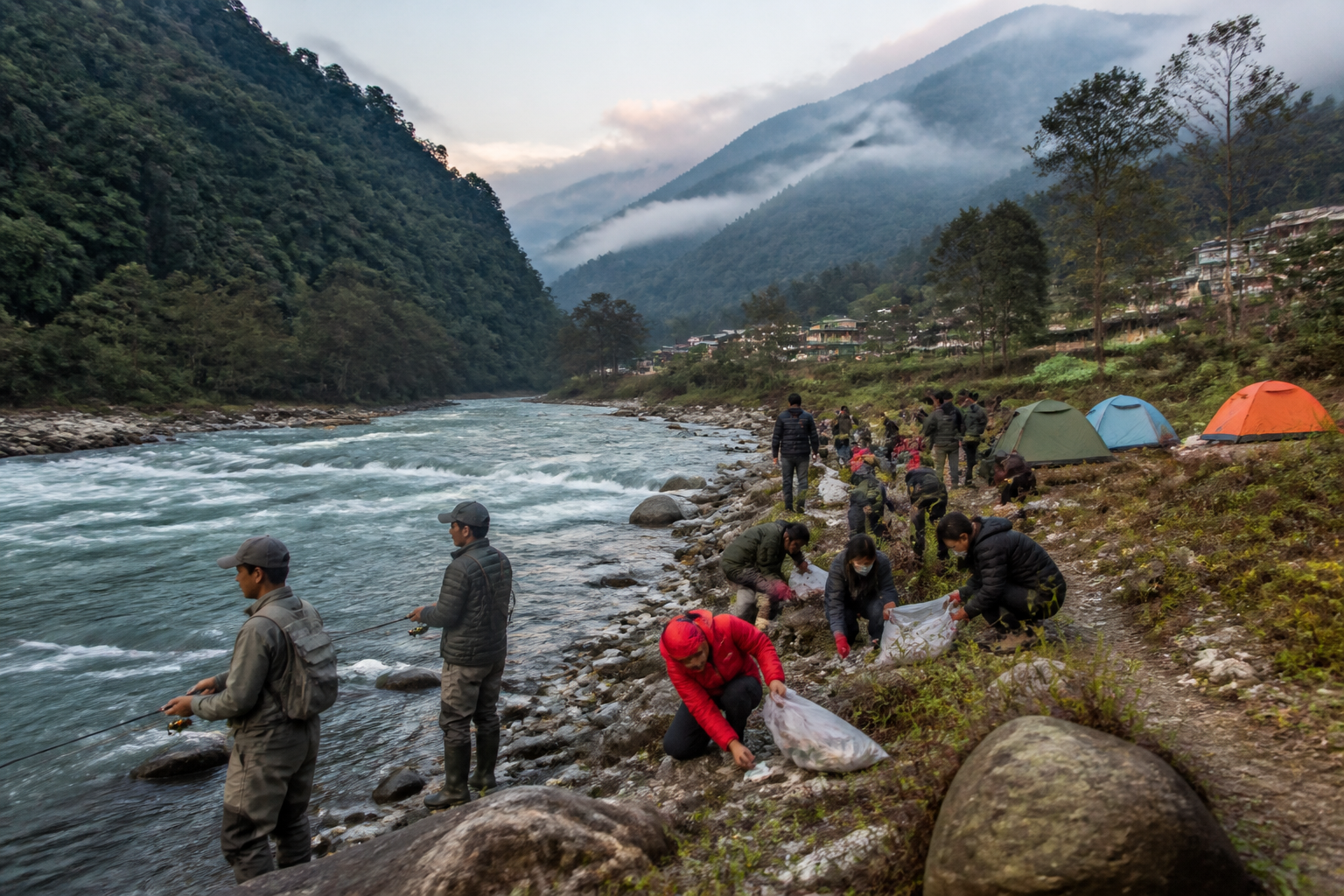
The first Chirbirey River Fest, planned along the Rangeet near Jorethang in Sikkim from September 25 to 27, is being presented as more than a three-day cultural and angling event. Its organisers want the festival to test whether conservation, local economic activity and community participation can be combined into a longer-term river destination without separating the river from the people who live beside it.
The event has been conceived by the Sikkim Anglers’ Association (SAA), which is marking its silver jubilee this year. Its programme brings together catch-and-release angling, a community clean-up called “The River Pick”, camping, birdwatching, photography, pottery, cooking, bakery sessions, poetry, storytelling, live music and other activities. At its centre will be the Chirbirey Mahseer Challenge, in which fish caught during the competition will be returned to the river.
That combination is significant because the organisers are not treating conservation as a separate environmental activity. Uday Chandra Rai of the SAA said the association’s members began questioning what they were leaving behind after 25 years of travelling to rivers and natural areas in places such as Arunachal Pradesh and Uttarakhand. The result was an attempt to move from individual conservation actions towards a sustainable angling and eco-tourism destination along the Rangeet.
The proposed model depends on a particular institutional argument: local communities are more likely to protect a river when economic activity around it produces benefits for them. Rai said the association’s aim was to ensure that local people benefit from the activity so that the community itself becomes a protector of the river. The claim remains a development proposition rather than an established outcome, but it identifies the central governance question around the initiative: who gains from a river economy, and who is responsible for protecting the resource on which it depends?
The festival is therefore also an experiment in widening participation. Angling is the association’s starting point, but the organisers have deliberately added activities that can draw in people who are not anglers. The SAA has said that protecting a river requires the involvement of non-anglers, making the festival a platform for public engagement rather than a specialist competition alone.
This matters for the Rangeet because the proposed destination cannot be created only through sporting events. The organisers expect to accommodate about 500 visitors for overnight camping on each of the three days. Camping facilities will be available, while visitors may also bring their own tents. Beyond the festival, the SAA has identified the need for basic local amenities while retaining conservation as the core of the proposed destination.
The scale of the infrastructure plan is still limited in the information available. The Sikkim government is expected to hand over the Chirbirey tar to the association and assist with infrastructure. The larger plan, according to Rai, could take three to five years to develop. The festival is being treated as the starting point for that effort, not as proof that the destination model has already succeeded.
That distinction is important. A river-based tourism plan can generate attention and income, but it also creates pressure on the landscape it seeks to promote. The supplied account does not provide visitor-capacity rules, waste-management targets, water-quality benchmarks, fishing limits or an assessment of the river’s ecological carrying capacity. It does, however, show that the organisers have placed conservation, catch-and-release angling and a river clean-up at the centre of the first public initiative. Whether those commitments become enforceable operating rules will determine how the model develops.
The festival also exposes the administrative limits of treating rivers as the responsibility of a single locality. The Rangeet runs through areas connected to Sikkim and the Darjeeling side of West Bengal. Rai said discussions had been held with residents of Singla on the Darjeeling side, while outreach programmes had been conducted in Darjeeling and Kalimpong. The SAA has also established contact with conservationists and anglers in Siliguri.
The association describes the initiative as non-political and community-led, arguing that there is no border when it comes to a river. That framing does not remove the need for coordination. It shows instead that a river-based programme will have to work across administrative boundaries, communities and interest groups. The SAA’s outreach is an early attempt to create that wider network, although the source material does not establish a formal inter-state institutional framework for the project.
The Sikkim government’s role will be equally important. The initiative was placed before chief minister Prem Singh Tamang, who accepted it, and the association is working with the state government on its development. The proposed handover of the Chirbirey tar and assistance with infrastructure indicate that public authorities are being asked to support a community organisation in creating a new local economic and conservation destination.
That arrangement raises practical questions about responsibility. The SAA has around 250 members and has worked on catch-and-release angling, river clean-ups and fish conservation for several years. Its experience gives the initiative an existing organisational base. But a three-to-five-year development plan will require clarity on land management, visitor regulation, infrastructure maintenance, safety, waste, local participation and ecological monitoring. The available account confirms the intention to build the destination but does not yet set out those administrative details.
The festival’s most useful contribution may therefore be as a public test of the relationship between conservation and development. It places a river at the centre of an event rather than using the river only as a scenic backdrop. The clean-up, fish-release competition and non-angling activities are intended to connect recreational use with stewardship. The proposed camping and local amenities, meanwhile, are intended to connect stewardship with livelihood opportunities.
The evidence currently confirms an initiative in its formative stage: a festival scheduled for September, a community organisation with 25 years of history, state-government support, planned camping for about 500 visitors a day and a longer destination plan that may take three to five years. It does not yet confirm the economic benefits for local communities or the ecological results of the model. Those outcomes will depend on how the plan is governed after the festival and whether conservation commitments are translated into measurable rules.
For cities and towns connected to river landscapes, the Rangeet initiative raises a broader question about what development means in environmentally sensitive areas. Tourism infrastructure can bring visitors and income, but the river’s health must remain the basis of the activity rather than its collateral cost. The next milestones are the festival itself, the proposed handover of the Chirbirey tar, the creation of basic amenities and the development of a cross-community framework capable of protecting the river beyond the event calendar.
