


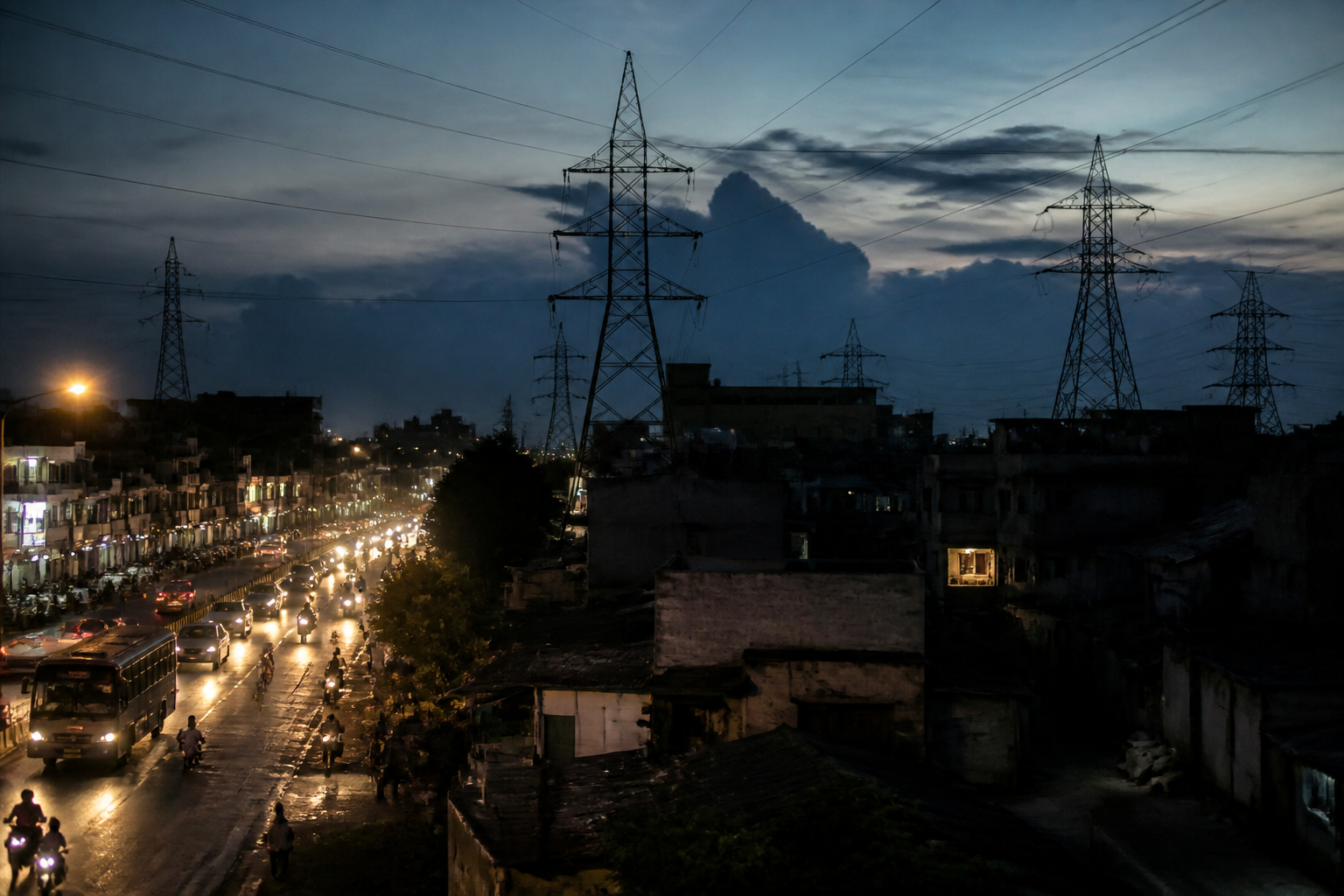
Tamil Nadu’s power shortage has pushed the state electricity board into buying electricity at more than Rs 20 per unit, with peak-hour purchases reportedly costing as much as Rs 25-Rs 30 per unit. The development highlights how a temporary gap between demand and available supply can quickly become a financial and service-delivery problem for a state whose households, factories and commercial establishments depend on reliable electricity.
According to a report by Dinamalar, average daily electricity demand in Tamil Nadu last week was about 21,000 MW. A decline in wind power generation created a shortfall of 1,500-2,000 MW, making it difficult for the board to meet demand through its available supply. At the same time, electricity prices in the market rose sharply as demand increased across several states.
The immediate consequence was a difficult procurement decision. Buying power from the market could help prevent supply interruptions, but the prices were high. The report said officials were initially hesitant to purchase electricity because of the cost. From the second week of September, one-hour power cuts were introduced in districts outside Chennai to manage the shortage. Residents, industrial units and commercial establishments were affected.
The board subsequently began procuring about 2,000 MW from various companies and from the open market from the end of last week. Tamil Nadu’s electricity minister, identified in the report as Nirmalkumar, said the price of this power was above Rs 20 per unit. The report separately said that purchases made during the evening peak, from 6 pm into the night, were costing between Rs 25 and Rs 30 per unit.
These figures show the pressure created when electricity demand peaks at the same time that a major generation source weakens. Wind power is particularly relevant to the reported episode because the supply gap emerged after wind generation declined. The available report does not establish whether the decline was caused by a specific weather event, seasonal variation or another operational factor. It does, however, identify the immediate relationship between lower wind generation, a supply deficit and expensive market purchases.
The numbers also show why peak demand cannot be treated only as a generation question. Tamil Nadu’s reported average demand of 21,000 MW had to be matched continuously, while the shortfall of 1,500-2,000 MW represented a substantial share of the electricity needed at the time. The board’s later purchase of around 2,000 MW was broadly equal to the reported deficit, indicating the scale of intervention required to restore supply during the episode.
For urban residents, the impact of this gap was not limited to the electricity market. Power cuts affect water pumping, lifts, traffic systems, small businesses, shops, offices and homes. Industrial and commercial users can face interruptions to production, refrigeration, digital systems and other electricity-dependent operations. Dinamalar reported that people, industries and commercial establishments were affected by the scheduled one-hour outages outside Chennai. The report did not provide a district-wise breakdown or quantify the economic losses.
The geography of the outages is also significant. Chennai was excluded from the reported one-hour cuts, while other districts faced them. The source does not explain the operational or administrative reasons for this distinction. It nevertheless illustrates how electricity shortages can be distributed unevenly across a state, with different consequences for the capital, industrial centres, smaller towns and rural areas. Without district-level information, it is not possible to determine whether the allocation reflected demand patterns, network constraints, critical services or another criterion.
The episode also raises questions about the electricity board’s exposure to volatile procurement costs. Board employees quoted by Dinamalar said that the board’s financial stress was primarily linked to large-scale power purchases at high prices during previous administrations. That is an attributed assessment by employees and not an independently established finding in the supplied report. The report provides no financial statements, procurement records or historical price series to test the claim.
The employees called for the government to disclose which companies supplied the emergency electricity, how much power was bought from each and at what price. This demand points to the institutional importance of procurement transparency during a shortage. Emergency buying may be operationally necessary when supply falls below demand, but the public cost depends on the volume, timing, supplier and price of each transaction. The report does not provide those details, leaving the total financial impact of the latest purchases unclear.
The state’s electricity system therefore faces two linked pressures. The first is physical: supply must match demand when wind generation falls and peak consumption rises. The second is financial: filling the gap through market purchases can be expensive, particularly during evening peak hours when demand is high across several states. A decision to avoid costly purchases may result in outages, while a decision to buy at high prices may increase pressure on the board’s finances. The source describes this tension through the board’s initial hesitation to procure power and its subsequent purchase of around 2,000 MW.
The report also suggests that short-term market dependence can shift the burden from the grid to consumers and public finances. Households and businesses experience interruptions when supply is restricted. If the board instead purchases expensive electricity, the financial consequences are absorbed within its operations and may affect its broader financial position. The available material does not establish whether the additional procurement costs will be recovered through tariffs, subsidies or other means.
This makes disclosure an important next step in understanding the episode. Supplier-wise purchase quantities, prices, procurement dates and the duration of the arrangements would show whether the high-cost buying was limited to a short peak period or continued for longer. Information on the availability of the board’s own generation, contracted power, transmission constraints and the exact reduction in wind output would also help distinguish a temporary supply shock from a wider planning problem. None of these details is provided in the report.
The immediate evidence confirms a shortage, scheduled outages outside Chennai, emergency procurement of about 2,000 MW and reported prices above Rs 20 per unit, rising to Rs 25-Rs 30 per unit during peak hours. It also confirms that the episode affected households, industrial units and commercial establishments. What remains unresolved is the full procurement record, the financial burden on the electricity board, the precise cause and duration of the wind-power decline, and the criteria used to limit outages to districts outside Chennai. The government’s disclosure of supplier, quantity and price details would determine how far the latest shortage was a short-term operational disruption or a wider governance and financial challenge for Tamil Nadu’s power system.
