


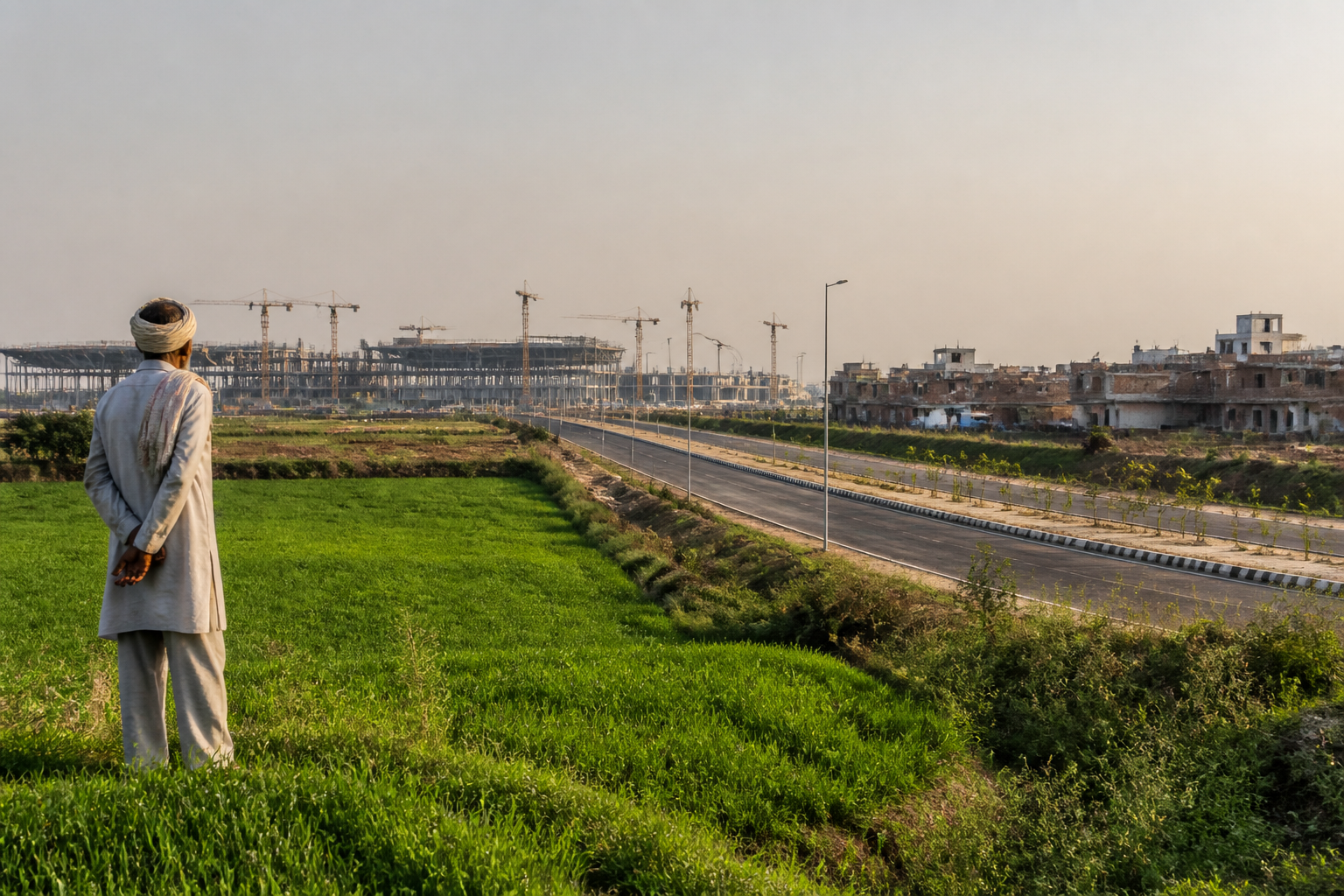
The sharp rise in Jewar land prices after the development of Noida International Airport is creating an unintended consequence for farmers whose land was acquired for the project: compensation that may once have supported the purchase of replacement farmland no longer buys the same amount of agricultural land. The result is a difficult transition from farming to other work, even for families that want to remain in agriculture.
A report by Navbharat Times – Noida says land prices in the Jewar area have increased by three to five times since the airport and related development activity accelerated demand. The report describes a market in which land outside planned development zones and land left after acquisition is being offered at substantially higher prices than before. For affected farmers, this has changed the meaning of compensation from a possible route back into cultivation to a payment that may not restore their previous productive asset.
That distinction is important. When agricultural land is acquired, the immediate question is usually the value of the compensation. But the longer-term question is whether the displaced household can recreate its livelihood in the same local economy. If surrounding land becomes unaffordable before compensation is deployed, the farmer may receive money for land but lose the ability to buy an equivalent farming base. The report’s account of Jewar points to this gap between compensation value and replacement-land value.
The airport has not developed in isolation. According to the report, the third phase of airport-related acquisition is taking place alongside land purchases by the Yamuna Expressway Industrial Development Authority for industrial, commercial, residential and logistics projects. In mutually agreed transactions, prices are being fixed at between Rs 33 lakh and Rs 41 lakh per bigha. At the same time, land outside planned development and acquisition areas is reportedly being quoted at between Rs 1.25 crore and Rs 1.5 crore per bigha.
The difference between these figures shows how sharply location is influencing the market. Land near populated areas is attracting more buyers, while plots with access to roads or proximity to planned development are commanding higher prices. The report attributes the increase to limited availability and rising demand. In practical terms, the same infrastructure investment that increases the development potential of land can reduce the supply of affordable agricultural land for households trying to continue farming.
The units themselves also complicate comparisons. The report says one bigha in Jewar is approximately 843 square metres, compared with 767 square metres in Aligarh and 632 square metres in most parts of Bulandshahr. These differences mean that a price quoted per bigha does not represent exactly the same land area across districts. Even so, the reported prices indicate that moving outside Jewar does not automatically provide an affordable alternative.
Some affected farmers have reportedly considered neighbouring districts such as Bulandshahr, Aligarh and Mathura in order to buy agricultural land. But the report says farmland in these areas has also become expensive, with prices reaching Rs 15 lakh to Rs 25 lakh per bigha. Land along roads or near populated areas is said to cost between Rs 30 lakh and Rs 50 lakh per bigha. The lower prices compared with Jewar may offer an alternative for some families, but the smaller bigha measurement and additional relocation costs make a direct comparison difficult.
This is the central planning problem exposed by the Jewar market. Large infrastructure projects create a new hierarchy of land values around airports, expressways and industrial zones. Land that was primarily a farming asset becomes a potential residential, logistics, commercial or investment asset. Once that transition begins, farmers who want to buy replacement land are competing with buyers who value the plot for future development rather than for agricultural production.
The report also indicates that the market is differentiating between land within planned development areas, land acquired for projects and land that remains outside those zones. Each category carries a different expectation of future use. That expectation can influence prices before construction or development is completed. For farmers, however, land is not only a financial asset. It is also the base for regular income, family work and local economic continuity. A higher price does not necessarily compensate for the loss of access to an equivalent livelihood.
The institutional structure behind the change is equally important. The airport project is driving one stream of land acquisition, while the Yamuna Expressway Industrial Development Authority is purchasing land for a broader regional development programme. The stated uses include industry, commerce, housing and logistics. Together, these activities are reshaping Jewar from an agricultural area into a strategic urban and economic growth zone.
That transformation creates responsibilities beyond the initial acquisition transaction. The supplied report does not establish the detailed compensation formula, the number of affected farmers, the payment schedule, rehabilitation provisions or whether any public programme is helping farmers purchase replacement farmland. It also does not provide an official response from the airport authority, the development authority or the district administration. These gaps matter because land-price inflation can determine whether compensation supports resettlement, investment in another livelihood or a long-term return to farming.
The evidence available in the report is strongest on the price mismatch. In Jewar, land outside planned development and acquisition areas is reportedly being quoted at up to Rs 1.5 crore per bigha, while mutually agreed purchases associated with the third phase and authority-led projects are reported at Rs 33 lakh to Rs 41 lakh per bigha. In neighbouring districts, reported agricultural prices of Rs 15 lakh to Rs 25 lakh per bigha still represent a substantial financial requirement, particularly when the land area represented by a bigha varies between districts.
The consequence described is not limited to property ownership. Farmers who cannot buy replacement land may have to seek other employment or move towards cities. That can shift the burden of adjustment from the project and the land market to individual households. It can also change the composition of the local workforce, as families that once depended on cultivation look for wage work, services or other forms of employment generated by the emerging urban economy.
Jewar therefore illustrates a broader challenge in infrastructure-led urbanisation: compensation can be calculated for land acquired at one point in time, while replacement land is priced by a market responding to the future city. If the market moves faster than the rehabilitation process, the affected family may not be able to restore its former landholding even when it receives compensation. The success of rehabilitation then depends not only on the amount paid, but also on land availability, timing, location and the intended livelihood of the affected household.
The available information confirms that airport-led development and related projects have sharply altered land prices in and around Jewar, and that some affected farmers are finding it difficult to remain in agriculture. It does not yet establish how many households face this problem or what institutional measures are being taken to address it. Those details will determine whether Jewar’s development transition produces a viable new livelihood base for displaced farmers or leaves them unable to recover the agricultural economy they lost.
