


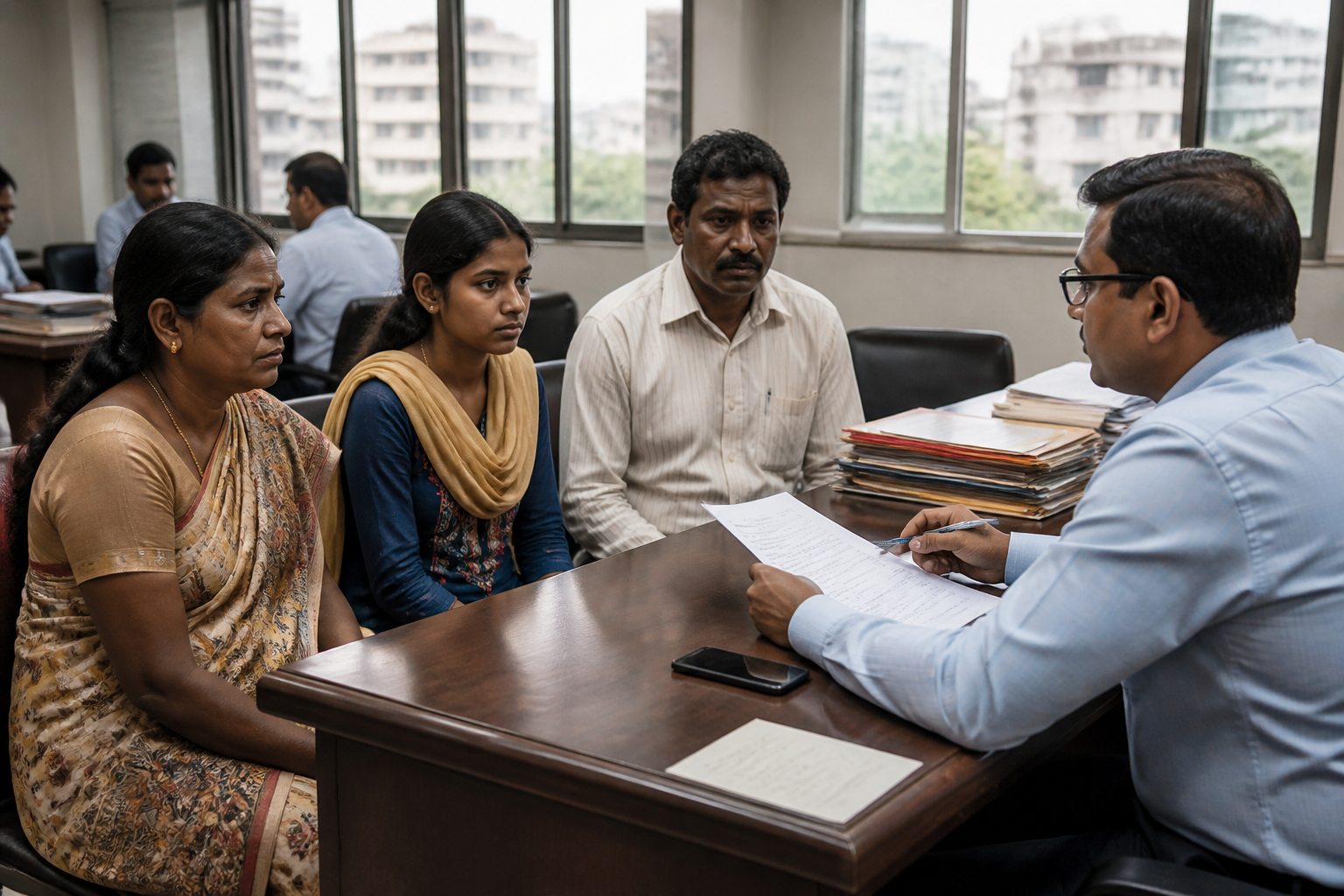
The disappearance of at least eight Telangana workers in the United Arab Emirates, Oman and Saudi Arabia is not only a series of distressing family emergencies. The cases reported by the Times of India also reveal how vulnerable migrant households can become when the systems meant to trace workers, coordinate with foreign authorities and support dependants fail to produce clear answers.
The families approached Pravasi Prajavani, a Telangana government grievance-redressal platform for Gulf migrant workers and non-resident Indians. Their requests were straightforward: locate missing relatives, establish what happened to them and, where necessary, facilitate their return to India. Yet the accounts in the report describe uncertainty continuing for weeks or months, with families unsure whether to approach the state government, Indian missions, employers, agents or fellow workers abroad.
That uncertainty has a direct economic consequence. In several cases, the missing person is described as the sole breadwinner. The disappearance therefore removes not just a family member but the income on which a household depends. Saida, whose husband Mohammed Sileman travelled to Oman to work as a cleaner, told the newspaper that she is now dependent on her sister for survival. Sileman reportedly went missing four days after arriving in Oman in June.
The circumstances described by his family illustrate the information gap that can develop after a worker leaves India. Sileman travelled on a tourist visa, according to the report, and his last communication was that he was going to a beach with his roommates. The agent who arranged his travel later refused to help, saying Sileman was no longer his responsibility. His roommates reportedly said they did not know where he was.
For a family in Telangana, the disappearance is therefore spread across multiple jurisdictions. The worker may have entered a foreign country under one type of visa, taken up informal or irregular employment, lived with other workers and become disconnected from both the employer and the family. The state government can receive the complaint, but tracing the person may require coordination with an Indian embassy, local police, immigration authorities, employers and people sharing accommodation with the missing worker.
The report does not establish why the eight workers disappeared or whether the cases are connected. That distinction matters. The available information identifies a common administrative problem—families seeking assistance to trace workers—but does not provide enough evidence to conclude that the workers faced a shared form of exploitation, trafficking or criminal activity. The central issue established by the report is the absence of reliable information and the difficulty families face in obtaining an effective response.
Officials at Pravasi Prajavani told the Times of India that eight families had recently approached the platform. Bhargavi N, a liaison officer, said the families were worried because they had no clarity about what had happened to their relatives. In one case, the platform received an email from an embassy stating that Alleswarapu Ramesh was being sent back to India, but officials still did not know where he was.
That account points to a serious breakdown in the final stages of consular and administrative assistance. Even when an embassy communicates that a worker is being returned, the information has limited value to a family unless it is followed by details about the person’s location, travel status, arrival and handover. A repatriation process that cannot be tracked by the family leaves the central question unresolved.
Ramesh’s wife, Sunitha, filed a petition seeking help to trace him and facilitate his repatriation. He is from Jagtial and has reportedly been missing from the UAE since June 16. The case shows that a grievance platform is not merely a place to register a complaint. For families, it is expected to function as a link between state authorities in Telangana and institutions operating outside India.
Other cases in the report show different versions of the same vulnerability. Malut Kotaiah from Kamareddy travelled to Saudi Arabia to work for a human resources firm and has been missing since June 30. Bhukya Srikanth, from Mallapur in Jagtial, reportedly became untraceable on June 7, around two years after travelling to Dubai to work at a firm near LuLu Hypermarket in Baniyas.
Srikanth’s mother said the family had been unable to contact him and had been told that he had not returned to his accommodation. His manager had not provided clear information, she said. Srikanth’s father is also in Dubai but cannot travel freely to search for him because his employment visa renewal is under way. The family’s ability to investigate is therefore constrained by the same migration and employment systems in which the missing worker was operating.
This is where the cases become a governance issue rather than only a consular one. The family’s first point of contact may be in Telangana, but the evidence needed to resolve a disappearance is distributed across countries and institutions. State-level officials may be able to receive petitions and communicate with embassies, while embassies may depend on host-country authorities, employers or local records. The report provides no evidence that a single agency has complete responsibility for the entire chain.
The role of private recruitment agents adds another layer. In Sileman’s case, his family said the agent who sent him abroad had withdrawn from the matter. The report does not establish the agent’s legal obligations or whether any complaint has been filed against the agent. It does, however, show how families can be left without an accountable intermediary once a worker is outside India.
Visa status is also significant in understanding the uncertainty. Sileman reportedly travelled to Oman on a tourist visa to work as a cleaner. The report does not say whether the other seven workers had similar arrangements, and no general conclusion can be drawn from one case. But the detail indicates how the legal status of a worker can affect access to employers, documentation, accommodation records and official assistance when contact is lost.
The families’ dependence on relatives also underlines the social cost of weak case management. When a migrant worker is the principal earner, a missing-person complaint can quickly become a livelihood crisis. Household members may have to borrow money, depend on relatives or stop normal work to pursue petitions and calls. The report records this burden through Saida’s dependence on her sister, while other families describe repeated attempts to obtain information.
The available evidence does not show how many complaints Pravasi Prajavani receives in total, how many cases it has resolved, how quickly cases are transferred to embassies or whether families receive regular status updates. It also does not provide a timeline for the eight cases beyond the dates on which some workers were last contacted. These gaps prevent a numerical assessment of the platform’s performance.
They do not, however, make the institutional question insignificant. A grievance mechanism is effective only if a complaint moves through identifiable stages: registration, verification of identity and travel details, contact with the relevant mission, coordination with local authorities or employers, regular communication with the family and a documented closure. The report indicates that, in at least some cases, families remain uncertain even after approaching the state platform.
The cases also show why migrant-worker protection cannot end at the point of recruitment or departure. A worker’s safety depends on what happens after arrival: whether the employer is known, whether accommodation can be verified, whether visa and employment records are accessible, and whether the family has a dependable channel for escalation. The supplied report does not establish the condition of these systems in the three countries involved, but it shows the consequences when families cannot navigate them.
For Telangana, the immediate administrative task is to establish the status of each missing worker and communicate verified updates to the families. That may include confirming the worker’s last known location, checking with employers and roommates, coordinating with Indian missions and determining whether the person has been detained, hospitalised, repatriated or otherwise separated from regular contact. The report does not state what action has been completed in each case.
The broader lesson is that migrant distress becomes an urban and governance concern even when it occurs outside the state’s territory. Migration from districts such as Medak, Jagtial and Kamareddy connects local households to foreign labour markets through recruitment agents, employers, embassies and state grievance systems. When one link fails, the impact returns to the village, town or city where the family lives and depends on remittances.
The eight cases reported here should not be treated as proof of a single Gulf-wide pattern without further evidence. They are, however, sufficient to raise a clear administrative test: whether families can obtain timely, traceable and accountable assistance when a worker disappears abroad. The next meaningful measure will be whether Pravasi Prajavani and the relevant Indian missions can establish the whereabouts of the workers, keep families informed and document the outcome of each complaint.
