


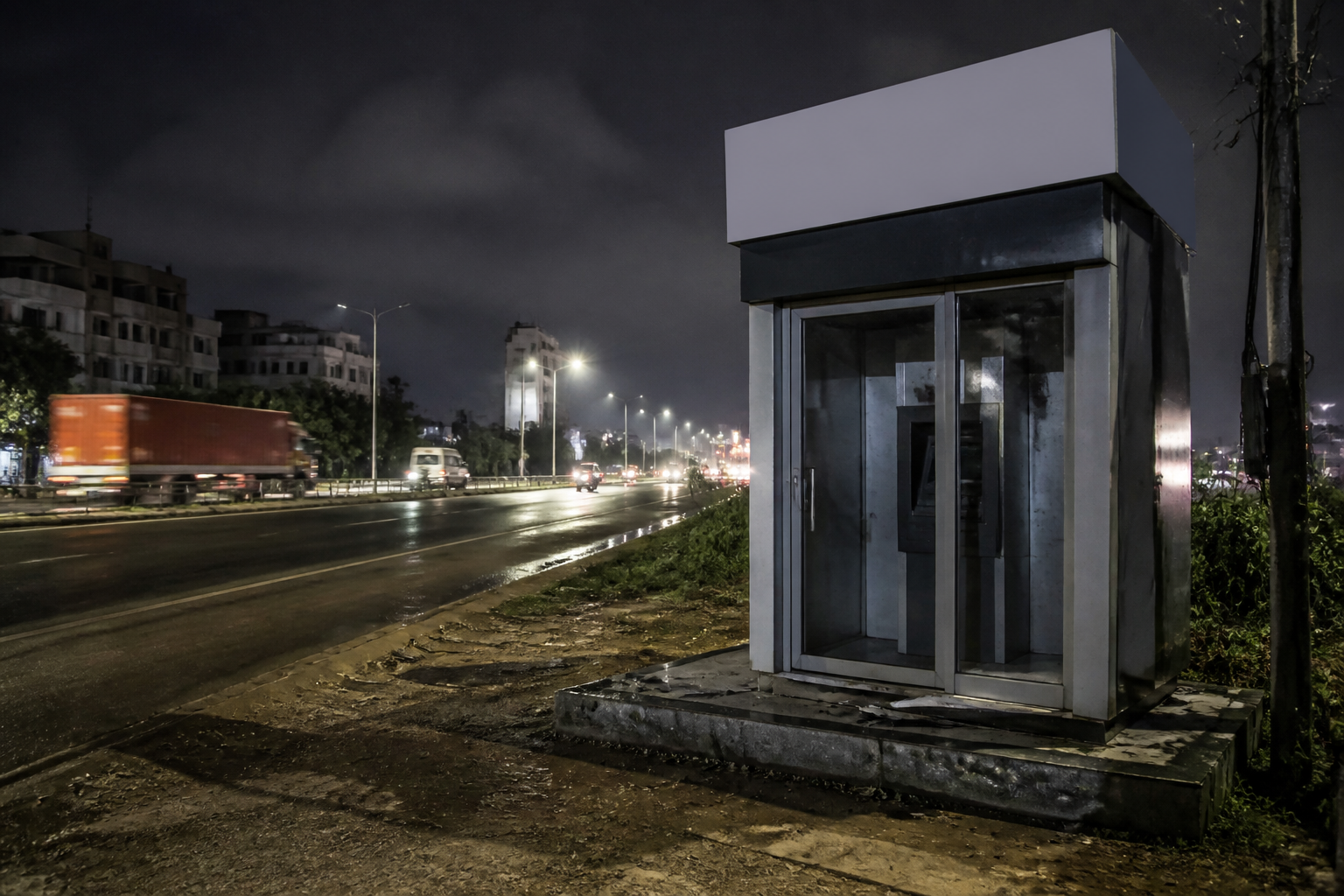
The Chennai ATM theft reported after a seven-member gang removed a machine containing about ₹12 lakh from Koodapakkam near Poonamallee is not only a police case. It is also a small but revealing test of how low-profile urban infrastructure is protected once it is placed outside a bank branch and along a highway corridor.
According to police details reported by the Times of India, the gang surveyed ATM kiosks at several locations for nearly a month and visited the particular kiosk at Mettu Kandigai at least five times before acting. The kiosk was located along the Poonamallee-Tirupati Highway and, police said, had neither a CCTV camera nor a burglar alarm. That combination made the machine a fixed cash point with limited local surveillance and no reported alarm system to trigger an immediate response.
The incident occurred on September 5, when the gang allegedly stole a hearse parked at Naduveerpattu with its key inside. Police said the vehicle was used to transport the ATM after the group removed it from the kiosk. The gang then took the cash, abandoned the hearse and fled. Police also said the group chose the funeral vehicle because they believed it was less likely to be stopped during the getaway.
The method matters because it shows that the security of an ATM kiosk depends on more than the machine itself. The surrounding site, the availability of vehicles, the visibility of the road, the presence of cameras and the ability to alert authorities all form part of the security arrangement. In this case, the source material identifies a gap at the kiosk, but it does not establish whether the ATM had other protections such as remote monitoring, cash sensors or a response contract. Those details remain unreported.
The police investigation also demonstrates the importance of the wider urban surveillance network after an incident has taken place. A team headed by Avadi deputy commissioner Vinoth Santharam formed five special teams and examined footage from nearly 300 CCTV cameras along possible escape routes. Further analysis of CCTV footage and mobile phone signals helped investigators identify Sameer, 36, Rasool, 30, and Masoom, 53, all from West Bengal. The three were traced to Kerala and arrested, while four other members of the group remained on the run, according to the report.
That sequence creates a clear distinction between prevention and investigation. The network of cameras helped police reconstruct the movement of the suspected gang after the theft, but the kiosk itself reportedly lacked a camera. The available evidence therefore points to stronger visibility along escape routes than at the immediate point where the cash machine was targeted. It would be premature to treat this single case as proof of a wider failure across Chennai, but it does identify a specific weakness in the security chain.
The case also shows how dispersed infrastructure creates administrative complexity. An ATM kiosk is connected to a bank or financial institution, but its physical location may be on a roadside or in a commercial setting far from a branch. Security responsibility can consequently involve the operator, the property owner, private security and the police. The supplied report does not identify the bank operating the machine, the kiosk owner or the agency responsible for security equipment. Without those details, it is not possible to determine where the reported absence of CCTV and an alarm originated or whether the site had been assessed previously.
The police account says the gang conducted reconnaissance at several kiosks over nearly a month. It also says the targeted kiosk was surveyed at least five times. This suggests that the group was not acting solely on an opportunity created by an unlocked vehicle; it had first selected a target and studied its surroundings. The stolen hearse was then used as a logistical tool for removing the machine. The reported planning places the kiosk’s physical setting at the centre of the incident rather than treating the ATM as an isolated object.
The recovery of ₹2 lakh from the three arrested suspects is one of the specific outcomes reported so far. The original machine contained about ₹12 lakh, leaving the report without a complete account of the remaining cash or the ATM itself. Four suspects were still at large at the time of publication. These unresolved details are important because they mark the boundary between what the investigation has established and what remains pending.
The use of nearly 300 CCTV feeds and mobile-phone signal analysis also highlights the different roles of public and private data in urban policing. CCTV footage can provide movement evidence across roads and junctions, while phone signals can help trace suspects beyond the immediate site. In this case, police combined both forms of information to trace the trio to Kerala. The report does not specify whether the cameras belonged to public agencies, private establishments or both, so the institutional structure behind the surveillance network remains unclear.
For the city’s cash infrastructure, the immediate lesson is site-specific rather than universal. The source establishes that one ATM kiosk on the Poonamallee-Tirupati Highway had no reported CCTV camera or burglar alarm and was targeted after repeated reconnaissance. It does not establish how many other kiosks have comparable protection, whether banks follow a common security standard for standalone machines, or whether any review was ordered after the theft. Those questions would require information from the concerned bank, police authorities or other responsible agencies.
The incident therefore sits at the intersection of banking operations, roadside land use and policing. A machine placed in a public-facing location extends access to cash, but it also becomes a physical asset that can be observed, approached and removed. The security design has to account for the immediate kiosk, the adjoining road, nearby vehicles and the speed with which an alert can reach responders. The reported case shows that the failure of even one layer can increase the importance of other layers later in the investigation.
What the evidence confirms is limited but significant: a gang allegedly planned the theft over weeks, targeted a kiosk without reported CCTV or an alarm, used a stolen hearse to move the ATM, and was partly traced through a large CCTV review and mobile-phone analysis. What it does not confirm is whether this was an isolated weakness or part of a broader pattern. The next developments to monitor are the recovery of the stolen machine and remaining cash, the arrest of the four suspects still at large, and any response from the concerned bank or authorities on security arrangements at standalone ATM kiosks.
