


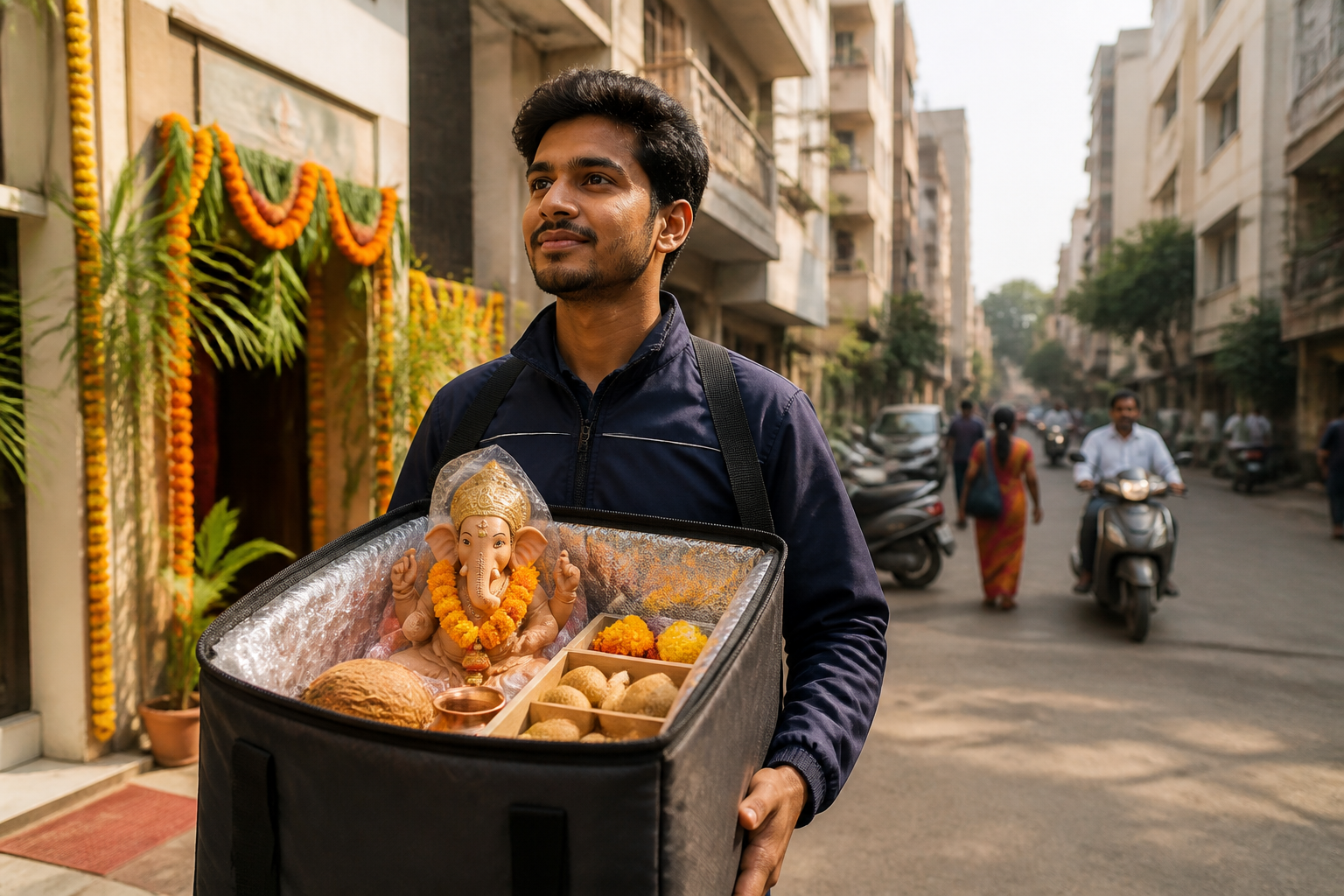
Quick commerce is becoming part of the urban infrastructure of festive consumption, according to new platform data showing sharp increases in online orders for Ganesh idols, modaks, flowers and puja essentials. The figures reveal more than a seasonal sales opportunity: they show how delivery networks are extending traditional festival markets beyond their usual geographies and compressing the time between household demand and fulfilment.
The data, reported by Swiggy Instamart and Flipkart Minutes, covers demand during Ganesh Chaturthi. Swiggy Instamart recorded a 176 per cent year-on-year increase in demand for eco-friendly clay idols. Ready-to-place clay idols represented 90 per cent of that demand, while paint-your-own eco idols accounted for the rest. The growth was particularly high in cities that are not traditionally identified with the festival’s strongest markets. Delhi recorded a 1,718 per cent increase in eco-Ganpati orders, followed by Kolkata at 1,305 per cent, Noida at 1,136 per cent and Bhubaneswar at 1,132 per cent.
These figures should be read as platform demand, not as a complete measure of festival consumption in each city. They nevertheless indicate a significant change in access. A household in a city with fewer established Ganesh Chaturthi retail clusters can now order an idol through an app connected to a local fulfilment network. The result is not the disappearance of physical markets, but an additional layer of distribution that makes festival purchases available in places where specialist supply may be less visible or less convenient.
The category mix is important. The reported demand was not limited to decorative or discretionary goods. Flowers, puja essentials, idols and sweets all appeared as major categories, linking quick commerce to the routine preparation of a religious event. The timing of orders also shows how delivery systems are being used. On September 14, flower orders on Instamart peaked at 7:42 am, reaching 868 orders a minute. Eco-friendly idol demand peaked at 8:48 am, puja essentials at 9:45 am and modak orders at 10:39 am.
This sequence suggests that the platform was serving a chain of related needs through the morning rather than a single purchase occasion. Flowers were ordered first, followed by idols, puja supplies and sweets. The data does not establish why consumers chose those times, but it does show that festive demand was concentrated within a narrow operational window. For quick-commerce companies, such peaks require inventory positioning, delivery capacity and local assortment decisions to be aligned before the order is placed.
Modaks provide a second view of how platforms are translating local preferences into city-level retail data. Mawa was the most-ordered flavour on Instamart, with demand rising 145 per cent year-on-year. It was followed by classic, kesar, kaju, assorted and amba variants. Mawa led demand in Bengaluru, Mumbai and Hyderabad, while consumers in Delhi and Gurgaon preferred kesar. Pune, Chennai, Kolkata and Nagpur leaned towards classic modaks.
The geographic variation matters because it shows that a national platform does not necessarily create a uniform national market. Its network can carry a common product category while still reflecting local taste. The platform’s role is therefore partly logistical and partly curatorial: it must decide which products to stock, in what quantities and at which fulfilment locations. The reported flavour patterns indicate that city-specific assortment is central to converting broad festive demand into completed orders.
Flipkart Minutes reported a 2.5-fold increase in demand across festive categories including décor, puja essentials, ethnic wear, sweets and gifting. The company said idol orders rose fivefold and modak demand increased fourfold. Tier 2 and Tier 3 cities, including Patna, Lucknow and Guwahati, recorded eightfold growth in sales during the festive period. Gen Z demand grew threefold, with eco-friendly idols, fruits, flowers and dry fruits among the most-ordered categories.
Taken together, the two sets of figures point to a wider expansion of the quick-commerce catchment area. Demand was reported not only in major metropolitan markets but also in cities that are gaining access to rapid delivery for culturally specific products. The available material does not identify the absolute order volumes, the number of dark stores involved or the share of total festive shopping represented by these platforms. Without those figures, the data cannot establish market dominance. It does, however, show that quick commerce is reaching into categories that were once more closely associated with neighbourhood vendors, seasonal stalls and specialist retail clusters.
That shift changes the urban geography of convenience. Traditional festive shopping depends on where markets, shops and temporary stalls are located. Quick commerce adds a digital layer in which the relevant proximity is not only the distance to a physical market but also the distance between a consumer and a fulfilment centre. The reported peaks suggest that the last-mile network is increasingly being used for planned festival preparation as well as urgent top-up purchases.
The distinction between routine and last-minute consumption is significant. The source data describes quick commerce as becoming part of consumers’ last-minute and routine festive shopping, with Flipkart Minutes identifying 6 am to 11 am as its busiest period during the festive window. This expands the role of delivery platforms from emergency convenience to a scheduled part of the household’s morning activity. In urban terms, the delivery network becomes an intermediary between domestic rituals and the commercial system that supplies them.
Eco-friendly idols add another layer to the story. The reported increase in clay idol demand, particularly outside traditional Ganesh Chaturthi markets, indicates that an environmental product category can travel through a mainstream digital retail channel. The data does not show whether these products were selected because of environmental awareness, product availability, price, convenience or platform merchandising. It does show that eco-friendly idols were not confined to a small specialist market during the period covered.
The institutional implications remain limited in the supplied evidence, but the operational implications are clear. A festival surge requires platforms to forecast demand by product, city and time of day. It also requires coordination between sellers, fulfilment centres and delivery workers. The sharper the peak, the greater the importance of stocking decisions made before the festival begins. A platform that underestimates demand may lose orders; one that overestimates it may be left with perishable sweets, flowers or other time-sensitive goods after the peak has passed.
For cities, this creates a parallel retail geography that is difficult to see from roads and markets alone. A neighbourhood may appear to have limited festive retail while still being connected to a dense digital supply chain. Conversely, a high concentration of online orders in a locality may place sudden pressure on loading, dispatch and last-mile delivery activity even when there is no visible festival market at street level. The supplied figures do not measure traffic, delivery-worker movement or warehouse capacity, so those effects cannot be quantified here.
The evidence confirms three developments. First, quick-commerce platforms are handling a wider range of culturally specific goods. Second, demand is spreading beyond the cities most closely associated with Ganesh Chaturthi. Third, the timing and flavour data show that platforms are responding to highly localised consumption patterns rather than selling a single standardised festive basket.
What remains unclear is the scale of this change relative to offline retail, the profitability of festival categories and the extent to which the reported increases reflect new consumption or a shift from physical stores to apps. Those questions will determine whether the trend is a temporary festive spike or a durable change in urban retail behaviour. For now, the platform data shows that India’s festival economy is increasingly being organised through city-level digital fulfilment networks, with quick commerce occupying a growing role between household rituals and the markets that serve them.
