


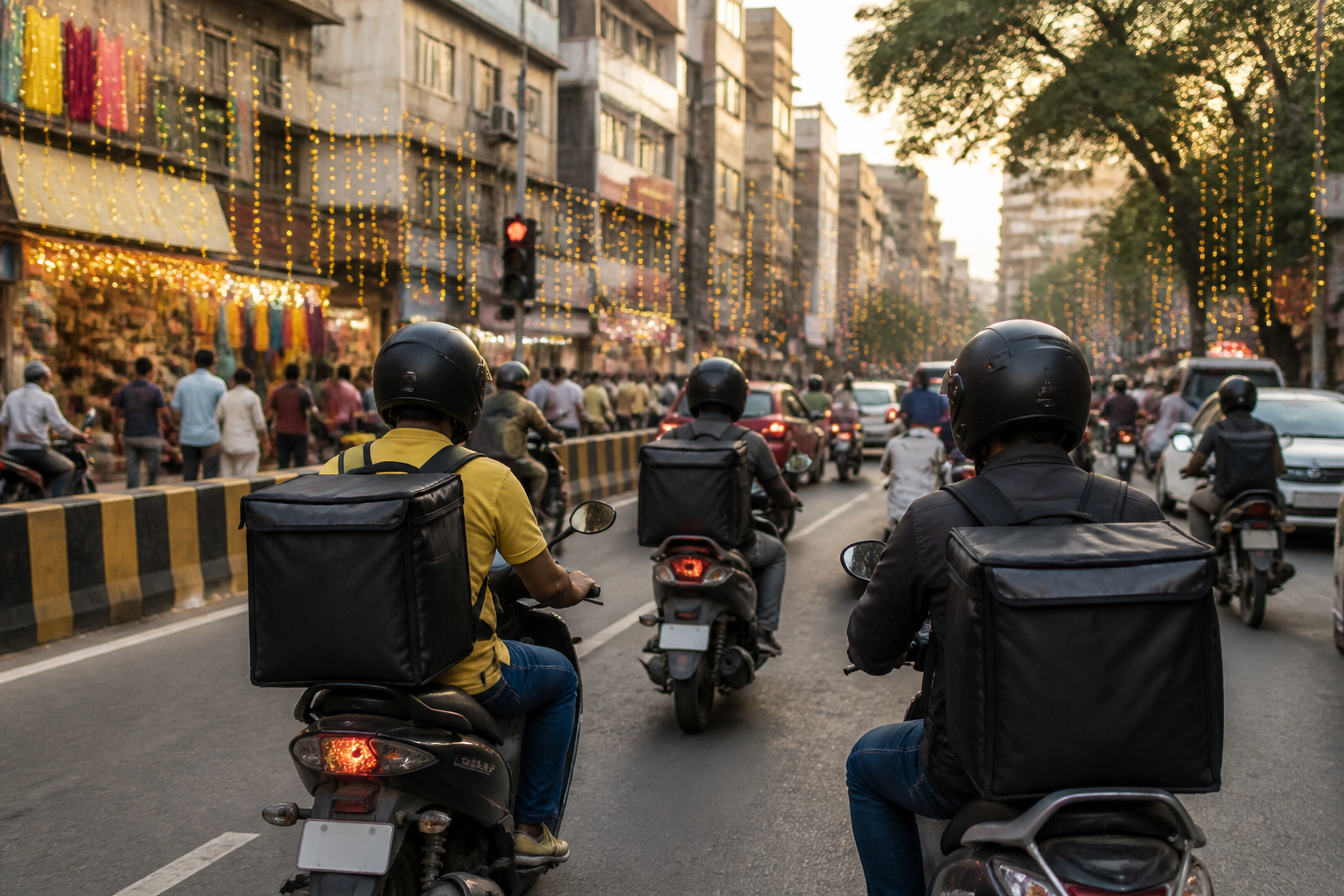
Quick commerce is moving from a metro convenience service to a broader contest over India’s festive consumption geography. Amazon, Flipkart, Blinkit, Zepto and Swiggy Instamart are expanding delivery networks beyond major metropolitan markets, while shoppers are increasingly being conditioned to expect groceries, electronics and personal-care products within minutes, according to a report by Business Standard.
The shift matters because festive e-commerce is no longer being defined only by the size of online discounts or the reach of large marketplaces. It is also being defined by how quickly products can move through cities and towns. Business Standard, citing Datum Intelligence, reported that festive online sales could grow by as much as 29 per cent this year, reaching up to ₹1,55,000 crore, or $17.6 billion, compared with ₹1,20,000 crore in 2025.
That projection places delivery speed at the centre of a market that traditionally depended on large shopping events, planned purchases and national fulfilment networks. The new competition is more immediate. Consumers are not simply choosing between online and physical retail; they are increasingly comparing how quickly an online platform can respond to a need that may arise within the same day.
This changes the role of urban logistics. A marketplace that promises delivery within minutes requires products to be positioned close to likely customers. That makes the geography of storage, order processing and last-mile movement as important as the digital storefront. The supplied report does not provide details of the companies’ warehouse counts, delivery hubs, investment levels or city-wise expansion plans. It does, however, identify a clear direction: major e-commerce platforms are extending their delivery networks beyond metros as the festive season approaches.
The significance of that move lies in the relationship between consumption and settlement patterns. Metro markets have generally offered the densest customer bases, more established delivery ecosystems and a larger concentration of retail demand. Expanding beyond them means platforms are seeking demand in a wider range of urban markets. The report does not specify which non-metro cities are being targeted or how the networks will be structured, so the scale of this expansion cannot be independently assessed from the available material.
Even with that limitation, the competitive logic is visible. Festive shopping produces a concentrated period of demand across several categories. Groceries and personal-care products are suited to frequent, short-cycle purchasing, while electronics involve higher-value and often more deliberate buying decisions. The inclusion of all three categories in the report indicates that quick commerce is being presented not only as a grocery model but as a broader fulfilment proposition.
That broadening could alter how urban consumers understand convenience. A delivery promise measured in minutes creates an expectation that availability should be local, immediate and reliable. It also places greater importance on the invisible systems behind the transaction: inventory placement, neighbourhood-level demand forecasting, road access, delivery-worker movement and the ability of platforms to process surges without losing service reliability. None of these operational indicators are provided in the report, but they are the urban systems that determine whether a speed-led model can work beyond its strongest markets.
The reported sales projection provides the clearest numerical measure of the opportunity. Growth from ₹1,20,000 crore in festive online sales in 2025 to as much as ₹1,55,000 crore this year would represent an increase of up to ₹35,000 crore. Datum Intelligence’s reported estimate of growth of as much as 29 per cent therefore places a larger transaction base in front of platforms competing for customer attention and fulfilment capacity.
The wording of the projection is important. “As much as 29 per cent” describes an upper estimate rather than a guaranteed outcome. The source material does not provide the methodology, assumptions or category-wise breakdown behind the Datum Intelligence figure. It also does not establish how much of the projected growth will come specifically from quick commerce, as opposed to conventional e-commerce or other digital retail channels. The figure should therefore be read as an indicator of the market opportunity, not as a confirmed measure of quick-commerce sales.
The same caution applies to the claim that consumers increasingly expect delivery within minutes. Business Standard presents this as a behavioural trend, but the supplied report does not include survey results, order data or a comparison across cities. What can be established is that speed has become a central competitive proposition for the companies named in the report. Whether that expectation is equally strong across metros, smaller cities and different product categories remains unspecified.
This distinction is important for urban policy and business strategy. A delivery model that works in a dense metropolitan neighbourhood may face different conditions in a less concentrated urban market. Customer density, road networks, local retail competition and the distance between fulfilment points and households can all affect the practicality of fast delivery. The source does not offer evidence on these variables, so it is not possible to conclude whether the expansion beyond metros represents a uniform national model or a set of highly localised experiments.
The institutional landscape is also not described in detail. The report identifies private companies and a market research firm, but it does not discuss municipal permissions, land use, labour arrangements, traffic management or regulation. This leaves unanswered questions about how rapid fulfilment networks interact with the built environment. If platforms require more neighbourhood-level storage and processing capacity, the location and operation of those facilities could become relevant to commercial real estate and local urban management. The supplied material does not establish whether such changes are occurring or how authorities are responding.
For cities, the larger issue is that retail demand is becoming increasingly connected to movement at very small geographic scales. Online commerce once made the distance between a consumer and a national warehouse less visible to the customer. Quick commerce reverses that pattern by making proximity central to the promise. The customer may see only a short delivery time on a screen, but the service depends on a physical network located close enough to support that promise.
The festive season is a useful test of this model because it concentrates demand and raises the stakes of fulfilment. Platforms are competing not only to attract shoppers but also to convert a larger share of their purchases into fast deliveries. Yet the available evidence does not reveal whether the companies have sufficient capacity for peak demand, whether delivery times vary across locations or whether expansion beyond metros will be sustained after the festive period.
The report’s central signal is therefore less about a single launch or announcement and more about the direction of competition. Amazon, Flipkart, Blinkit, Zepto and Swiggy Instamart are identified as participants in a market where speed is becoming a key differentiator. Their expansion beyond metros suggests that the next phase of competition will depend on how effectively fast-delivery systems can be adapted to a broader urban geography.
What the evidence confirms is that festive online sales are expected to grow substantially, that quick commerce is becoming a prominent competitive arena and that major platforms are extending delivery networks beyond metros. What remains unclear is the precise size, location and operating model of that expansion. Those details will determine whether quick commerce becomes a durable layer of India’s urban retail infrastructure or remains concentrated in selected markets and categories. The next developments to monitor are company-level network disclosures, city-wise service expansion and evidence on how festive demand translates into sustained delivery activity.
