


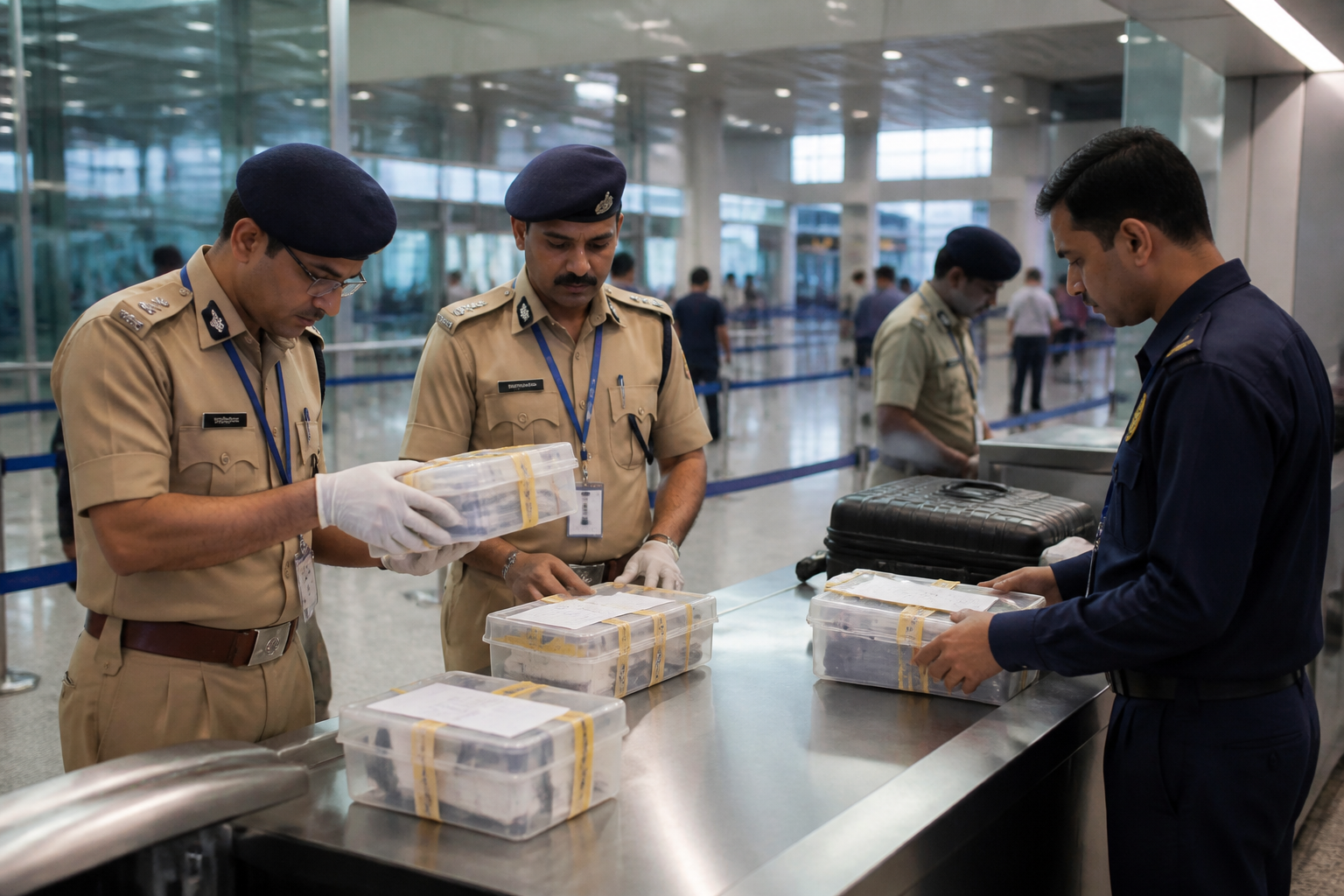
The Delhi airport gold seizure involving a Bangladesh-bound passenger has exposed how an international transit area can become the setting for an alleged handoff without the traveller formally entering the city. Customs authorities say 1.346 kg of gold, valued at Rs 1,88,20,715, was recovered from a passenger who had arrived from Jeddah and was scheduled to continue to Dhaka.
The incident took place on September 12 at Terminal 3 of Indira Gandhi International Airport. According to the report by Live Hindustan – NCR, the passenger arrived on Air India flight AI-2256 and was due to board Air India flight AI-237 for Dhaka. He was stopped by Central Industrial Security Force personnel in the international transit area after officers noticed what they described as suspicious activity.
The case is significant because the passenger was not reported to have planned a stay in Delhi or an exit from the airport. He was travelling through the international transit area, where passengers connecting between international flights can remain within the airport system while moving towards their onward departure. In this case, the customs account says the suspected transfer was also intended to take place inside that area.
During the inspection, officers found three oval capsules concealed in the passenger’s undergarment. The capsules contained gold in the form of chemical paste. The combined weight of the material, including its packaging, was reported at about 1,596 grams. The passenger was then taken to the Customs Preventive team for further examination.
After the material was processed, customs officials recovered two gold bars weighing 1,346 grams. The department placed the value of the seized gold at approximately Rs 1.88 crore. The difference between the packaged material and the recovered gold is relevant to the enforcement record: the larger figure included the capsules and packaging, while the final gold weight referred to the two bars extracted during the examination.
The passenger reportedly told investigators that he was supposed to hand over the gold to a contact in the international transit area. That account, as reported, shifts the focus of the case beyond the individual carrying the material. The immediate question for investigators is not only how the gold entered the airport system, but also who was expected to receive it and how the proposed handoff was to be carried out without the passenger leaving the transit zone.
The case therefore brings together two different layers of airport administration. CISF personnel identified and stopped the passenger during security operations, while the Customs Preventive team handled the subsequent examination, seizure and legal action. The report attributes the seizure to Section 110 of the Customs Act and the arrest to Section 104. The source does not provide further details about the specific procedural steps taken under those provisions.
This division of responsibility matters in an international airport because security screening and customs enforcement are related but distinct functions. A passenger can be inside a highly controlled airport environment while still moving through different institutional checkpoints. The reported incident shows that the transit area is not merely a waiting space between two flights; it is also an operational zone where security officers, customs officials, airlines and passengers interact under time-bound conditions.
The routing of the passenger is another important feature. The journey began in Jeddah, continued to Delhi and was scheduled to end in Dhaka. The reported seizure therefore involved a cross-border movement that used Delhi as an intermediate aviation point rather than as the passenger’s final destination. The source does not establish where the gold was originally obtained, who arranged the travel or whether any airport employee or other passenger was involved.
Those unanswered questions are now central to the investigation. Customs authorities are seeking to identify the alleged contact who was supposed to receive the gold in the transit area. The supplied report does not state whether that person was located, whether the onward flight was missed, or whether further arrests were made. It also does not establish the source of the gold or the wider network, if any, behind the alleged movement.
The method of concealment illustrates the difficulty of detecting contraband that is carried in compact form and disguised within personal clothing. In this case, the gold was not reported as loose metal or as ordinary luggage contents. It was placed inside three capsules and concealed in an undergarment before being discovered during the airport inspection. The recovery required a further examination by customs officials to separate the gold from the chemical paste and packaging.
For airport operations, the case highlights the importance of coordination between frontline security and specialised enforcement agencies. The initial intervention was made by CISF officers, while the valuation, recovery of the gold bars and seizure were attributed to customs officials. The report does not provide information about the screening trigger beyond the reference to suspicious activity, so it is not possible to determine which specific behaviour or inspection finding led to the intervention.
The incident also demonstrates why international transit requires attention beyond the conventional distinction between arrival and departure. A passenger who does not leave the airport may still be part of a suspected transfer chain operating within the terminal. The alleged plan described in the report depended on a handoff in the transit area rather than on the passenger personally transporting the gold onward through the city. That makes identification of the proposed recipient an essential part of the enforcement process.
At the legal level, customs officials have seized the gold under Section 110 of the Customs Act, while the passenger has been arrested under Section 104, according to the report. These actions establish the immediate status of the recovered material and the passenger in the case. They do not, by themselves, establish the final outcome of the investigation or any eventual court finding.
The available facts also place limits on what can be concluded. The passenger’s reported statement about the intended handoff is an investigative claim attributed to the customs inquiry. The identity of the alleged contact remains unknown in the supplied material. There is no information about the passenger’s previous travel history, the ownership of the gold, the route by which it reached Jeddah or whether the case is connected to other seizures.
That distinction is important in reporting airport seizures. A recovery and arrest are confirmed actions described by the authorities, while the purpose of the consignment and the identity of its intended recipient remain subjects of investigation. Treating the alleged handoff as an established wider network would go beyond the evidence currently available.
The Delhi case ultimately raises a specific institutional question: how are suspected transfers detected and investigated when they are planned entirely within an international transit environment? The supplied report confirms that the passenger was stopped, the material was examined and the gold was seized. It does not yet reveal how the alleged contact was identified or whether the investigation will lead to further action.
For now, the confirmed sequence is limited but significant. A passenger travelling from Jeddah to Dhaka was intercepted at Delhi airport, three concealed capsules were found, two gold bars weighing 1,346 grams were recovered, and customs authorities valued them at about Rs 1.88 crore. The passenger has been arrested, the gold has been seized and the investigation into the intended recipient and the wider circumstances remains in progress.
