


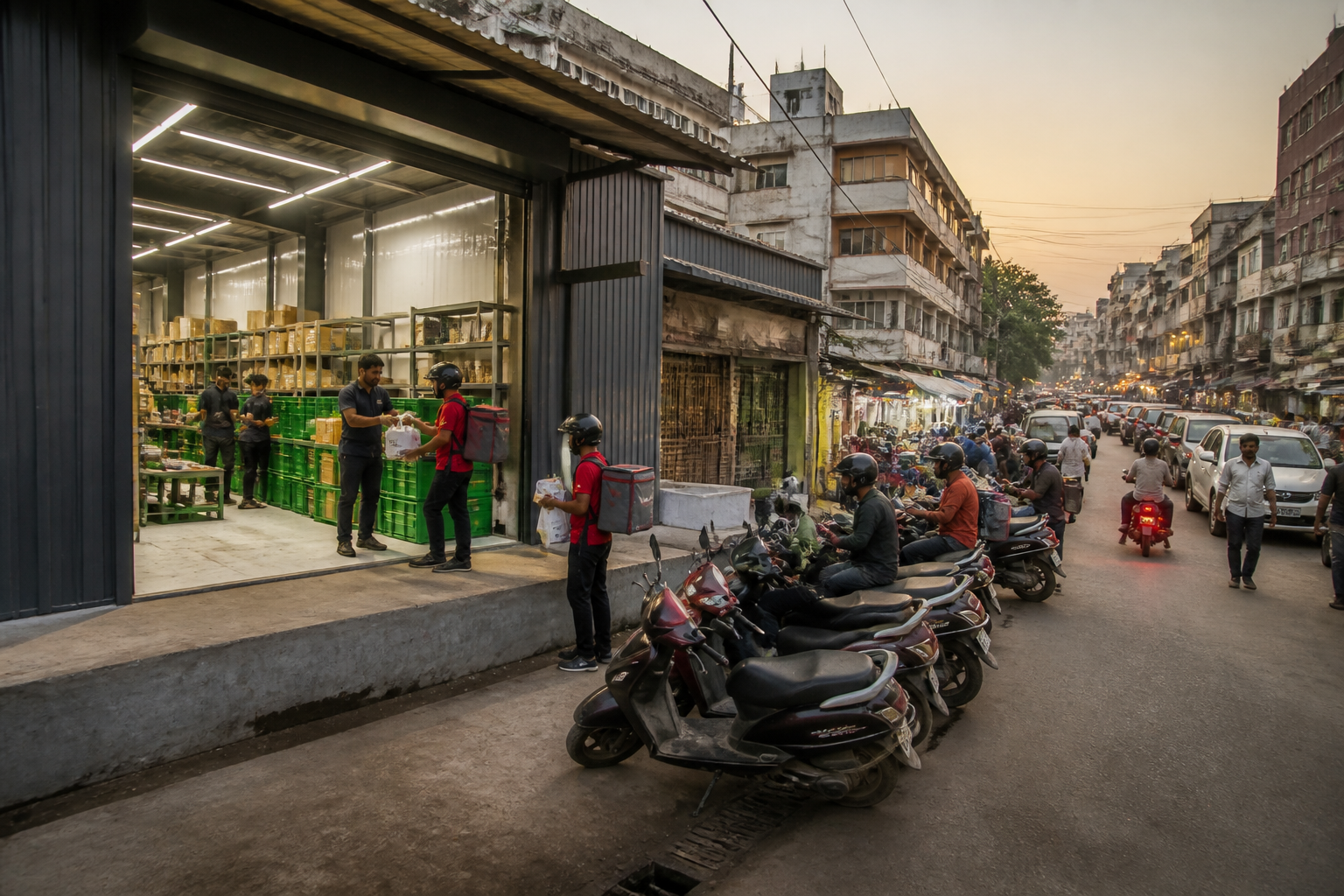
Amazon Now crossing $1 billion in annualised gross sales is more than a milestone for one delivery service: it shows how quickly India’s urban retail infrastructure is being reorganised around fulfilment centres located close to customers. Amazon says its instant-delivery network has reached more than 60 cities and towns in less than 10 weeks, with plans to reach 100 cities by Diwali.
The expansion places Amazon in a more direct contest with Blinkit, Zepto, Swiggy Instamart, Flipkart Minutes and BigBasket. But the larger urban shift is the movement of inventory into neighbourhood-scale facilities designed to serve orders within minutes. These facilities are changing where goods are stored, how local demand is mapped and how commercial space is used in cities and towns.
Amazon said Amazon Now’s annualised gross sales reached $1 billion based on its performance over the past three months. The company also said orders have doubled every quarter since launch, making the service the fastest-growing e-commerce business in Amazon India’s history. Samir Kumar, country manager at Amazon India, attributed the performance to customer response and said the company was on track to expand to 100 cities by Diwali.
The service is now available in more than 60 cities and towns, including Padubidri, Tirupati, Guntur, Gurdaspur, Jalandhar, Vellore, Dharwad, Warangal and Berhampur, apart from metropolitan markets. Amazon said orders are supported by more than 750 micro-fulfilment and urban fulfilment centres.
That network represents a different model from conventional e-commerce, where a smaller number of large warehouses feed regional distribution networks. In quick commerce, the final delivery is planned backwards from the promised time. Products must be positioned close to residential catchments, orders must be picked rapidly and riders must be able to complete short-distance trips through dense and often congested streets.
The result is a logistics system that is increasingly embedded in the everyday fabric of urban neighbourhoods. A micro-fulfilment centre may not be visible to most customers, but its location affects delivery routes, loading activity, rider movement and the demand for small commercial premises. As the networks expand beyond major metros, the model is also reaching towns where organised retail and formal e-commerce infrastructure have traditionally been less extensive.
People familiar with Amazon Now’s operations, as cited in the report, said the average order value is around ₹540 and that the service handles about 700,000 orders a day. They also said Amazon Now has a 10 per cent share by orders and 14 per cent by value. These figures were not attributed to a public company filing in the supplied material and therefore indicate the reported scale of the operation rather than independently established market data.
Amazon’s product mix also illustrates why fulfilment centres are becoming more important to urban retail. The company said sellers on Amazon Now offer groceries, fruits and vegetables, frozen food, personal care products, fashion and beauty items, small appliances, and home and kitchen products. It is not limited to emergency top-up purchases; the service is being positioned as a wider retail channel with a broad selection.
Amazon said customers can access tens of thousands of products within minutes or a few hours, more than one million products within the same day and over four million the next day. Millions of additional products remain available through Prime Delivery. This creates a layered delivery system in which speed is linked to the physical location of inventory: the closest facilities support immediate orders, while larger networks handle products that can arrive later.
The company had announced in June 2026 that it planned to build India’s largest delivery-in-minutes network by scaling Amazon Now to more than 300 cities. The latest expansion to over 60 cities is therefore an early step in a substantially larger rollout. The stated target of 100 cities by Diwali would further extend the network during the country’s busiest shopping period.
Competitors are also expanding their physical footprint. Flipkart Minutes, which launched in August 2024, has nearly 1,200 micro-fulfilment centres across more than 150 cities, according to the supplied report. Flipkart said its business had quadrupled over the preceding year as it marked two years since launch.
Data cited from a recent CLSA report places the overall quick-commerce footprint at 477 cities nationally. In the top 10 cities, the five players tracked by the brokerage had 3,536 dark stores. Blinkit accounted for close to 30 per cent of dark stores across those top 10 cities and more than 34 per cent nationally, according to the report. It had the leading store count in six of the 10 cities, while Zepto led in three of the remaining four.
The same data shows that competition is no longer confined to store counts in the largest metropolitan markets. Flipkart Minutes had 627 dark stores in the top 10 cities, compared with 615 for Swiggy Instamart, while BigBasket had 497. Flipkart Minutes had also surpassed Swiggy Instamart in dark-store count and PIN code coverage within those cities, according to CLSA’s tracking.
This expansion raises an institutional and planning question: how will cities accommodate a rapidly multiplying layer of delivery infrastructure? The supplied material does not establish a separate regulatory framework for micro-fulfilment centres or identify how municipal authorities classify them. It does, however, show that fulfilment is becoming a significant urban land-use function, alongside retail shops, warehouses and conventional distribution centres.
The geography of Amazon Now’s rollout is particularly important. The company’s stated plan extends from Gurdaspur and Hoshiarpur in the north to Vembayam and Alamcode in the south. Locations such as Tirupati, Guntur, Dharwad, Warangal and Berhampur indicate that delivery-in-minutes is being tested and scaled in a wide range of urban contexts rather than only in the country’s largest consumption centres.
For citizens, the immediate effect is greater access to a wider selection of products with shorter delivery times. For urban economies, the model creates demand for fulfilment space, delivery labour and local supply arrangements. It also increases the importance of accurate demand forecasting, because a facility’s viability depends on enough orders being generated within a compact service area.
The competitive race is therefore not simply about which platform promises the shortest delivery time. It is about who can build the densest and most economically sustainable network of stores, fulfilment centres, sellers and delivery routes. A company with more locations can bring inventory closer to customers, but it must also support those locations with sufficient demand and operational capacity.
Amazon Now’s $1 billion annualised gross-sales milestone confirms the speed of the company’s expansion, while the wider market data indicates that quick commerce is becoming a major urban logistics system. What remains unclear from the available information is how these networks will affect commercial rents, traffic and curbside activity, worker conditions, municipal regulation and the long-term economics of instant delivery. Those questions will become more significant as Amazon moves towards 100 cities and its competitors continue adding dark stores across India.
