


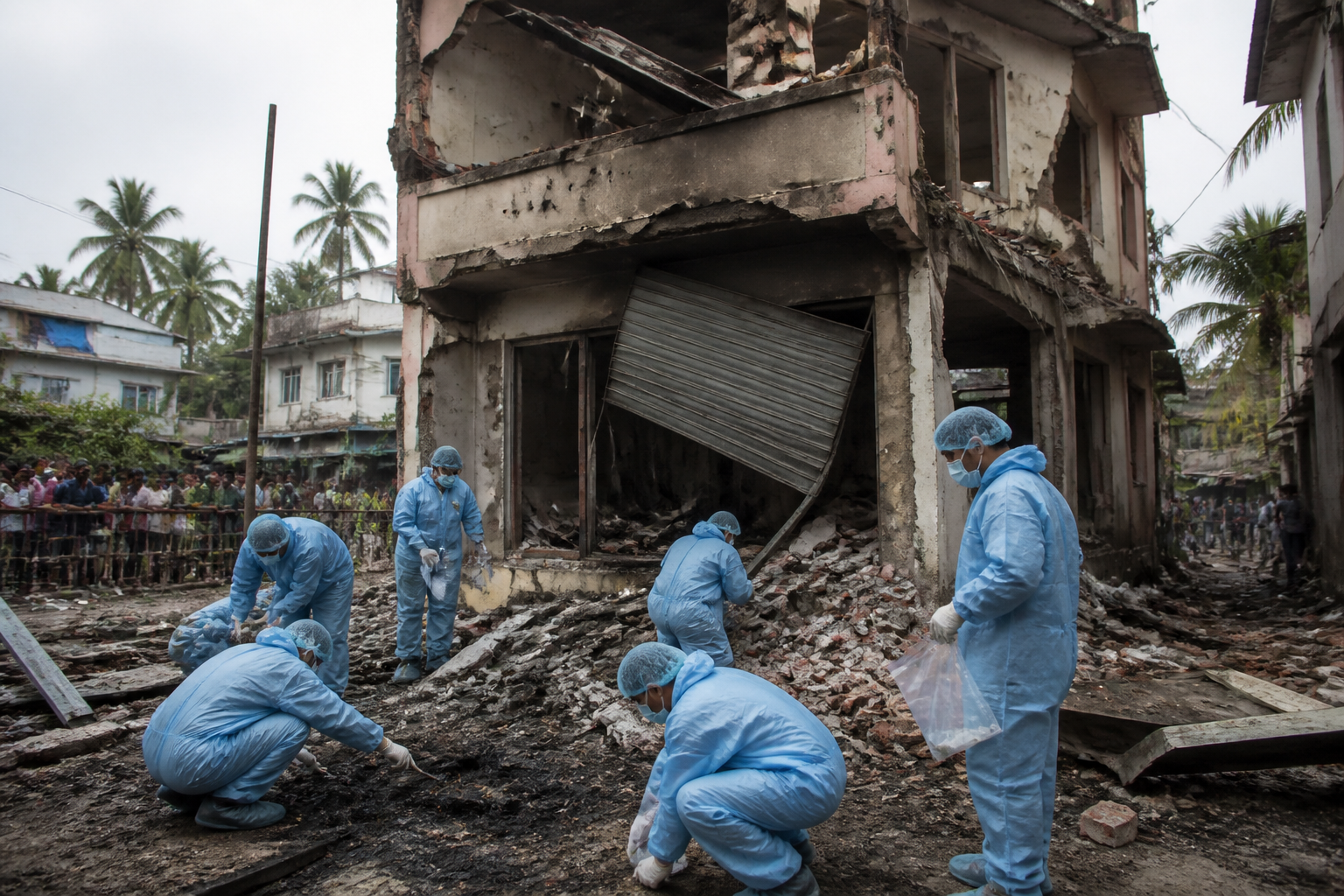
The Baruipur explosion has left two unresolved questions at the centre of the investigation: what caused the blast that destroyed a two-storey house, and why forensic experts reached the site only three days later. The incident in North Bhaga’s Lalpol area caused no reported deaths or injuries because the Trinamool Congress youth leader who owned the house and his family were not present, but the scale of the damage has turned the case into a public-safety and investigation-timing issue.
The explosion occurred late on Thursday night at the house of Dwijen Mondal. The blast was strong enough to destroy the concrete two-storey structure, send a metal shutter flying about 100 metres and start a fire. One fire engine attended the site and extinguished the flames. These details establish the physical seriousness of the incident, but they do not establish what triggered it.
The police initially said the explosion may have originated from a cooking-gas cylinder inside the house. Local residents and local Bharatiya Janata Party leaders, however, alleged that a large quantity of bombs had been stored there and that the blast resulted from that stockpile. The report does not provide independent evidence confirming either explanation. That distinction is central: the extent of destruction can be observed, while the source and nature of the explosive force require technical examination.
The forensic team’s delayed arrival is therefore more than a procedural detail. Investigators collected samples on Monday, three days after the explosion, and the team did not comment on its findings at the site. The police said the investigation was continuing and that they were waiting for the forensic report. Until that report is available, the competing explanations remain allegations or preliminary possibilities rather than established conclusions.
A forensic examination conducted after a destructive incident must work with the material that remains at the scene. In this case, the building had been severely damaged and a fire had followed the blast. The delay between the incident and sample collection adds another layer of uncertainty to the process, although the supplied report does not establish whether evidence was lost, disturbed or compromised during those three days. It would therefore be inaccurate to conclude that the delay altered the outcome. What can be stated is that the delay has become a relevant part of the public-interest story because the forensic report is expected to determine the cause.
The location also matters. This was not an isolated object exploding in an open area; it was a blast inside a residential property that damaged the entire building and scattered part of its structure beyond the immediate premises. Such incidents raise questions about how authorities identify and manage risks in occupied neighbourhoods, especially when a property is being investigated for a possible gas-related accident or illegal storage of explosive material. The available report does not say whether any prior complaint had been made, whether the property had been inspected earlier, or whether authorities had identified a safety risk before the explosion.
The political context adds sensitivity but does not resolve the factual question. Mondal is described as a Trinamool Congress youth leader, while the allegation about stored bombs has been attributed to local residents and local BJP leaders. The report also says that Mondal and his family had been away from the house since the results of the Assembly election, although it does not provide further details about why they left or whether that absence was connected to the incident. Their absence explains why there were no casualties inside the house at the time, but it does not independently support either theory about the blast.
That separation between political identity and physical evidence is important in incidents involving alleged explosives. A property linked to a political worker can quickly become the subject of competing narratives, but the investigation must still answer specific technical questions: what material caused the explosion, where was it located, what ignition mechanism was involved, and whether the fire began before or after the blast. The supplied report confirms that forensic samples have been collected, but it does not disclose the answers to any of these questions.
The case also shows how much public understanding depends on the sequence of official action. The police appear to have offered an initial possibility involving a gas cylinder and subsequently said that forensic testing would be conducted. The forensic team arrived only on the third day, collected samples and declined to comment. The next formal step is the forensic report. Until then, public statements about a bomb cache or a gas-cylinder failure remain unverified explanations rather than findings.
There is no evidence in the supplied material that the police have identified suspects, registered a particular type of criminal case, made arrests or announced a recovery of explosive material. There is also no stated finding from the fire service beyond its response to the blaze. These omissions are not proof that no such action has taken place; they indicate only that the available report does not establish it. A responsible account must avoid filling those gaps with assumptions.
The absence of casualties should not obscure the seriousness of the event. The blast destroyed a home, displaced structural material over a substantial distance and caused a fire. A change in timing or occupancy could have produced a different outcome, but the supplied facts do not permit speculation about what might have happened. The confirmed public-safety concern is that a powerful explosion occurred within a built-up residential setting and that its cause remains pending technical verification.
The investigation’s credibility will depend on whether the forensic process produces a clear, documented explanation and whether the police communicate the next steps. The report does not state when the forensic findings will be submitted, whether additional agencies will examine the site, or whether the damaged property will be secured for further investigation. Those are the milestones that will determine whether the case moves from competing claims to an evidence-based conclusion.
For residents, the immediate issue is not choosing between the gas-cylinder theory and the allegation of stored bombs. It is knowing whether the site has been made safe, whether any further hazard remains and what authorities have established through their examination. The available report does not provide those details. It records the collection of samples and the police request for patience until the forensic report is received.
The Baruipur explosion therefore remains a case defined by a confirmed destructive event but an unconfirmed cause. The forensic team’s visit has moved the investigation from preliminary statements to evidence collection, yet it has not settled the dispute. The next authoritative development will be the forensic report and any formal police action based on it. Until those findings are made public, the destruction at the house is established, while the explanation for it is not.
