


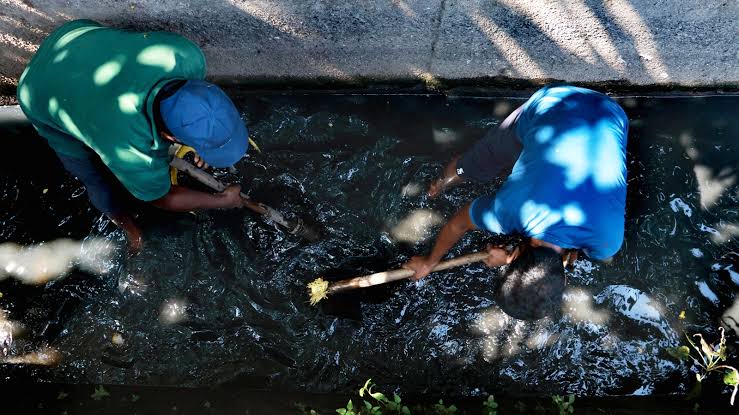
Manual scavenging compensation has become a test of whether India’s ban on hazardous sewer and septic-tank cleaning exists beyond official paperwork. In and around Mumbai, workers continue to enter confined spaces without safety equipment, while families of those who die wait months or years for money that courts and policy frameworks have already recognised as a statutory obligation.
The cases reported from Panvel, Uran, Powai and Govandi show that the issue is not limited to individual contractors or isolated accidents. It involves the way sanitation work is commissioned, the absence of effective monitoring, the treatment of workers engaged through private agencies, and the administrative route through which bereaved families must claim relief. The legal prohibition is clear. The chain of responsibility on the ground remains much less so.
Arjun Chauhan, a contract worker from Panvel, told the Times of India that he has been entering septic tanks and sewers for 15 to 20 years. He is aware that machines are meant to be used and protective equipment is mandatory, but continues to accept the work because it provides an income. Contractors pay him between Rs 700 and Rs 1,000 a day, while some other employers pay between Rs 1,500 and Rs 2,000.
His account captures the economic condition that allows prohibited work to continue. A legal ban does not automatically remove the demand for low-cost manual cleaning, nor does it provide an alternative livelihood to workers who depend on such assignments. When sanitation work is arranged through contractors, buildings or housing societies, the worker may be several steps removed from the public authority that is expected to enforce safety standards.
The consequences become most visible after a death. In December 2024, Chandan Jaiswar, 22, and Vikas Kisan Tak, 33, died after entering a septic tank at a chawl in Uran. They had reportedly gone inside to rescue another worker who had collapsed. An FIR named the contractor, the suction-truck owner and one of the homeowners who had employed them to clean the tank without safety equipment.
Jaiswar’s father, Ratanlal, is still waiting for compensation, according to the report. He now paints vehicles and said that work becomes difficult during the monsoon. Tak’s widow, Archana, 22, his mother and his sister have taken up domestic work to pay rent in Asudgaon, Panvel. Tak had worked as a driver-cleaner on a suction truck and also carried out septic-tank cleaning. His monthly income was about Rs 17,000, mostly paid in cash.
The families’ circumstances demonstrate why compensation cannot be treated as a discretionary payment or a private settlement. The death of a sanitation worker removes household income immediately, while the legal process can take years. Education, rent, food and medical expenses continue during the delay. In Tak’s case, the family said that the suction-truck owner offered to pay for the deceased worker’s child’s education, but the family considered that inadequate because he had been the sole breadwinner.
A similar pattern was reported in Powai, where Akshay Mandal, 23, and Fulchand Kumar Saw, 29, died in November 2025 while cleaning a sewage plant. Mandal’s family received Rs 10 lakh from the contractor on humanitarian grounds but was still awaiting the statutory compensation. The distinction between an employer’s humanitarian payment and compensation owed under law is important: the former depends on private action, while the latter is intended to follow from a public obligation.
The scale of the problem is contested. Data from the National Commission for Safai Karamcharis cited in the report recorded 332 sanitation-worker deaths in 18 states and Union Territories during hazardous cleaning of sewers and septic tanks between January 1, 2021, and June 30, 2026. Maharashtra recorded the highest number, with 58 deaths. At the same time, state data tabled in the House in July 2025 showed zero deaths in Mumbai between 2021 and 2024, a figure disputed by activists.
That contrast is not merely a dispute over numbers. It raises questions about how deaths are classified, which agency records them, whether private workers are included, and whether an incident is recognised as hazardous cleaning when the work is described through another occupational label. If official systems record no deaths while families, police cases and compensation claims point to fatalities, the problem is also one of administrative visibility.
The Centre has also maintained that a survey found no manual scavengers in India. The report notes that activists challenge such official positions, arguing that the survey and the legal definition do not capture the full range of hazardous sanitation work. Workers who enter septic tanks, manholes or sewers may not always be classified as manual scavengers in official records, even when the task involves direct exposure to toxic gases, drowning risks and structural collapse.
This distinction has practical consequences. A narrow administrative category can make the problem appear smaller without eliminating the work itself. It can also affect whether a family is identified, whether an FIR is registered, whether a death is included in official data and whether compensation is processed. The absence of recognition at one stage can become the basis for delay at the next.
The responsibility for payment has itself been contested in Maharashtra. In the Jaiswar and Tak cases, the state reportedly argued that because the workers had been engaged by a private contractor, compensation should be recovered from the employer. The Bombay High Court, however, held in August that the state must pay even when workers are privately engaged and may recover the amount from employers later. The court struck down Item 11 of the 2019 and 2025 government resolutions that required private societies or contractors to pay instead of the state.
That ruling addresses a recurring weakness in outsourced public services. Contracting may change who signs the work order or pays the daily wage, but it does not remove the state’s responsibility to ensure that hazardous sanitation work is not carried out illegally. If families must first establish liability against a contractor before receiving statutory relief, compensation can become dependent on the solvency, cooperation or continued existence of a private entity.
The ruling also separates two administrative tasks that are often conflated: immediate relief for the family and later recovery from the party responsible for the unsafe work. The court’s position, as reported, places the first obligation on the state. That is significant for families who may have no practical ability to pursue a contractor while coping with the loss of a breadwinner.
The compensation framework has evolved through the courts. In 2023, the Supreme Court raised the amount to Rs 30 lakh and directed governments to provide rehabilitation, including employment for the next of kin and education for children. Yet the experience of families in Govandi shows that the higher entitlement does not necessarily translate into timely payment. Nearly seven years after three workers died while cleaning a tank in 2019, each widow had received Rs 10 lakh, while the balance remained pending.
The gap between entitlement and disbursement is therefore central to the story. A compensation figure has limited protective value if families must repeatedly approach authorities, wait for departmental decisions or negotiate between municipal bodies, contractors and state agencies. The report cites advocate Abha Singh, who is pursuing the Govandi cases pro bono, as saying that payment should have been released automatically and that there had been no response from the authority.
Rehabilitation is also broader than a cheque. The Supreme Court’s direction includes employment for next of kin and education for children. The families described in the report are dealing with insecure work, rent pressures and uncertainty over children’s futures. Tak’s widow said that her five-year-old son’s education was her only hope of escaping the situation. That statement illustrates why rehabilitation must be tracked as an outcome rather than treated as an administrative promise.
The institutional problem is complicated by the fragmented nature of urban sanitation. Housing societies, contractors, suction-truck operators, municipal authorities and state departments may all be involved in a single cleaning assignment. The worker, however, remains at the bottom of that chain. Payment may be informal, equipment may be absent, and the legal responsibility may be disputed only after a death.
The report also places the issue within a caste structure. Milind Ranade of the Maharashtra Municipal Kamgar Union said official systems were hiding the reality of caste-based discrimination and that the deaths reflected an attitude that such workers were expected to serve. Bezwada Wilson of Safai Karmachari Andolan described the delays as evidence that governments had not fully acknowledged the extent to which manual scavenging and hazardous cleaning continue.
Those claims should be understood alongside the documented contradiction between the ban and the continuing work. Workers such as Chauhan know that manual entry is prohibited, yet the next day’s wages remain more immediate than the possibility of long-term injury or death. Enforcement that reaches only the post-accident stage cannot prevent the work from being offered or accepted.
The evidence currently establishes three related failures: hazardous cleaning continues despite the ban; deaths and their official recognition remain contested; and families do not consistently receive the full compensation and rehabilitation promised by law. The Bombay High Court’s ruling may clarify who must pay first, but the supplied report does not establish how quickly authorities will implement it or whether pending cases will be cleared automatically.
The developments that require monitoring are therefore concrete: payment of the outstanding compensation in the Jaiswar, Tak and Govandi cases; implementation of the Bombay High Court ruling; identification of workers still engaged in hazardous cleaning; and the quality of official death and occupation data. Until those systems connect prevention, accountability and rehabilitation, the distance between the legal ban and the urban sanitation economy will remain visible in the families waiting for relief.
