


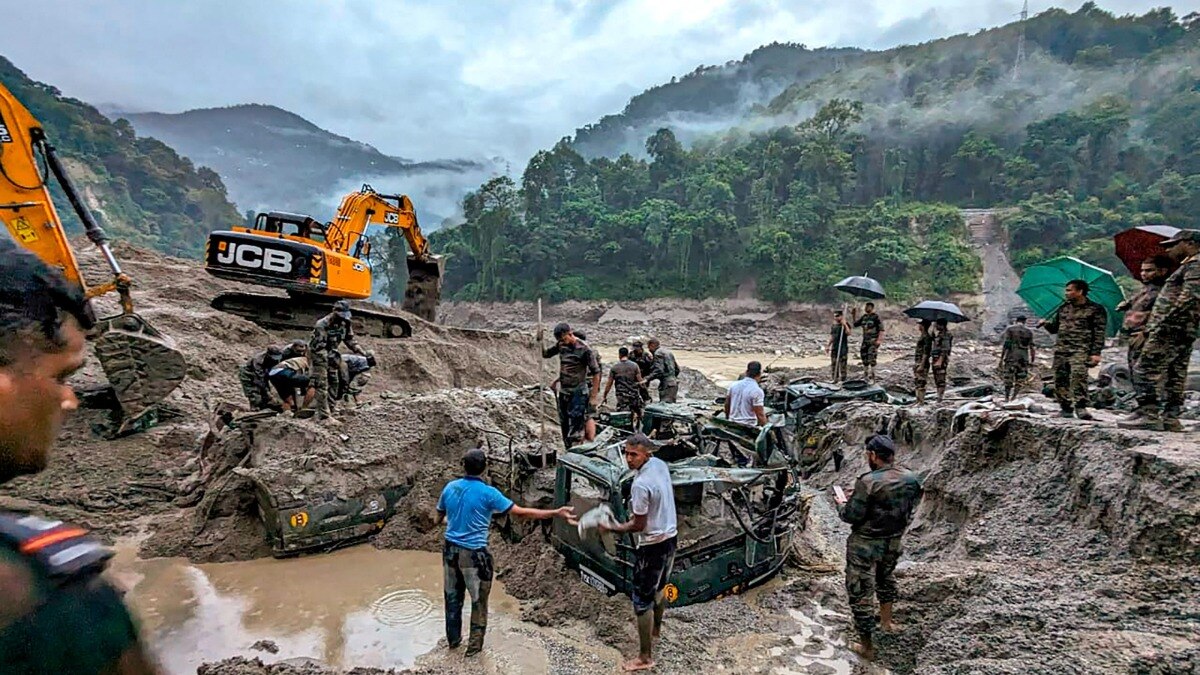
Sikkim’s commission on glacial lake outburst floods and other glacial hazards has submitted an eight-point report to Chief Minister Prem Singh Tamang, outlining measures to strengthen the state’s preparedness, resilience and response systems after the devastating South Lhonak Lake GLOF of October 2023.
Commission chairman Akhilesh Gupta handed over the report to Tamang in Gangtok on Saturday in the presence of Pintso Namgyal Lepcha, Sikkim’s minister for forests and environment. The commission was constituted by the Sikkim government on September 11, 2024, to prepare a comprehensive strategy and roadmap for mitigating glacial hazards across the state.
According to sources in the chief minister’s office, the report contains eight major recommendations. The proposals are aimed at improving Sikkim’s capacity to prepare for, monitor and respond to glacial hazards, while also positioning the state as a model for mitigation in the Himalayan region.
The National Disaster Management Authority has identified 189 glacial lakes across the Indian Himalayan region as highly vulnerable. Around 40 of these lakes are located in Sikkim, including 16 categorised as high-risk lakes. The state government has intensified monitoring of glacial lakes since the October 2023 GLOF.
The South Lhonak Lake outburst caused extensive destruction in Sikkim and renewed attention on the risks posed by glacial lakes located above settlements, roads, bridges and other infrastructure. The commission’s report comes as the state continues to manage a wider set of hazards in its mountainous terrain, including landslides and disruptions to road connectivity.
A landslide above Rimbi in West Sikkim, around 120 kilometres from Gangtok, prompted residents of the affected village to move to safer locations on Sunday. The district administration was monitoring the mudslide and taking measures to mitigate the threat and prevent possible damage to nearby houses, officials said.
The state is also maintaining key links between the hills and the plains. A 58-metre-long Bailey bridge over the Balason river at Dudhia, along the Siliguri-Mirik route, will remain closed for 12 hours from 6am on September 15 for maintenance work. The bridge, constructed jointly by the Indian Army and the state public works department, has a width of 3.75 metres and a load-bearing capacity of nine metric tonnes. No vehicles will be allowed to use it during the closure.
The bridge opened to the public in July and currently provides direct road connectivity between Mirik and adjoining areas, Siliguri and other parts of the plains. Its temporary closure highlights the operational importance of road infrastructure in a region where glacial hazards, landslides and difficult terrain can affect access to communities and emergency services.
Tamang said the Sikkim government would take the commission’s recommendations forward with determination and a spirit of collective responsibility. He said sustained efforts were needed to build a safer, more resilient and climate-conscious state, and expressed confidence that the initiatives arising from the report would help establish Sikkim as a model for glacial hazard mitigation across the Himalayan region.
