


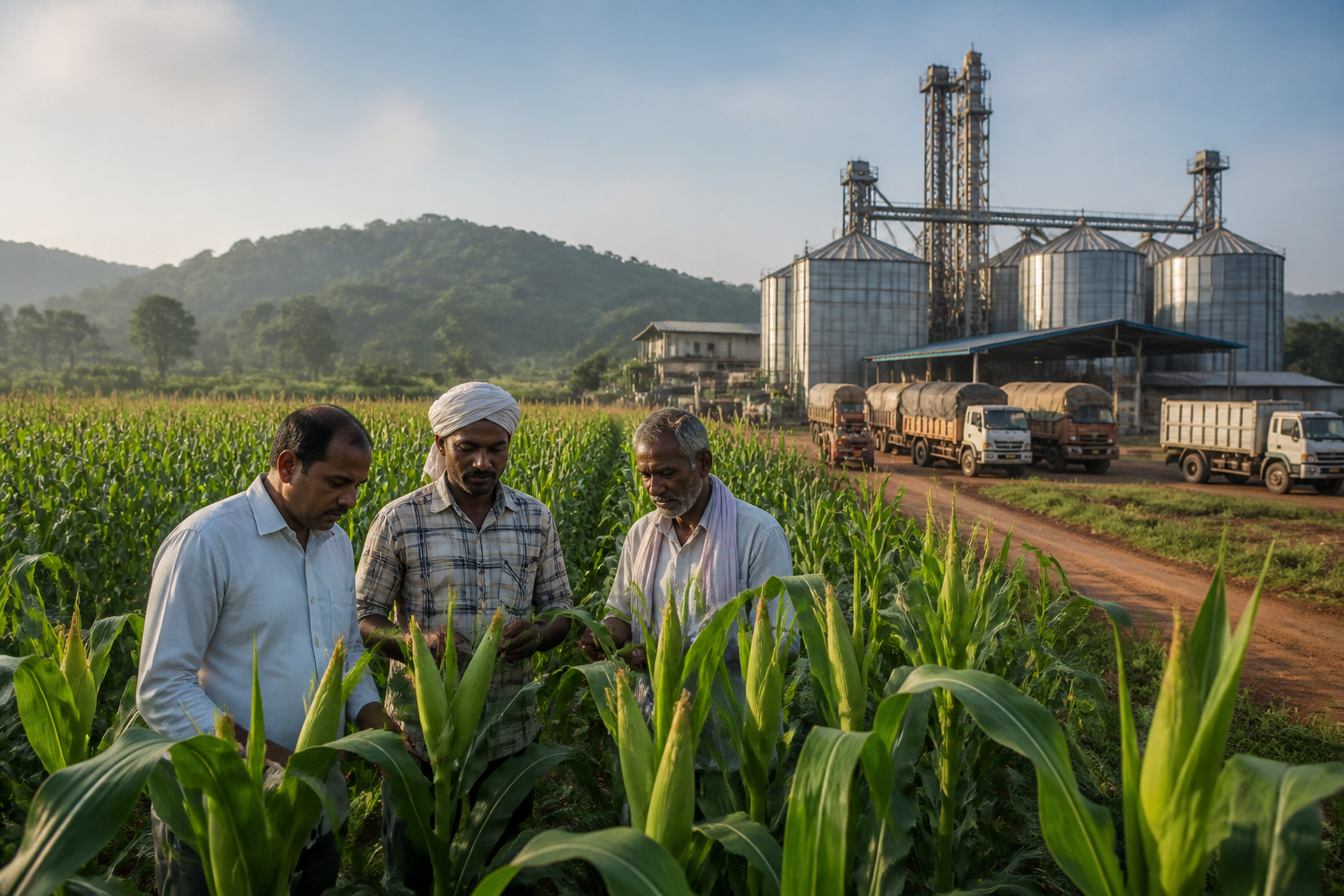
Gourmet Popcornica’s expansion from imported corn premix to a contracted farming network across 40,000 acres offers a case study in how India’s agricultural supply chains are being reorganised around processing, predictable procurement and direct links to large urban consumers. The Chennai-based company says it now works with about 17,500 farmers in eight states, while extending the same model to seeds and oil palm.
The business began with a problem inside India’s cinema economy. When S B P Pattabhi Rama Rao, managing director of Gourmet Popcornica, was working with SPI Cinemas, he noticed that cinemas were importing expensive popcorn premix. Restrictions on corn imports added to the complexity. The company’s initial response was not to start farming, but to source popcorn maize from Nebraska and process it in India.
That model connected an international agricultural supplier to India’s rapidly expanding multiplex market. In 2014, Rao travelled to Nebraska and reached an agreement with Preferred Popcorn, founded by Norm Krug. After a road show with cinema chains, the two companies signed a seven-year exclusive arrangement for India. The agreement was renewed in 2022 for another 20 years, according to the report.
SPI Cinemas became the first customer, followed by Inox and PVR in 2015. But importing the raw material left the business exposed to supply conditions outside its control. The company therefore began testing whether popcorn maize could be grown commercially in India and whether farmers could produce a crop with the characteristics required by processors and cinema operators.
The early results showed why this transition was not straightforward. A 12-acre trial in 2016 produced 28 litres of popped popcorn per kilogram, compared with 38 to 48 litres from US varieties, according to the company. A change in the planting season raised the yield to 38-42 litres in a subsequent 40-acre trial. The improvement allowed the company to increase acreage and develop a more organised procurement system.
This shift from importing and processing to managing cultivation changed the nature of the business. Instead of treating farming as a source of raw material alone, Gourmet Popcornica began linking seed distribution, cultivation, procurement, processing and sales. The company says the Covid period reinforced the importance of controlling the chain from seed and farmer to processing and customer.
The model now covers approximately 40,000 acres in Andhra Pradesh, Chhattisgarh, Telangana, Maharashtra, Karnataka, Uttar Pradesh, Madhya Pradesh and Gujarat. About 8,000 acres are in Chhattisgarh, including the Bastar-Kondagaon region. The company says other states remain at the trial stage.
The Chhattisgarh example is particularly significant because the report places the farming activity in a region previously associated with conflict. Rao describes the change through the sound of popcorn production replacing the sound of gunfire. That statement is a company founder’s account rather than an independently measured assessment of regional transformation, but it points to the wider question of whether dependable agricultural markets can support economic activity in difficult regions.
At the centre of the company’s system are contracts signed before planting. Farmers receive seed after entering into an agreement, are given a price before cultivation begins and receive inputs financed without interest or margin, according to the report. Digital ledgers are used to track costs and earnings, while the company commits to buying the contracted output.
This arrangement attempts to address two forms of uncertainty. Farmers adopting an unfamiliar crop may not know what price they will receive or whether a buyer will be available at harvest. A processor, meanwhile, needs consistent varieties, volumes and quality to supply its own customers. The contract therefore serves both sides: it gives farmers a pre-agreed market while giving the company greater control over its raw material.
The arrangement also shows the institutional importance of the buyer in a processing-led agricultural economy. The company is not simply purchasing whatever reaches a wholesale market. It is shaping the crop through the choice of seed, the timing of planting, the financing of inputs and the commitment to procure output. In effect, the requirements of an urban consumption business are being transmitted back into the production process.
That connection is visible in the company’s origins. Popcorn’s growth as a cinema product created a specialised demand for maize with particular popping characteristics. The company’s farming expansion followed only after the imported supply chain revealed the value of domestic cultivation. The crop was therefore organised around a defined industrial and consumer market rather than introduced as a general agricultural diversification programme.
Gourmet Popcornica says it is India’s largest grower of popcorn maize and the world’s fifth-largest, and claims a 69% share of India’s pre-mix popcorn segment. These are company claims contained in the report and are not independently established by the supplied material. The company projects revenue of Rs 500 crore for FY27, compared with Rs 355 crore in FY26. Its revenue was Rs 9 crore in FY15.
The reported numbers indicate a rapid expansion in the company’s commercial scale, but they do not by themselves establish the profitability or risk distribution of the farming model. The supplied material does not provide farmer-level income comparisons, contract rejection rates, crop-loss data, payment timelines, land-use details or independent verification of the company’s market-share claim. Those gaps matter when assessing whether the model offers a durable improvement for cultivators or primarily creates a more reliable input system for the processor.
The company’s next phase extends beyond popcorn. It is developing corn and mustard seed and has entered oil palm, with around 8,000 acres under cultivation. In leased paddy land, it is experimenting with elevated “islands” for oil palm trees. The report presents these initiatives as part of a common objective: reducing import dependence by building domestic farm-to-market supply chains.
The move into oil palm also brings a different production and land-use context from annual popcorn cultivation. However, the available information does not establish the duration of leases, the terms offered to farmers, the impact on existing paddy production or the performance of the elevated cultivation method. Those issues will determine whether the model can be replicated beyond the company’s current operations.
The business aims to bring more than 100,000 acres under popcorn, seeds and oil palm by FY31 and to reach combined revenue of Rs 1,500 crore by 2032. These are forward-looking company targets, not confirmed outcomes. Their achievement would depend on the availability of suitable land, farmer participation, crop performance, processing capacity, buyer demand and the company’s ability to manage multiple commodities across different states.
The institutional structure described in the report is largely private and contract-based. The company supplies or finances inputs, fixes a price before planting, records transactions digitally and commits to procurement. The report does not identify a government scheme, public subsidy, state procurement guarantee or formal agricultural-market intervention supporting the model. It therefore represents a private supply-chain arrangement operating across several state jurisdictions rather than a documented public agricultural programme.
That distinction is important for understanding what can and cannot be generalised. A company with a captive B2B market, processing capability and long-term commercial agreements may be able to organise cultivation in ways that are difficult for smaller buyers or fragmented traders. The cinema market gave Gourmet Popcornica a specific demand anchor. Other crops and regions may not offer the same combination of predictable consumption and processing requirements.
The numbers nevertheless reveal the scale of the company’s integration. The network covers 17,500 farmers, 40,000 acres and eight states. Chhattisgarh accounts for about 8,000 acres, or roughly one-fifth of the stated cultivated area. The company’s reported revenue rose from Rs 9 crore in FY15 to Rs 355 crore in FY26, with a projection of Rs 500 crore in FY27. These figures describe a business that has moved from a specialised cinema input to a multi-state agricultural platform.
For cities, the relevance lies in the infrastructure between farm and consumer. Urban cinemas and food-service businesses require standardised products, dependable volumes and processing systems. Meeting that demand depends on rural aggregation, roads, storage, processing plants, digital records and commercial contracts, even when the final product is sold inside a multiplex. The popcorn example makes visible a supply chain that consumers usually encounter only at the point of purchase.
The larger question is whether such arrangements can make agricultural diversification less uncertain while maintaining transparency for farmers. The report establishes the company’s operating model and ambitions, but not its independent social or economic outcomes. Future scrutiny would need to examine farmer returns, the enforceability of contracts, crop risks, land arrangements and the performance of the seed and oil-palm businesses.
What the evidence currently confirms is a substantial private effort to connect specialised farming with processing and urban demand. What remains unestablished is whether the model’s results can be reproduced across crops and regions, and how benefits and risks are distributed between the company and participating farmers. The next milestones are the company’s planned acreage expansion, the development of its seed business and the performance of its oil-palm cultivation programme.
