


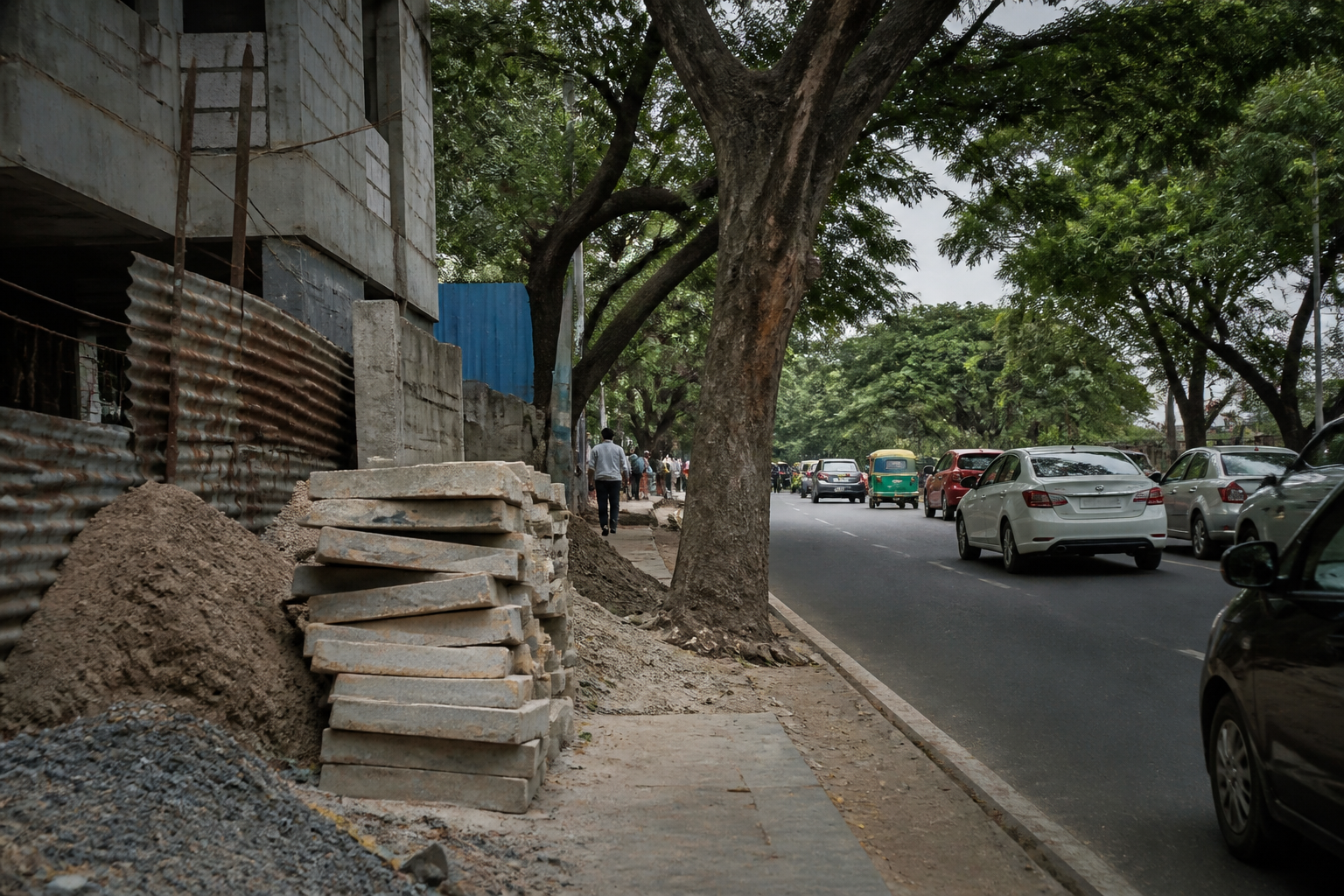
Bengaluru’s latest disputes over tree cutting in Indiranagar and alleged tree poisoning in Vijayanagar point to a problem larger than the loss of individual trees: the city’s permissions and enforcement systems appear disconnected from what happens on the street. At the same time, construction debris blocking footpaths is pushing pedestrians into traffic, showing how environmental and access failures are converging in the same neighbourhoods.
The incidents reported by Bangalore Mirror include allegations that two trees in Vijayanagar were poisoned last month and that a large tree in Indiranagar was felled or substantially cut despite objections from residents and environmentalists. The developments followed an earlier report about three established trees being removed overnight in HRBR Layout. In that case, the Forest Department registered an FIR, according to the report, but residents say unauthorised tree cutting has continued.
The Indiranagar dispute also illustrates how a lawful permission can become difficult to monitor once an operation begins. According to the report, a property owner applied to the Forest Department to trim four branches of a tree beside the property. The Tree Officer and Deputy Conservator of Forests granted permission after the branches were allegedly presented as an obstruction to vehicle parking. Residents and environmentalists then alleged that the operation went beyond the permitted scope and resulted in the felling of a large tree.
The distinction between pruning and felling is central to the controversy. A permission granted for limited trimming is not the same as authorisation to remove an entire tree. Yet, as environmentalist and urban strategist Vinod Jacob told Bangalore Mirror, permissions are being treated as expendable approvals rather than tightly bounded conditions. The report does not establish through a published order whether the Indiranagar operation exceeded its permission, but the allegation exposes the weakness of a system that depends on supervision at the work site.
Sneha Nandihal of I Change Indiranagar said tree-cutting operations should have a designated BBMP official physically present. Her demand addresses the gap between administrative approval and execution. If an officer is involved only at the permission stage, the authority may have limited visibility over the number of branches removed, the equipment used, the condition of the tree after the work and whether the original justification remains valid during the operation.
The allegations also raise questions about the way Bengaluru treats trees when private construction and parking requirements enter the approval process. In the reported Indiranagar case, the stated conflict was between tree branches and vehicle parking. That framing places a public environmental asset in competition with a private access or storage requirement. The wider issue is not whether every tree can remain untouched, but whether the city has a transparent hierarchy for deciding when pruning is justified, how alternatives are assessed and who is accountable when the approved work changes on the ground.
The Forest Department’s role is important because the report identifies it as the authority that received the trimming application and granted permission. The BBMP, meanwhile, becomes relevant through the alleged involvement of its contractors and the demand for official supervision. Residents cited in the report alleged a nexus between BBMP tree contractors and offices connected to elected representatives. That is an allegation, not an established finding, but it identifies an institutional risk: responsibility can become fragmented across the department issuing permission, contractors carrying out the work and local civic officials expected to monitor public consequences.
The earlier HRBR Layout incident shows why enforcement after the event may not be enough. An FIR can initiate investigation and create a formal record, but it does not restore an established tree or reverse the loss of shade and ecological function. The report says residents are asking authorities to hold accountable those responsible for the overnight removal of three trees. Their concern is therefore both punitive and preventive: they want action against a specific incident, but also a system that makes similar removal harder to carry out without scrutiny.
Bengaluru’s footpath problem adds a second layer to the same governance question. Residents of Indiranagar told Bangalore Mirror that construction material has been dumped on footpaths, forcing pedestrians to use the road. They also alleged that a building being constructed by a politician on Krishna Temple Road has resulted in such obstruction and questioned why civic engineers had not cleared it. The report does not independently establish the identity of the builder or the status of enforcement action, but it records a clear public-safety complaint.
Footpath obstruction is often treated as a routine clearance matter. In practice, it determines whether walking is a safe and continuous mode of travel. When construction debris occupies the pedestrian edge, people are required to negotiate with moving vehicles rather than with the built environment. Jacob said some footpaths remain encroached for months, unsigned and unsafe, forcing pedestrians into traffic. This connects a local construction-management failure to the city’s broader mobility system.
The reported complaints also reveal a perceived difference in enforcement. Residents alleged that Bengaluru Central City Corporation engineers discriminate between street vendors and property owners with political influence when clearing footpaths. That claim has not been established in the supplied material, but it matters because consistent enforcement is part of the infrastructure itself. A footpath is not made pedestrian-friendly only by its design; it also requires regular protection from construction storage, private extensions and other forms of occupation.
The reference to Greater Bengaluru Development Minister Krishna Byre Gowda’s efforts to keep footpaths free from encroachment places the local complaints within a wider administrative push. However, the existence of a policy or ministerial priority does not guarantee implementation at the ward or street level. Clearing an obstruction requires an inspection, a notice or other lawful action, coordination with the property owner or contractor, and follow-up to prevent the material from returning. The same implementation chain is visible in tree management: a permission, supervision, compliance check and enforcement response are all needed.
What emerges from the incidents is a city where formal authority exists but street-level accountability remains contested. The Forest Department can grant or deny tree-cutting permissions, while BBMP-linked personnel and contractors may be involved in carrying out or supervising work. Civic engineers are expected to address footpath encroachments, but residents say action is uneven. When institutional boundaries are unclear, residents may know that a violation has occurred without knowing which office must respond or who is responsible for the delay.
The evidence in the report does not establish the scale of Bengaluru’s total tree loss, nor does it provide a citywide database of tree permissions, violations, penalties or footpath-clearance timelines. It therefore cannot support a numerical claim about shrinking green cover or the frequency of illegal felling. It does, however, document a recurring pattern in residents’ complaints: permissions are alleged to be exceeded, enforcement is alleged to be delayed, and public space is alleged to be surrendered to private construction or parking needs.
That pattern is significant because trees and footpaths perform public functions that are not captured by the immediate property transaction. Trees provide shade and help shape the comfort of streets, while footpaths provide a protected route for pedestrians. When trees are removed to facilitate parking or when footpaths are used to store construction material, the cost is distributed across the neighbourhood. Residents who do not own the property bear the loss of shade, walkability and safety.
The central institutional question is therefore not simply whether a particular tree was illegally cut or whether a particular footpath was encroached. It is whether Bengaluru’s enforcement model can prevent small, localised violations from accumulating into a citywide decline in public assets. The reported incidents suggest that approval systems are being judged by residents not only on the quality of their written decisions, but on whether those decisions are monitored and enforced after approval.
For now, the Forest Department’s FIR in the HRBR Layout case, the disputed Indiranagar tree operation and the alleged Vijayanagar poisoning incidents remain separate matters in the supplied report. The next developments that warrant monitoring are any investigation findings, action against proven violations, clarification of the permissions granted in Indiranagar and steps by BCCC engineers to clear and protect the affected footpaths. Those outcomes will indicate whether Bengaluru’s existing rules can function beyond paper approvals and respond effectively at street level.
