


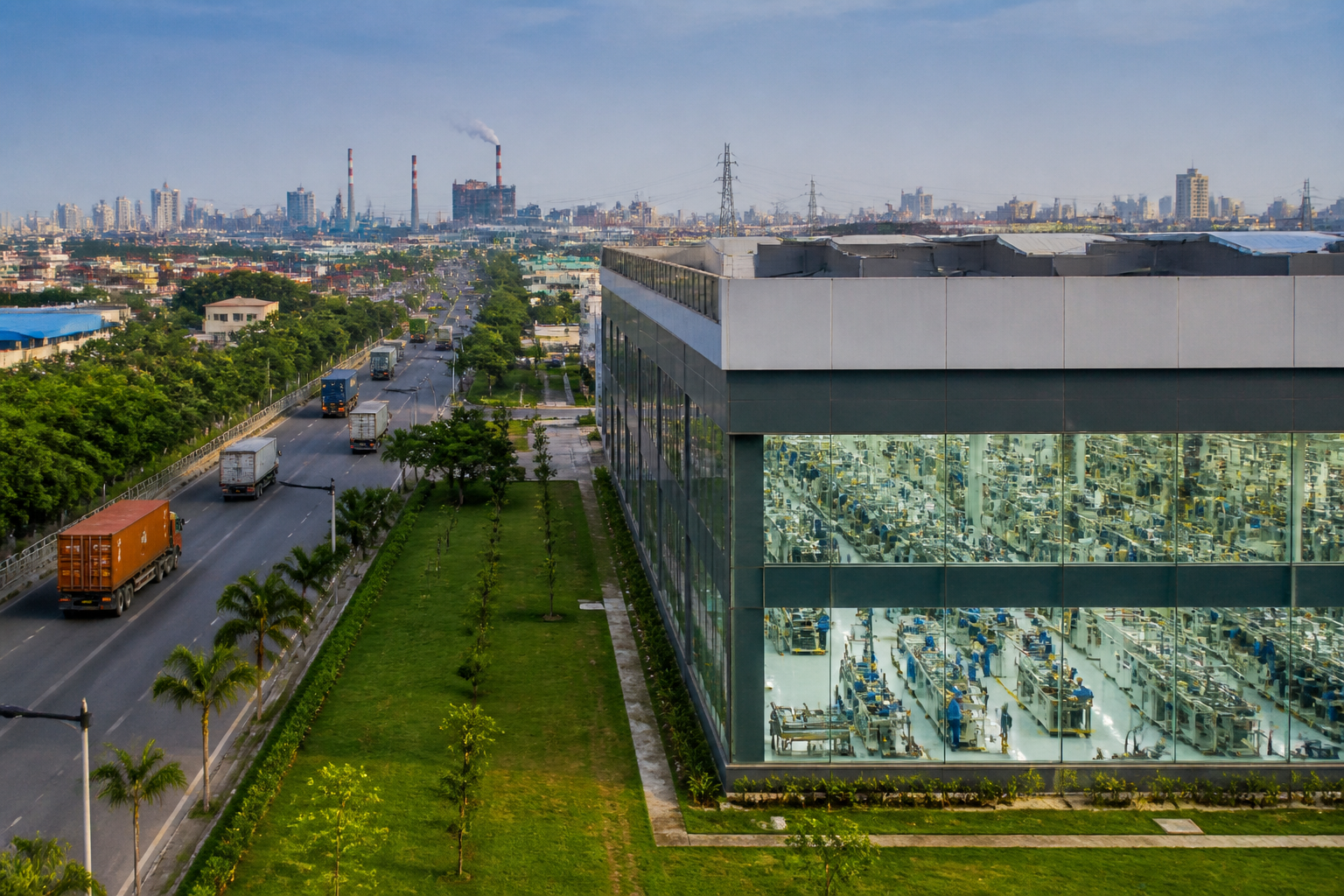
Tamil Nadu is preparing a new industrial policy at a moment when the competition for factories, global capability centres and advanced manufacturing investment is becoming more intense. The central question is no longer whether the state can attract industrial capital. It is whether that capital can create deeper local capabilities in design, research, engineering, intellectual property and global market access.
The policy is being drafted by the state government as companies explore India for new manufacturing and technology operations under China+1 strategies. Industry representatives told the Times of India that companies are making two to three enquiries a day about setting up global capability centres in India, with Bengaluru, Hyderabad and Chennai among the cities being considered. The reported interest reflects both an opportunity and a warning: Tamil Nadu has a strong industrial base, but other locations are competing for the next generation of investment.
The proposed policy therefore arrives at an inflection point. Tamil Nadu’s Industrial Policy 2021 broadly met its original objectives, according to the report, which said the policy targeted Rs 10 lakh crore of investment and 20 lakh jobs by 2025. Manufacturing grew at an estimated 9-10% compound annual growth rate over five years. The issue identified by industry voices is not simply a failure of execution. It is that the economic environment around the policy has changed.
Nithin Chandra, senior partner at Kearney, said Tamil Nadu needed a new industrial policy because the ecosystem for which the existing policy was designed no longer exists. The change is visible in sectors such as electronics, where the state’s exports rose from $5.37 billion in financial year 2022-23 to $14.65 billion in financial year 2024-25. Tamil Nadu’s share crossed 41% of India’s electronics exports, while Kancheepuram became the country’s second-largest exporting district, according to the report.
These figures show the scale of the state’s manufacturing progress, but they do not by themselves show how much value is retained locally. Assembly can generate exports and employment while leaving higher-value activities—product design, component development, engineering, intellectual property and branding—elsewhere. That distinction is at the centre of the debate over the next policy.
P Ravichandran, chairman of the CII Southern Region, said the policy should ensure that every rupee of investment creates more local value, technology, intellectual property and access to global markets. His proposed direction is a shift from measuring investment attracted to measuring what the investment enables Tamil Nadu to do that it could not do earlier.
Electronics provides the clearest test. The next phase could move beyond assembly towards printed circuit boards, displays, connectors, semiconductor design, assembly, testing and marking, industrial electronics and research and development, according to the industry recommendations reported by TOI. The policy challenge is to create the conditions for these activities to develop around existing factories rather than treating each investment as an isolated project.
Tamil Nadu’s automotive base offers a similar possibility. The state already has an auto-component ecosystem, and industry representatives cited battery cells, battery-management systems, power electronics, motors and vehicle research and development as areas where that base could support new capabilities. The transition would depend not only on attracting large manufacturers but also on whether suppliers, engineering institutions and skilled workers can participate in the higher-value parts of the chain.
The state’s experience with non-leather footwear illustrates how a more targeted sector strategy can work. Anchor investors including Hong Fu, Pou Chen, Feng Tay and Evervan Kothari have brought approximately Rs 6,550 crore and more than 86,000 jobs across five districts, with many jobs held by women. Chandra described the model as one in which the state identifies a sector responding to China+1 demand, attracts two or three anchor investors and allows the vendor ecosystem to follow. The next challenge, he said, is moving into design, branding and higher-value materials.
That model also shows why industrial policy is an urban and regional development instrument, not merely an investment department document. Jobs, supplier networks, transport links, industrial land, housing, training institutions and public services must connect if a sector is to expand beyond a few large facilities. The reported footwear investments span five districts, while the proposed expansion of global capability centres could extend beyond Chennai to Coimbatore, Madurai and Tiruchirappalli.
Global capability centres are identified in the report as the most immediate opportunity. Chennai’s GCC headcount has roughly doubled since 2019, and the state could differentiate itself through centres linked to engineering and manufacturing rather than limiting the model to general corporate services. Such a strategy would connect Tamil Nadu’s industrial base with its information technology and professional talent, but it would also require coordination between industry, higher education, skills and infrastructure authorities.
Ramkumar Ramamoorthy, partner at Catalincs and former chairman and managing director of Cognizant India, argued that these departments need a mechanism to work together. He proposed an overarching body, compared with the Department of Military Affairs, with the authority to define ownership and encourage interaction between academia, industry and government. The proposal points to an institutional problem: a policy can identify priority sectors, but fragmented responsibilities can prevent those sectors from developing as integrated ecosystems.
The same concern applies to skills. Prof Vidya Mahambare of Great Lakes Institute of Management said industrial subsidies should align with local skills. Otherwise, she argued, public money could subsidise jobs filled by migrant workers without addressing youth unemployment in the state. She also said sector-specific subsidies may not create significant new employment and that broad-based infrastructure should receive greater attention.
This is a crucial distinction in incentive design. A capital subsidy can help a company establish a facility, but it does not automatically create a local supplier base, improve training outcomes or build research capacity. The new policy will have to decide whether incentives should be linked to employment quality, local procurement, technology transfer, research activity or supplier development. The reported discussion does not establish the final design, but it identifies the policy choices now before the government.
Chandra cited Gujarat’s “choose your incentive” mechanism as a possible benchmark. Under that approach, investors can choose between options such as a capital subsidy, an interest subsidy or relief on power tariffs. For Tamil Nadu, the relevance is not that one state’s model can simply be copied. It is that incentive design could become more flexible and better matched to the needs of different sectors and project types.
The state is also looking beyond electronics and GCCs. Defence and aerospace are identified as another growth area. Tamil Nadu’s defence industrial corridor has attracted more than Rs 23,000 crore against a target of Rs 75,000 crore by 2032, according to the reported figures. Advanced capital goods, heavy engineering, shipbuilding and the blue economy are also being considered as opportunities.
These sectors could strengthen existing industrial capabilities rather than replace them. A Viswanathan, president of the Madras Chamber of Commerce and Industry, said new-age sectors such as semiconductors, artificial intelligence, aerospace, space, advanced manufacturing, GCCs and research and development should complement traditional industries. Existing sectors can supply inputs to emerging industries and consume their output, creating a wider industrial network.
That approach is different from announcing a list of fashionable sectors and offering each one a separate incentive. It treats industrial development as a system in which established manufacturers, technology firms, universities, MSMEs and infrastructure providers reinforce one another. The practical test will be whether the policy assigns responsibility across departments and provides the physical and institutional infrastructure needed for these connections.
The state industries minister, S Keerthana, said Tamil Nadu was not moving away from manufacturing and would support sectors that generate employment at scale while creating a differentiated framework for newer, higher-value industries. That position reflects the central balancing act. Traditional sectors remain important employers and export earners, while future growth is expected to come from activities requiring more advanced technology and specialised skills.
Tamil Nadu’s reported strengths are substantial: an established manufacturing base, supplier networks, export orientation and a growing presence in electronics, automotive production, footwear, GCCs, defence and aerospace. Its vulnerability is that these strengths may not be sufficient if competitors offer faster approvals, more flexible incentives or better-integrated ecosystems. The new policy must therefore be judged not only by the number of projects announced but by the capabilities that remain after the investment is made.
The evidence presented in the report confirms that Tamil Nadu has already built a platform for industrial expansion. It does not yet establish how the new policy will allocate incentives, coordinate departments, measure local value creation or distribute benefits across districts. Those details will determine whether the next phase produces more assembly lines or a deeper industrial economy. The policy’s eventual framework, its implementation body and its sector-specific targets will be the developments to monitor.
