


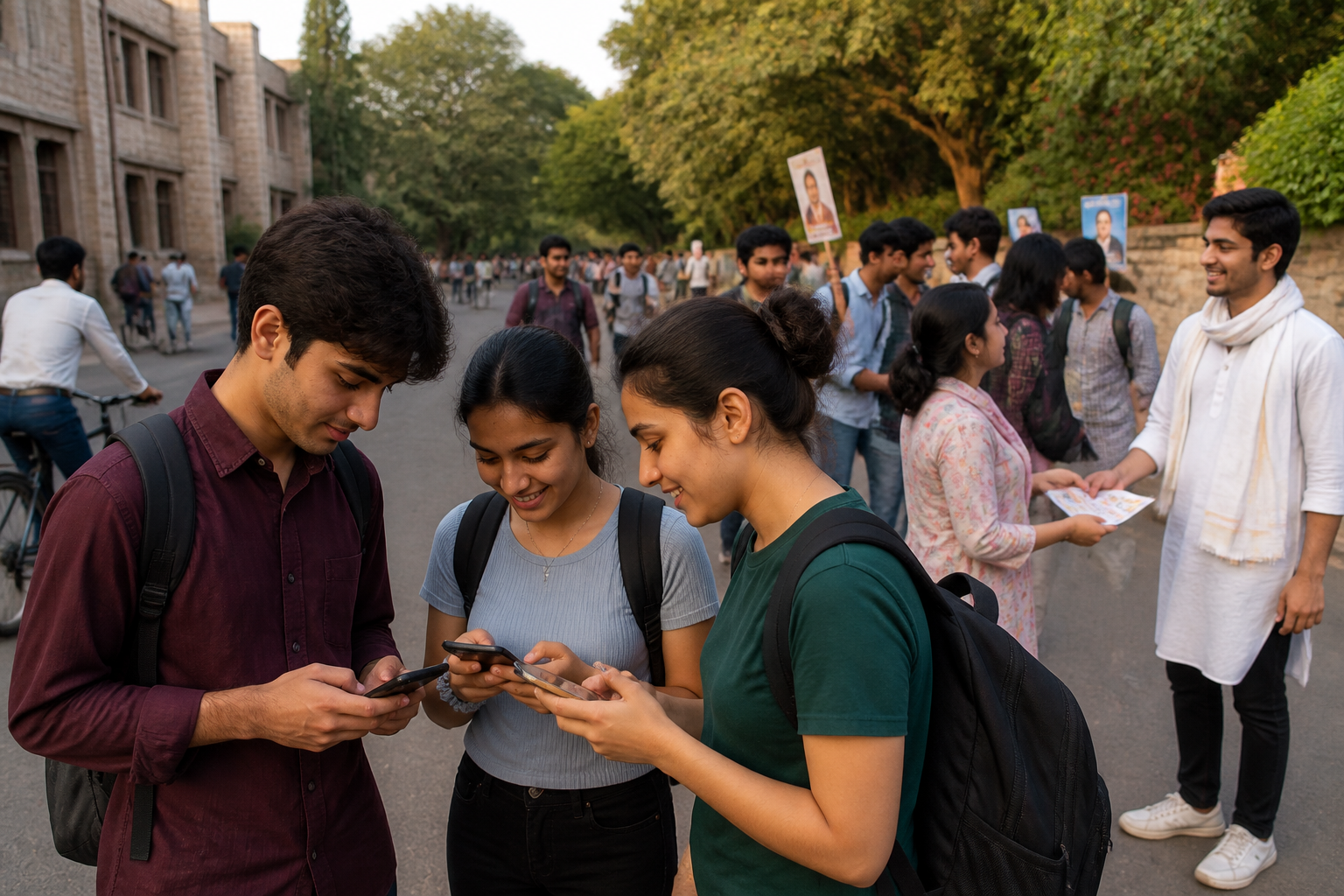
Delhi University’s DUSU elections 2026 are testing whether student politics can move from crowded college gates to the phone screens where a large part of the university’s Gen Z electorate already spends its time. With polling scheduled for September 18, candidates are using reels, influencers, campus humour and short issue-based videos to build visibility, while restrictions on posters and printed campaign material are accelerating the shift away from conventional campaigning.
The change is more than a new publicity tactic. It is altering the physical and institutional footprint of the election. Earlier campaigns depended on marches, meetings, face-to-face canvassing, handwritten or printed material and personal networks. The current contest retains some of that physical activity, but digital platforms are becoming central to how candidates introduce themselves, project a personality and circulate campaign messages.
That transition reflects two pressures operating at the same time. Candidates need to reach young voters through platforms that are already part of their daily routines. The university, meanwhile, has an interest in reducing the visible and environmental costs associated with electioneering, including defacement of public spaces and pollution linked to conventional campaign material. Social media offers a way to expand reach without placing the same volume of physical material on campus walls, gates and surrounding public areas.
The format of the message is changing along with its location. A long speech or formal manifesto requires students to stop, listen or read. A reel can deliver a candidate introduction, a joke, a visual symbol or a campus issue within a few seconds. A student involved in election-related content told the Times of India that long speeches may struggle to hold attention, while short videos can work when they are entertaining, relatable or connected to an issue on campus.
This makes the campaign less dependent on a single public encounter. A student who does not want to stop outside a classroom or attend a meeting can encounter campaign material while using a social platform, decide whether to watch it and scroll past it if it does not hold attention. Kavya, a first-year student quoted in the report, described this control over when and whether to engage as one of the advantages of digital campaigning. The change therefore affects not only how candidates communicate, but also how students experience political communication in a university environment.
The physical campus has not disappeared from the campaign. Candidates continue to campaign in person, and the election remains rooted in university spaces and student concerns. But the phone screen is becoming an additional political venue, one with different rules from a college gate or public meeting. Visibility is no longer created only by the number of people a candidate can reach directly. It is also shaped by the ability to produce content that travels quickly, fits platform conventions and creates a recognisable online identity.
The content creator quoted in the report pointed to the creative possibilities of this environment. Cars, props and other visual elements can be incorporated into videos even when comparable displays cannot be part of physical campaigning on campus. Editing, humour, online trends and platform-specific formats allow campaigns to package political messages for a Gen Z audience. These techniques give candidates more control over the visual presentation of their public image, but they also make campaign communication more dependent on production choices and digital fluency.
That is why the role of content creators is expanding. They operate between student politics and social media culture, translating campaign material into formats designed to attract attention online. Their contribution is not limited to recording speeches or documenting rallies. It includes deciding how a candidate looks, speaks and appears in a short video; selecting the tone of an edit; and presenting campus concerns in a form that can compete with the wider stream of online content.
The result is a broader definition of a candidate’s image. A manifesto and a speech remain part of the formal campaign, but they no longer determine public perception on their own. Appearance, manner of speaking, humour, participation in online trends and the ability to present a campus concern can all contribute to a candidate’s digital identity, according to the report. Campaigning is consequently becoming a process of continuous image-making rather than a series of occasional physical events.
For Delhi University, this evolution has a direct administrative dimension. A senior university official said the administration would encourage social media campaigning because it could help limit defacement of public spaces and reduce pollution associated with conventional campaign materials. The statement places digital campaigning within the university’s effort to manage the environmental and spatial consequences of elections, rather than treating it only as a matter of student preference.
The distinction matters because the physical form of campaigning leaves consequences beyond the election period. Posters and printed material occupy walls and other visible surfaces, while large campaign displays and gatherings can affect how campus spaces are used. The source report does not quantify the volume of waste, the area affected by defacement or the reduction expected from online campaigning. It does, however, establish the administration’s stated rationale: moving campaign activity online may reduce pressure on public spaces and lower pollution associated with physical materials.
At the same time, digital campaigning does not eliminate the need for rules or oversight. It shifts campaign activity into a space where content can be produced and distributed rapidly, potentially reaching thousands of students within hours. The report does not provide details of a separate university framework for monitoring online campaign expenditure, influencer involvement, content standards or the disclosure of campaign affiliations. Those questions are not resolved by the shift to reels, but they become more relevant as online activity moves closer to the centre of election strategy.
The available evidence also shows a change in the speed and durability of political attention. A physical meeting, march or personal interaction creates a direct encounter. A digital video can travel further and faster, but its visibility may be brief. Students cited in the report noted that a reel can reach thousands within hours and disappear from attention just as rapidly. This creates a campaign environment in which candidates must repeatedly compete for visibility, even after a message has been published.
That cycle is different from the campaign culture remembered by alumni who contested or observed earlier elections. Deepali Raina, a Delhi University graduate from 2010, recalled that candidates then relied heavily on physical outreach, word of mouth, face-to-face canvassing, meetings, marches and personal networks. In that system, being known required a candidate or campaign worker to enter the spaces where students gathered. The relationship was slower and more personal, but its reach was tied closely to physical effort and existing networks.
The present system does not simply replace those networks with technology. Instead, it combines campus politics with the habits and incentives of social platforms. A candidate may still need physical recognition on campus, but digital content can extend that recognition beyond a meeting or a conversation. Conversely, an online campaign may generate visibility without guaranteeing sustained attention or direct engagement with students. The source material establishes this tension but does not show whether digital reach translates into votes.
That uncertainty is central to understanding the DUSU elections 2026. The move online clearly changes the route through which campaign messages are delivered, the people involved in producing them and the way candidates construct a public persona. It also responds to institutional concerns about posters, defacement and pollution. What remains unestablished in the available evidence is whether the new format produces deeper engagement, broadens participation, changes electoral outcomes or merely rewards campaigns that are better at producing attention-grabbing content.
The election will therefore provide a visible test of digital campaigning within a large university setting. Its immediate significance lies in the coexistence of two campaign environments: the physical campus, where candidates continue to meet students, and the online feed, where messages can be edited, shared and consumed on demand. Delhi University’s stated encouragement of social media campaigning indicates that this is not only a candidate-led adaptation. It is also becoming part of how the institution manages the space, material impact and public image of its elections.
