


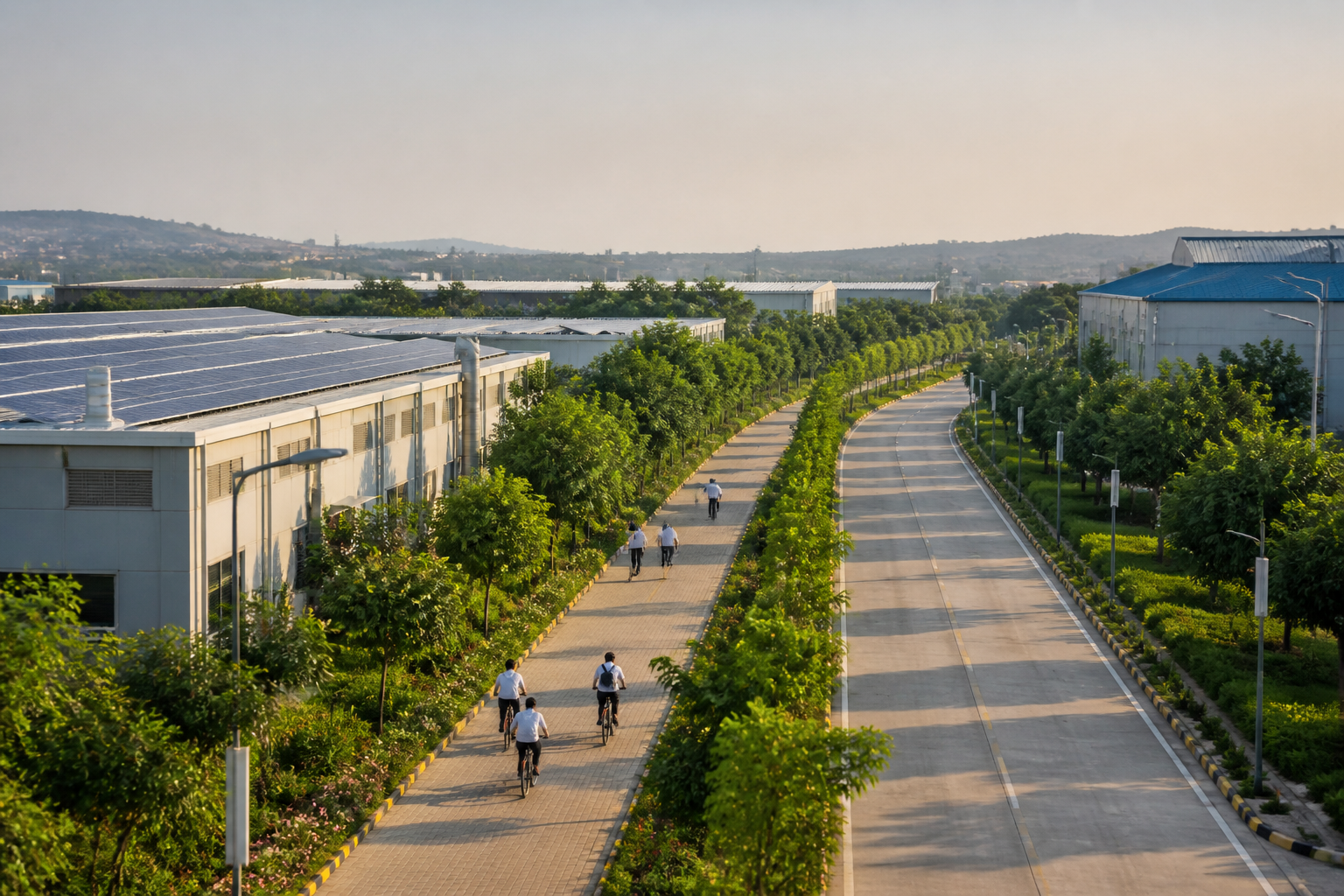
Karnataka’s proposal to plan future industrial zones as green corridors is more than an environmental design suggestion. It points to a larger shift in how the state may need to treat industrial expansion: not as isolated land-and-factory projects, but as urban systems that consume power, shape mobility, alter local temperatures and place pressure on fragile natural landscapes.
The proposal emerged during the Confederation of Indian Industry’s Karnataka ESG Summit 2026, where industry representatives urged the state government to build sustainability into new industrial corridors from the beginning. Guruprasad Mudlapur, chairman of the CII Karnataka State Council, specifically referred to emerging industrial development beyond Bengaluru and argued that such zones could be created as green corridors with sustainability practices already embedded in their design.
That distinction matters. Retrofitting environmental measures after an industrial area has been laid out is usually more difficult than incorporating them into the original plan. Roads, drainage, power networks, worker housing, logistics routes and open spaces are often fixed early in a project’s development. If vegetation, active mobility and renewable energy are treated as later additions, they can become fragmented or expensive interventions rather than core infrastructure.
The discussion also shows that the idea of a green industrial corridor is broader than planting trees along roads. In the account of the summit, green corridors would incorporate vegetation and open spaces into industrial areas, help protect or connect fragmented natural habitats, promote active mobility and cool urban environments. Renewable power would be another central component, with the aim of ensuring that smaller businesses do not have to struggle individually to secure cleaner energy.
This is particularly significant for the planned expansion of industrial activity beyond Bengaluru. The phrase “Beyond Bengaluru” signals a development objective that is also a spatial planning challenge. As economic activity spreads to other parts of Karnataka, new industrial zones will need supporting infrastructure and services. The design choices made at the start could determine whether these areas become more liveable employment districts or car-dependent enclaves surrounded by stressed water, energy and transport systems.
The CII discussion does not establish that Karnataka has already approved a specific green industrial corridor, nor does it provide a project-wise design, budget, location list or implementation timetable. What it does establish is that industry representatives are asking the state to make environmental suitability a planning priority and to provide frameworks that can convert broad ESG goals into operational requirements.
Pavitra Shankar, convener of CII’s environmental sustainability panel, said government intervention would need to go beyond vision. Industries, she said, also require frameworks to ensure that progress is made. That observation identifies one of the central institutional questions: which authority will define a green corridor, what standards will apply, how compliance will be assessed and whether the requirements will be uniform across industrial zones.
Without such frameworks, sustainability can remain dependent on individual companies. That may produce uneven outcomes inside the same industrial area. One unit may invest in renewable electricity, efficient buildings or employee mobility, while neighbouring facilities continue to operate with little connection to a shared environmental plan. A corridor-level approach could address systems that no single enterprise can manage alone, including common power infrastructure, public transport, walking and cycling routes, stormwater networks, open spaces and habitat protection.
The emphasis on smaller and medium enterprises is also important. Guruprasad Mudlapur said renewable power should be fully ensured in advance so that every MSME does not have to struggle separately. This frames clean energy access as an infrastructure and governance issue rather than only a corporate responsibility. If renewable power is available through the industrial zone’s common systems, smaller firms may face fewer barriers than they would if each had to arrange its own supply, technology and financing.
However, the supplied evidence does not specify the proposed energy model. It is not clear whether the reference is to dedicated renewable generation, contracted power, shared infrastructure or another arrangement. Nor does the discussion establish how costs would be allocated between the state, industrial-area authorities, developers and individual businesses. Those details will determine whether the proposal becomes a practical advantage for MSMEs or remains an aspiration attached to future expansion.
The summit also placed governance within companies alongside government responsibility. N Venu, Hitachi Energy’s managing director for India and South Asia, argued that corporate governance should be measured through how companies treat employees, shareholders and partners, how they create ecosystems and how they handle minimum-wage compliance. His comments widen the scope of ESG beyond energy and emissions. A green industrial corridor would still be incomplete if its environmental infrastructure existed alongside weak labour standards or poor accountability within participating companies.
This broader definition of governance is relevant to the built environment because industrial districts are not used only by factories. They are workplaces, transport destinations and often the basis for surrounding settlements. Decisions about wages, worker facilities, access routes and public services influence how the district functions beyond the boundary of an individual plot. The source material does not provide evidence about existing worker housing or mobility conditions in Karnataka’s industrial areas, but it establishes that these questions belong within the governance conversation.
The strongest warning at the summit came from Srinivasulu, chairman of the Karnataka State Pollution Control Board. He said climate change had become a business and economic risk rather than only an environmental or developmental concern. His formulation that “climate intelligence must therefore become business intelligence” places climate considerations alongside land, labour, capital and finance in boardroom decisions.
For industrial planning, that means climate risk cannot be treated as a separate compliance file. It is connected to the reliability of power, the performance of transport networks, worker safety, operating costs and the long-term suitability of a site. Yet the supplied report does not identify the specific climate risks assessed for any proposed corridor. It does not state whether flood exposure, heat, water availability, drought or extreme weather has been mapped for future zones. These omissions are precisely where a policy framework would need to become more specific.
The temperature examples cited at the event provide a warning about changing baseline conditions. Thimmegowda MN, a professor at the University of Agricultural Sciences, Bengaluru, said Bengaluru was expected to experience 28-29 degrees Celsius during the first week of September but had already reached 33 degrees. In north Karnataka, he said, temperatures had reached 37 degrees against an expected 33 degrees.
These figures are event statements rather than a complete climate dataset, and they should not be treated as a full assessment of Karnataka’s temperature trend. They nevertheless show why industrial expansion cannot rely only on historical assumptions about local weather. Higher temperatures can affect outdoor work, indoor cooling demand, energy use and the comfort of people walking or cycling through large employment districts. The proposed use of vegetation and open spaces is therefore linked to the functioning of the industrial area, not only to its visual appearance.
The cooling function of green infrastructure also raises a question about maintenance. The report describes the role of vegetation and open spaces but does not explain who would own, irrigate, protect or monitor them. In an industrial corridor, such spaces would need to coexist with heavy vehicles, utility lines and security requirements. Their effectiveness would depend on design standards and long-term management, not simply on the number of trees planted during construction.
Active mobility presents a similar planning test. The CII description identifies walking and cycling as elements of a green corridor, but no details are available on the proposed network, distances between workplaces and transit points, road safety arrangements or the needs of shift workers. A corridor can contain footpaths on paper and still remain difficult to navigate if its roads are designed primarily for freight and private vehicles. The evidence supports active mobility as a stated objective, but not yet as an implemented plan.
The policy landscape emerging from the summit therefore has three layers. The first is state-level spatial planning: deciding where industrial expansion should occur and what environmental suitability means before land is developed. The second is shared infrastructure: providing renewable power, open spaces, mobility systems and other services at the scale of the corridor. The third is company-level governance: ensuring that businesses meet environmental, labour and partner-related responsibilities after they begin operations.
The Karnataka State Pollution Control Board’s participation adds a regulatory dimension, but the report does not specify how its role would connect with industrial-area developers, local governments, planning agencies or power authorities. That institutional coordination will be important because a corridor crosses administrative boundaries in practical terms even when it sits within a defined jurisdiction. Workers may live in one settlement, travel through another, depend on a regional power network and use roads maintained by different agencies.
The proposal’s significance lies in bringing these systems together before new industrial zones are built. If industrial expansion is approved plot by plot, the opportunity to coordinate energy, mobility, landscape and climate resilience can narrow quickly. If it is planned as a connected urban district, environmental performance can become part of the area’s basic infrastructure.
At present, the evidence confirms a strong industry demand for clearer government frameworks and an official recognition that climate change is an economic risk. It does not confirm a final Karnataka policy, a sanctioned corridor, financing arrangements or measurable standards. The next stage will therefore be to watch whether the state converts the summit’s principles into planning rules, project requirements, renewable-energy provisions, mobility standards and accountable maintenance systems.
Karnataka’s green industrial corridor discussion is ultimately a test of whether sustainability will be added to industrial expansion after the fact or designed into it from the first drawing. The difference will determine whether new employment districts merely distribute factories across the state or create more resilient pieces of the urban system.
