


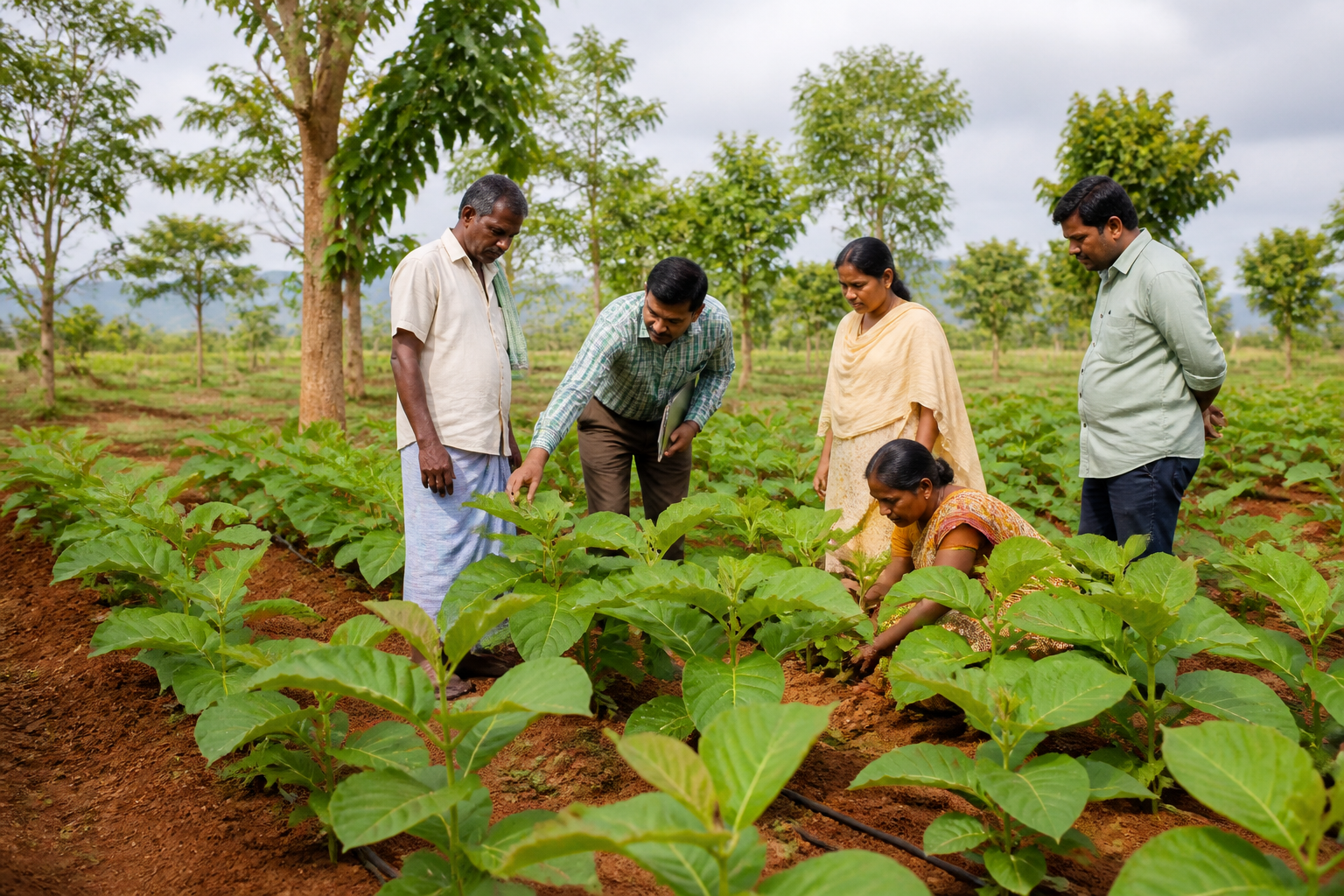
Tamil Nadu has launched five high-yielding teak clones for farmer plantations, beginning a state-backed programme that will establish 55,000 seedlings across demonstration plots in 20 districts. The initiative is being implemented by the Green Tamil Nadu Mission (GTM) with the Institute of Forest Genetics and Tree Breeding (IFGTB), Coimbatore, to improve timber productivity and strengthen long-term returns for growers.
The five clones, identified as IFGTB-TG-1 to IFGTB-TG-5, were developed and evaluated by IFGTB. According to GTM mission director I Anwardeen, they were selected for faster growth, better girth development, straight and cylindrical bole form, and higher potential timber productivity. Field observations have shown promising performance across different agro-climatic regions, he said.
The programme is designed around clonal teak’s potential to produce a cleaner and more uniform bole with reduced branching. This can increase the proportion of commercially usable timber compared with ordinary seedling teak, according to the officials cited in the announcement. The quality and form of the tree are important because they influence the quantity and grade of timber that can eventually be harvested.
Tamil Nadu already has significant farmer interest in teak cultivation. Officials estimate that between 22 lakh and 30 lakh teak seedlings are planted annually in the state. The new programme seeks to improve the productivity and quality of those plantations by making superior planting material available and allowing farmers to observe its performance under local conditions before wider adoption.
As an initial step, GTM has identified 20 districts considered suitable for teak cultivation. Each district will have three demonstration plots, taking the total to 60 plots. Farmers are being identified and connected to these sites so that they can monitor the growth and performance of the five clones in their respective regions.
The mission is adopting a polyclonal approach rather than depending on a single clone. Officials said different clones can respond differently to pests, diseases and climatic stress, making a mixture of clones a way to reduce concentration risk within the plantation programme. The approach also allows performance to be assessed across varying local growing conditions.
A key implementation challenge is the production of sufficient clonal planting material. Unlike conventional seed-based propagation, the new clones require vegetative multiplication through tissue culture. GTM therefore plans to establish and strengthen tissue-culture facilities in the state, creating capacity to produce and distribute clonal material for farm forestry.
IFGTB director Rabi Kumar said the institute and GTM would soon sign a memorandum of understanding covering teak and cashew. The proposed agreement includes the development of “vegetative multiplication gardens” and systems to supply superior planting material to farmers regularly through research nurseries.
The immediate milestone is the establishment of the demonstration plots and the observation of the clones under district-level conditions. The programme’s wider rollout will depend on the availability of planting material, the performance recorded at the plots and the development of the proposed nursery and tissue-culture network.
