


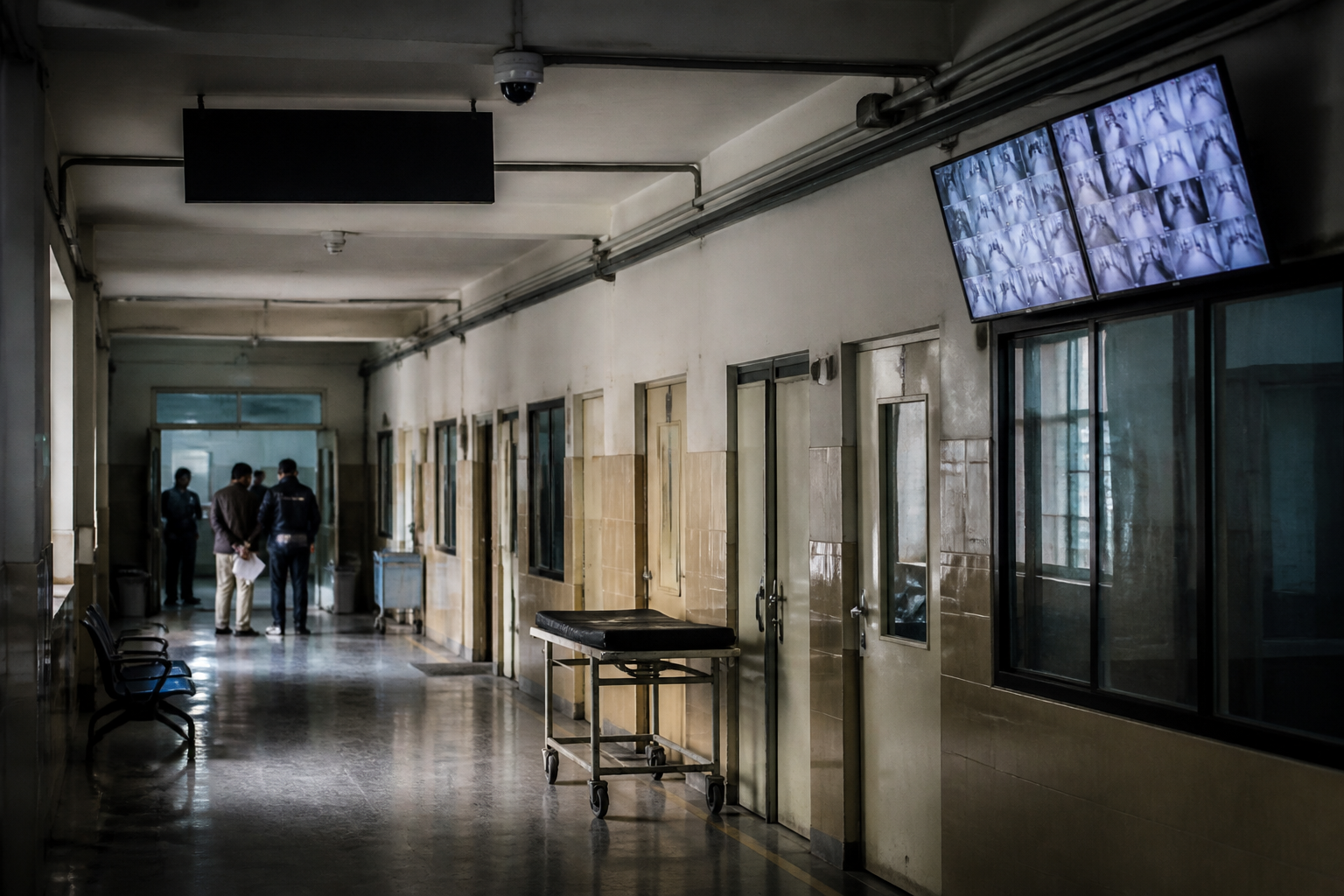
Fresh scrutiny of unclear CCTV footage has reopened a central question in the RG Kar case: how could several unidentified people move around the hospital’s respiratory medicine department and adjoining corridors on the night a doctor-trainee was raped and murdered, and what does that reveal about the institution’s security and investigative record?
The Central Bureau of Investigation is examining footage showing multiple people wearing Bermuda-style shorts and towels around their necks and bodies in the vicinity of the respiratory medicine department during the early hours of 8 August 2024, according to a report by Anandabazar. Investigators have questioned nursing staff on duty that night, along with doctors and doctor-trainees working in nearby wards, to establish who the people were. A process of identifying them has also begun.
The footage is reportedly unclear and lacks continuity. Investigators appear only once or twice at some locations, making it difficult to establish a complete sequence of movement. That limitation is important because CCTV evidence can show presence and direction, but fragmented footage may not by itself establish when a person entered an area, whom they met or whether they was connected to the crime.
The issue has emerged during a fresh investigation ordered by the Calcutta High Court. The report says the CBI began the reinvestigation after a special investigation team was constituted under the court’s direction several months ago. Kolkata Police and the CBI had previously identified civic volunteer Sanjay Roy as the sole accused in the case, and he has been convicted.
However, questions about the case’s institutional and evidentiary gaps have not disappeared with that conviction. The report notes that judges of the Supreme Court and the trial court had questioned how Sanjay Roy reached the interior of the hospital during the night. The victim’s family has also maintained that more than one person was involved. The CBI’s renewed examination of CCTV material therefore sits at the intersection of two unresolved issues: the identity of people visible in the footage and the adequacy of the earlier reconstruction of events.
The dispute is not simply about whether a blurred image can identify a suspect. It is also about how a public hospital records movement, preserves surveillance material and accounts for access to sensitive areas during night duty. The available report does not establish that the people visible in the footage participated in the crime. It establishes only that investigators are examining their presence and questioning staff who may be able to identify them.
According to the report, a lawyer representing the victim’s family said a pen drive containing similar footage had been handed to the CBI, but alleged that the agency had not clearly explained the progress of its examination. The investigators said they had reviewed the footage provided by the family but were not making all information public in the interest of the investigation. This difference reflects a recurring tension in judicially monitored investigations: families seek visibility into investigative progress, while agencies restrict disclosure when they believe it could affect the process.
The case also contains a separate evidentiary trail relating to the hours before the murder. Investigators recorded written statements from four fellow students who, according to the family’s account, had eaten with the doctor-trainee in the seminar hall on the night of the incident. A representative of the food delivery company who delivered the meal also provided a written statement. These statements were compiled into a report and submitted to judges of the Calcutta High Court, who examined it.
The significance of these statements lies in the attempt to reconstruct the victim’s movements and interactions before the crime. In a case where the available CCTV footage is described as fragmented, witness statements and delivery records may form part of the broader timeline. But the report does not disclose the contents of those statements or indicate what conclusions the court or investigators drew from them. Their existence should therefore not be treated as proof of any particular version of events.
The CBI has so far questioned 30 people, according to the report. Investigators have also said that they found multiple inconsistencies during the inquiry. The nature of every inconsistency has not been publicly detailed in the supplied account. That lack of detail limits what can responsibly be concluded, but it confirms that the reinvestigation is not confined to identifying the figures in the footage. It is examining whether the established account of the night is internally complete.
For a large public medical institution, this is an administrative question as much as a criminal-investigation question. Hospitals operate through multiple layers of access: patients, relatives, doctors, students, nurses, contractors, service workers and security personnel may all move through the premises. When an incident occurs in an interior clinical area, the quality of access records, surveillance coverage, staff recollection and evidence preservation becomes critical to both public safety and the credibility of the investigation.
The supplied report does not provide details of the hospital’s access-control system, the number or placement of cameras, the duration for which footage was preserved, or whether any surveillance gaps resulted from equipment failure or operational decisions. It also does not establish whether the unidentified people were authorised to be in the area. Those are among the questions that would need documentary or official answers before conclusions can be drawn about institutional responsibility.
The judicial role has consequently become central to the case. The Calcutta High Court has received reports on witness statements and is overseeing the renewed investigative process. The investigators are withholding some information, while the family continues to press for clarity about footage and the possibility of multiple people being involved. The court’s scrutiny provides an institutional mechanism for testing whether investigative steps are being taken and whether unresolved inconsistencies are being addressed.
The case therefore illustrates the limits of treating a conviction as the end of a public institution’s accountability process. A conviction establishes the outcome reached against the convicted person; it does not automatically answer every question about access, evidence handling, possible witnesses or the conduct of the investigation. In the RG Kar case, those questions remain active because the courts, the family and investigators have identified gaps that require further examination.
What the available evidence confirms is narrower than some public claims. Investigators are reviewing unclear CCTV footage, have questioned hospital personnel, have begun an identification exercise and have examined statements from people connected to the victim’s movements before the incident. Thirty people have been questioned, and investigators say they have found inconsistencies. What remains unestablished is whether the blurred figures were connected to the crime, whether more than one person was involved and how the surveillance material fits into the final reconstruction of the night.
The next stage of the case will depend on whether the CBI can identify the people visible in the footage, clarify the reported inconsistencies and present its findings to the Calcutta High Court. Until those steps are completed, the footage remains an investigative lead rather than proof of a wider criminal conspiracy.
