


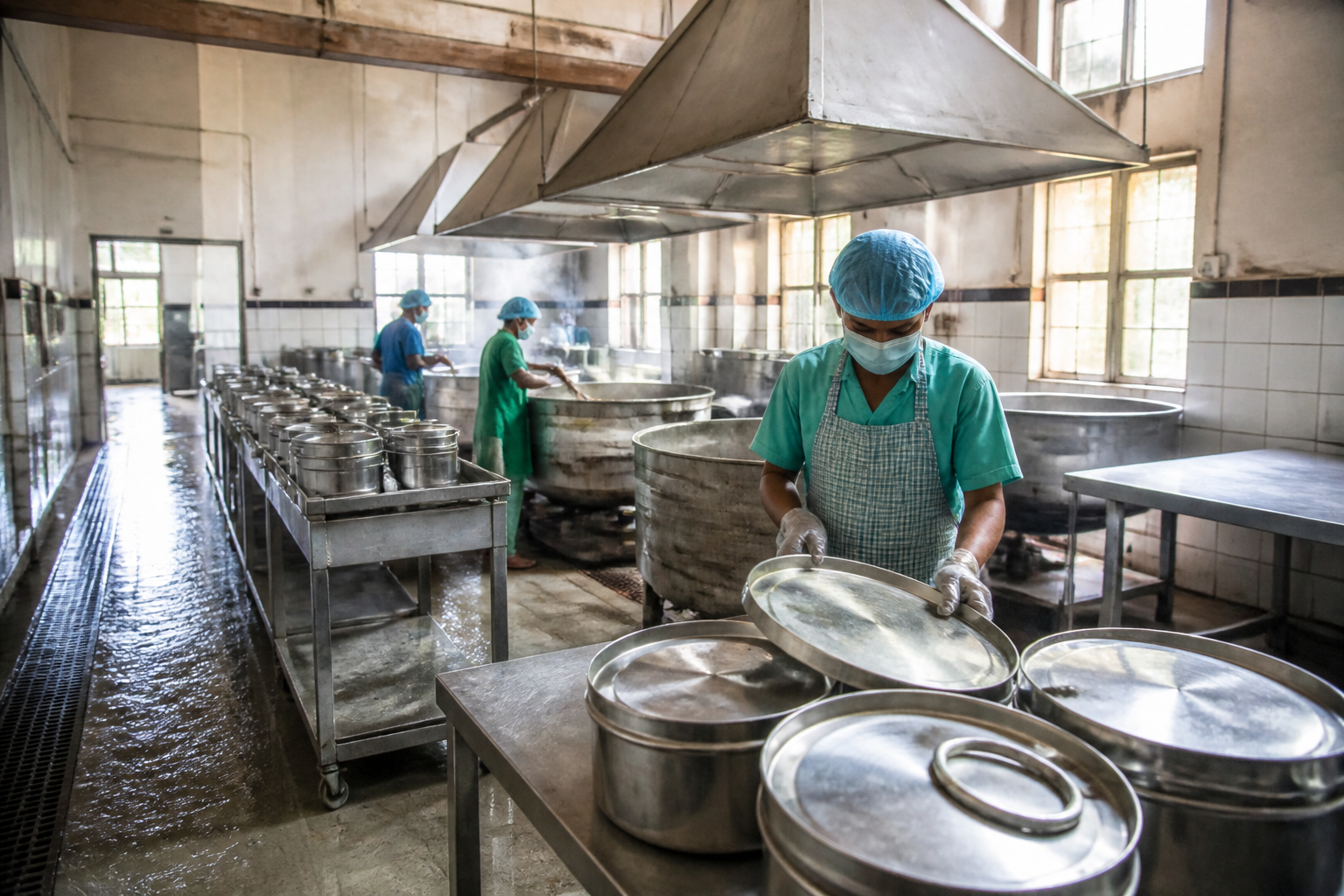
A report on hospital kitchen hygiene at Kolkata’s RG Kar Medical College and Hospital and Nil Ratan Sircar Medical College has exposed a troubling gap in the city’s food-safety regime: private restaurants are being inspected and penalised, while kitchens serving some of the city’s most vulnerable people appear to receive less consistent scrutiny.
The report by Anandabazar – Kolkata describes kitchens where workers bathe beside cooking areas, clothing is dried inside the food-preparation space, powdered spices are stored in open packets, drains are clogged with waste and food trolleys move between wards and kitchens without an evident separation from cooking operations. These are not merely housekeeping lapses. In a hospital, where meals are prepared for patients whose health may already be compromised, the kitchen is part of the care system.
At RG Kar Medical College and Hospital, the kitchen is located close to the administrative offices and prepares food twice a day for approximately 2,000 patients. The report observed cooking utensils and potato sacks along an unclean access passage. Inside, workers were seen bathing at a tap in the kitchen, while clothes dried on a line. Open packets of powdered spices were kept on rusted, grease-covered racks. A narrow passage nearby was being used for construction work, with cement and sand dust entering the surrounding area.
The report also noted that food trolleys used to distribute meals across wards enter the kitchen after moving through the hospital. That movement creates a basic operational question: how are cooking areas, food-distribution equipment and patient-care spaces being separated and cleaned? The report does not establish whether contamination occurred or whether patients fell ill because of the conditions. It does show that visible sanitation controls appear inconsistent with the level of care expected in a hospital food operation.
The comparison with the city’s private food sector is central to the story. Kolkata Municipal Corporation recently took action against 40 food establishments. According to the report, 35 of those cases involved alleged failures to maintain hygiene and cleanliness. Some establishments were shut, while others were given 15 days to correct deficiencies. The enforcement drive covered businesses ranging from small roadside outlets to prominent establishments selling biryani, pizza and sweets.
That campaign has created a clear public standard: food businesses must maintain clean cooking spaces, store ingredients safely and correct violations within a defined period. The condition of government hospital kitchens raises the question of whether the same standard is being applied to public institutions. If open spice containers, dirty drains, uncovered ingredients and inadequate worker clothing are treated as violations in restaurants, the public interest in correcting them is at least as strong in a hospital kitchen.
## The institutional gap behind the kitchen door
Food safety in a hospital is not the responsibility of one worker or one kitchen manager alone. It depends on a chain of administrative controls: procurement, storage, preparation, cooking, cleaning, staff hygiene, equipment maintenance, waste disposal and distribution. A failure at any point can affect meals served to patients, attendants and hospital staff.
The report’s observations at Nil Ratan Sircar Medical College and Hospital show how several of these functions can overlap in a confined space. The kitchen has seven gas stoves assigned to different preparations, including rice, dal, vegetables, fish, meat and tea. The final stove stands beside a drainage channel that, during the visit, was covered with accumulated waste and resembled an open drain. The floor had an oily layer of dirt, and a grinding stone was lying on it. Open powdered turmeric was also visible.
The kitchen manager, Prosেনjit Ghosh, said the drain would be cleaned and claimed that a mesh prevented rats and cockroaches from entering. He also said that the grinding stone was not being used for spice preparation. A worker making dough for the evening rotis was reportedly not wearing a cap or shirt at the time of the visit. The manager said the worker was putting on the required clothing.
These responses point to an important distinction between compliance on paper and compliance during operations. A kitchen may have equipment, instructions or inspection records, but food safety depends on whether those controls are followed continuously. A cap worn only when an inspection is underway, or a drain covered by a mesh but filled with waste, does not resolve the wider problem of routine maintenance.
The report says managers at both RG Kar and NRS claimed that officials from the municipal corporation and health department had inspected their kitchens. However, the health department report reviewed by the publication did not mention those inspections. That discrepancy is significant because inspection is useful only when it produces a recorded finding, a corrective order, a deadline and a follow-up check.
## A higher food allocation does not guarantee safer meals
The financial context makes the issue more pressing. The allocation for food served to patients in government hospitals was reportedly increased from Rs 56.40 per patient in 2017 to Rs 110 in the latest budget. The increase is intended to support the quality and quantity of patient meals, but a larger allocation cannot by itself ensure safe preparation.
Food budgets must operate alongside procurement standards, storage systems, kitchen design, cleaning schedules, pest-control arrangements and staff training. If ingredients are purchased but stored in open containers, or if a kitchen receives more money but lacks functioning drainage and clear movement protocols, the additional allocation may not translate into a safer meal. The report does not establish how the increased amount is being spent at individual hospitals. It does, however, show why expenditure and food quality cannot be assessed separately from the physical condition of the kitchen.
The state health minister has reportedly visited several hospitals to assess whether patients are receiving meals in line with the revised allocation and expressed dissatisfaction with food at some locations. The health department has also issued instructions on kitchen cleanliness, according to RG Kar’s medical superintendent and vice-principal Saptarshi Chattopadhyay. He said the hospital was following those instructions but that changing long-standing practices would take time.
That response identifies the institutional challenge but does not answer the operational one. Hospitals need to demonstrate what has changed, who is responsible for each corrective measure and when compliance will be checked again. The 15-day correction period used for private restaurants offers one possible reference point, but the report does not indicate whether a similar deadline exists for government hospitals.
## What a hospital food-safety system must control
Public health specialist Kajalkrishna Banik told the publication that food quality depends on several linked stages. Workers involved in food processing, preparation and distribution must maintain personal cleanliness. The place and method of preparation must be monitored. Vegetables, fish, meat, eggs and rice must be stored according to requirements. The person serving food must also maintain hygiene, and the utensils used for service must be disinfected.
The significance of this framework is that it moves the discussion beyond the appearance of a kitchen. Clean floors matter, but they are only one part of the system. Ingredient storage, staff clothing, drainage, pest control, cleaning of trolleys and the separation of construction activity from food preparation are equally relevant. A kitchen can look orderly during a brief visit and still fail if these controls are not documented and maintained throughout the day.
The report found a comparatively better condition at Calcutta National Medical College. Its floor was broadly clean, and the utensils and spice containers did not have the sticky black residue observed elsewhere. The kitchen manager said officials from Borough VII had collected samples of cooking materials approximately two weeks earlier, although the results had not yet arrived. This comparison is useful because it shows that conditions are not uniform across government hospitals and that improvement is possible within the same city system.
But the absence of a sample report also highlights the limits of inspection without disclosure and follow-through. A sample collection becomes meaningful only when the result is recorded, communicated to the institution and connected to action where necessary. The available report does not say whether the samples from Calcutta National Medical College passed or failed, leaving the outcome unresolved.
## The larger governance question
Kolkata’s food-safety drive has made enforcement visible in restaurants. Government inspectors have questioned businesses over dirty utensils, open ingredients and inadequate storage, and municipal action has followed in some cases. The hospital kitchens described in the report show that food safety is not simply a matter of regulating commercial establishments. It is also a public-institution management issue.
Hospitals occupy a special position in this system. Patients may be unable to choose their meals, inspect the kitchen or seek an alternative when food appears unsafe. Many depend entirely on the institution for nutrition during treatment. This makes transparency, inspection and corrective action more important, not less.
The available evidence establishes a mismatch between the standards being enforced in parts of the private food sector and the conditions observed in two government hospital kitchens. It does not establish the scale of the problem across all hospitals, nor does it prove that any patient illness resulted from the reported conditions. Those questions require inspection records, laboratory results, complaint data and responses from the relevant municipal and health authorities.
The immediate administrative test is therefore straightforward: whether the hospitals can document corrective action, whether inspections are formally recorded, whether food and environmental samples are tested, and whether follow-up visits confirm compliance. Until those steps are visible, the increase in food allocation and the issuance of hygiene instructions will remain inputs rather than proof of safer meals for patients.
