


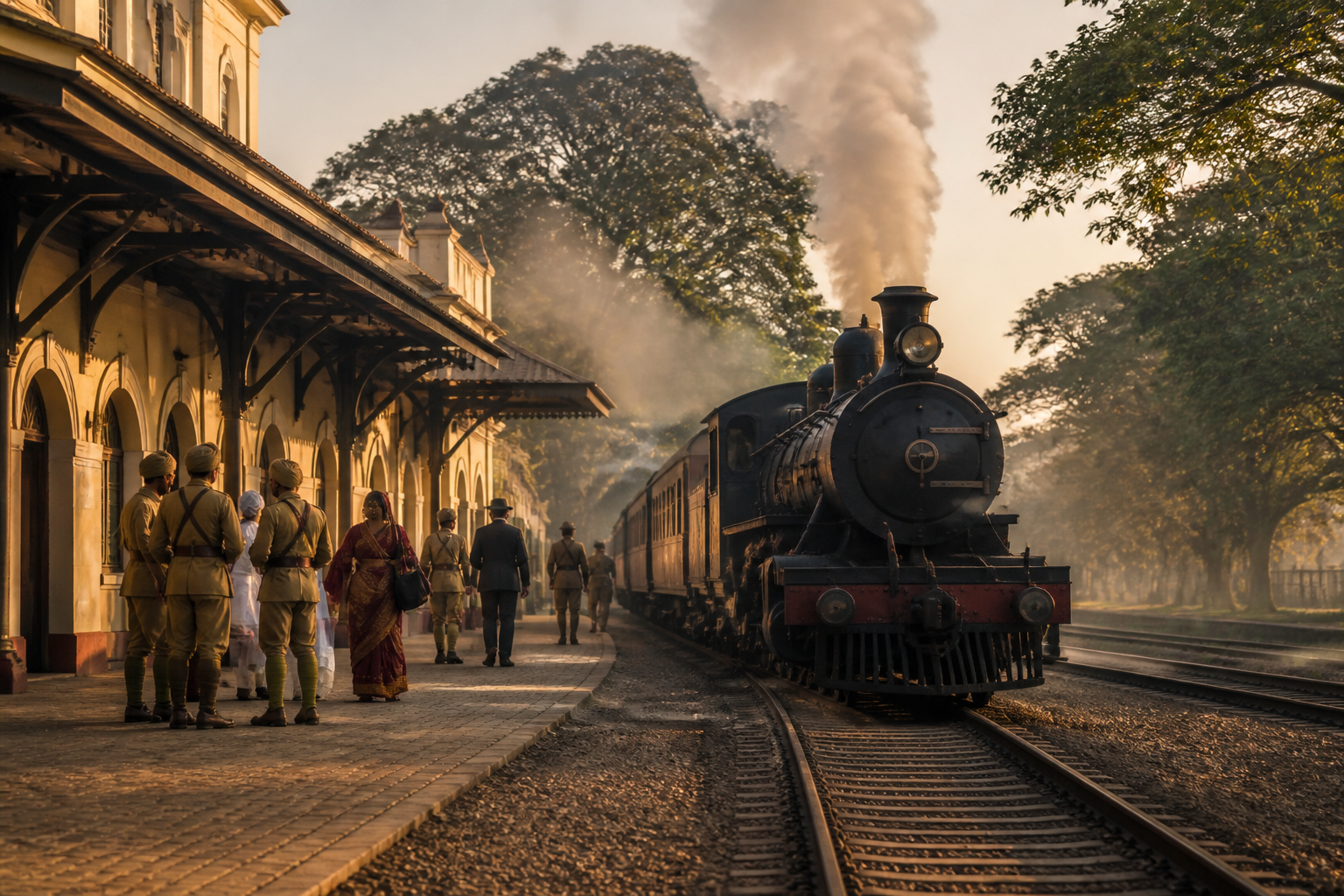
Bengaluru railway history began with a 149-km line that did far more than bring steam locomotives to the city. When passenger services began between Bengaluru Cantonment and Jolarpettai on August 1, 1864, the connection tied Bengaluru to the wider railway network, strengthened the movement of troops and goods, and began changing the city’s relationship with the surrounding region.
The first service was operated by the Madras Railway Company, one of the private companies formed to develop railway lines in British India. The train became popularly known as the Bangalore Mail. Its arrival marked the beginning of a transport system that would later extend into central Bengaluru and connect the city with Mysore, Tumkur and other parts of southern India.
The significance of the line lies not only in its age but in the purpose for which it was built. Bengaluru’s first railway gateway was the Cantonment station, located in what was then known as the Civil and Military Station. The station had been completed by 1862 and was initially associated with the movement of British Indian troops. The first passenger service to Jolarpettai therefore emerged from an infrastructure system shaped substantially by military and administrative requirements.
That origin offers an important way to understand the city’s early transport geography. Infrastructure was not introduced evenly across Bengaluru or designed first around the daily needs of the entire urban population. It arrived through an institutional priority: connecting an important military centre with Madras and the expanding railway system. Passenger and commercial uses grew around that initial purpose.
### A railway connection built around military needs
The railway provided a direct link between Bengaluru Cantonment and Jolarpettai, a railway town in what is now Vellore district of Tamil Nadu. From Jolarpettai, passengers could connect to trains travelling towards Madras and other parts of the railway network. The route consequently made travel towards the Madras Presidency easier and positioned Bengaluru within a larger regional system.
Historical accounts cited in the source indicate that the first passenger service carried large numbers of Tamil-speaking soldiers serving in the Cantonment. This movement of people became part of Bengaluru’s changing demographic and economic landscape. The railway was thus not simply a line over which trains moved. It created a channel through which workers, soldiers, administrators, goods and later passengers entered and left the city.
The route also passed through the Kolar Gold Fields region. Its connection to that area later became important as mining activity expanded, although the earliest service was particularly useful for military movement and administration. The railway’s value therefore developed across several overlapping systems: defence, regional trade, resource extraction and urban growth.
This pattern is familiar in the history of major infrastructure. A line may begin as a project for one institutional purpose but produce wider effects once it becomes available to civilians, businesses and local economies. In Bengaluru’s case, the railway helped shift the city from a relatively contained inland settlement into a node connected to a much larger network.
### The limits of early rail travel
The first railway journey was technologically significant but operationally slow by modern standards. Historical accounts indicate that trains travelled at around 12 miles per hour on parts of the route. A journey between Jolarpettai and Bengaluru could take many hours, with one account describing journeys of close to 10 hours when stops were included.
Passengers also encountered conditions that underline the distance between nineteenth-century rail travel and the present system. Reports cited in the source say travellers could emerge covered in ash from the steam locomotive. The railway offered a new form of regional mobility, but it was not yet a fast, comfortable or frictionless service.
That contrast is useful when examining infrastructure as a process rather than a finished product. The first rail connection did not instantly solve mobility challenges. It established a corridor, a station and a set of operating practices that could later be expanded. Its transformative effect came from creating a dependable physical link where none had existed before.
The early railway also depended on communication systems that appear basic compared with today’s networked operations. Stations used Magneto phones, which had no dial or number pad. An operator turned a handle to make the instrument at the other end ring. Railway signalling relied on coloured lamps, with red indicating stop or emergency, yellow meaning proceed and blue indicating that the line or operation was not yet ready.
These systems show how transport infrastructure is inseparable from governance and coordination. Tracks and trains alone cannot create a functioning railway. Stations, signals, communications, operating rules and trained staff must work together. Even the earliest Bengaluru connection required an institutional framework capable of managing movement across multiple locations.
### From Cantonment gateway to citywide network
For its first 18 years, Cantonment station remained Bengaluru’s main railway gateway. The railway eventually extended to Bengaluru City station in 1882, marking a new phase in the city’s transport history. The shift brought rail infrastructure closer to the city’s central areas and created a second major point from which routes could develop.
The expansion was accompanied by new services. A Bangalore–Channapatna service began in 1881, while the Bangalore–Mysore line was completed in 1882. The sequence is important because it shows that Bengaluru’s railway development did not stop with its first external connection. The initial line became the foundation for a broader regional network.
This progression also reveals how transport networks influence the shape of cities. The first line connected Bengaluru outward to Jolarpettai. Later extensions connected the city to destinations across the region. As stations and routes multiplied, the railway’s role moved beyond military logistics and became part of the city’s passenger, commercial and administrative geography.
The distinction between Cantonment and City stations also reflects a wider urban question: where infrastructure is placed affects which parts of a city receive early access to mobility and economic opportunity. Bengaluru’s first station was associated with the military Cantonment, while the later City station helped bring the railway into another important part of the urban area. The network’s geography was therefore also a record of institutional priorities and urban expansion.
### What Bengaluru’s first railway reveals
The history of Bengaluru’s first railway line demonstrates that infrastructure creates more than physical connectivity. It reorganises relationships between a city and its hinterland, changes the movement of people and goods, and can influence demographic and economic patterns over time.
The source does not establish that the railway alone caused Bengaluru’s later growth. It does, however, document several channels through which the connection mattered: access to the wider railway network, easier movement towards Madras, military transport, passenger services, links to the Kolar Gold Fields region and subsequent expansion towards Mysore, Tumkur and other destinations.
The city’s railway story also illustrates the importance of institutional continuity. The line introduced in 1864 was not an isolated project. It was followed by extensions, new stations and additional services. The railway’s long-term significance came from the network built around the original connection.
For contemporary urban planning, that history offers a grounded lesson. A transport project should be understood not only by its opening date or route length but by the institutions, destinations and communities it connects. Its effects depend on what happens after inauguration: whether more routes are added, whether stations are integrated into the city, and whether the system serves different categories of users.
Bengaluru’s first train therefore represents both an event and an urban process. The 149-km line began as a connection shaped by military priorities, but it became the first layer of a wider railway network. From the Cantonment station to the later City station and onward links to Channapatna and Mysore, the railway helped turn mobility into one of the forces reshaping Bengaluru.
What remains clear from the historical record supplied is that the city’s rail system was built incrementally. Its first connection opened access to a larger network in 1864; later extensions broadened that access within two decades. The development of Bengaluru’s railway geography was consequently not a single act of construction but a sequence of institutional and infrastructural decisions that changed how the city functioned.
