


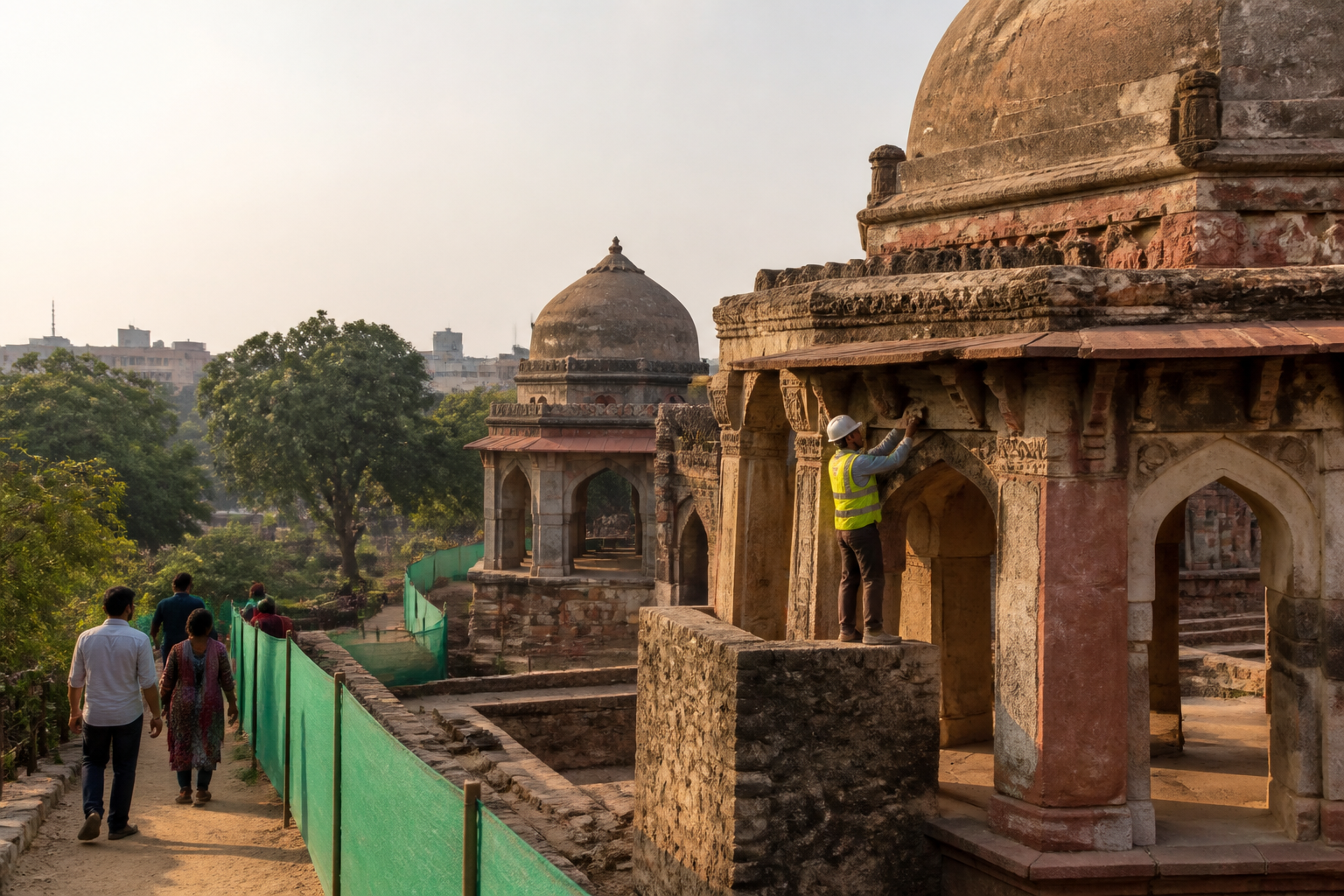
Delhi’s heritage landscape is becoming harder to access as the Archaeological Survey of India carries out repairs, conservation and visitor-facility upgrades across several major monuments. Information obtained through the Right to Information Act shows that parts of Hauz Khas, Jantar Mantar, Agrasen ki Baoli, the Red Fort, Qutub Minar complex and other protected sites have been closed or placed under access restrictions, while the Delhi Circle has spent almost its full annual allocation on conservation-related work in each of the last five financial years listed.
The disclosure is important because it shows that the experience of visiting a historic monument is shaped not only by ticketing and tourism management, but also by the physical condition of the site and the nature of conservation work underway. In Delhi, where monuments are embedded within dense neighbourhoods and are used simultaneously as tourist destinations, educational spaces and public landmarks, even partial closures affect how the city’s cultural infrastructure is experienced.
The RTI response, a copy of which was obtained by news agency PTI, states that restrictions have been imposed at several monuments among the 10 Delhi sites covered by the information request. It does not specify when every restriction began. That distinction matters: some closures are linked to current repair or improvement work, while others, particularly inside the Red Fort and Qutub Minar complex, have existed for years.
At Hauz Khas, access has been restricted in parts of the monument complex while structural repairs are carried out. The complex was built around a large medieval reservoir created during the reign of Alauddin Khalji, with later structures associated with Sultan Firoz Shah Tughlaq, including a madrasa and a tomb. Its heritage value therefore lies not in a single building but in the relationship between water infrastructure, religious and educational institutions, funerary architecture and the surrounding urban landscape.
The restriction at Hauz Khas illustrates the complexity of conserving monuments that remain part of an active city. The site is located within a major urban neighbourhood rather than an isolated archaeological zone. Any repair programme must therefore manage both the protection of historic structures and the movement of visitors through a complex that includes multiple buildings, open areas and historically significant landscape elements. The supplied RTI information does not specify the exact sections under repair or the completion schedule.
Jantar Mantar and Agrasen ki Baoli, both in central Delhi, have also seen restrictions on visitor movement. Jantar Mantar was built in 1724 by Maharaja Sawai Jai Singh II and is known for its large masonry instruments used for astronomical observation. The restriction at such a site affects access to structures whose meaning depends partly on scale, spatial arrangement and the ability of visitors to understand how the instruments occupy the site.
Agrasen ki Baoli presents a different conservation challenge. As a historic stepwell, its significance is connected to its recessed geometry, stone construction and relationship with water management in the city. The source material confirms that access to buildings at the site has been restricted, but does not provide details of the repair activity, the affected areas or the expected reopening date. Those gaps limit what can be concluded about the condition of the monument or the precise reason for the restriction.
The Red Fort provides the clearest example of how conservation and public access can diverge within a single destination. The Delhi Circle has restricted access to six buildings inside the fort: the Hammam, Moti Masjid, Diwan-i-Khas, Khas Mahal, Rang Mahal and Sheesh Mahal. These structures represent different aspects of Mughal court and residential life. The Hammam was a royal bathhouse, Moti Masjid a private mosque built by Aurangzeb, Diwan-i-Khas a hall for private meetings, Khas Mahal part of Shah Jahan’s residential quarters, Rang Mahal a space associated with the royal family, and Sheesh Mahal another major court-era structure.
The information states that some Red Fort restrictions have been in place for a considerable period. The Hammam and Moti Masjid have remained closed to tourists for years because of concern that heavy visitor movement could damage delicate marble and carved work. This points to a recurring problem in heritage management: the most valuable and fragile spaces are often the ones visitors most want to enter, but unrestricted access can accelerate deterioration.
The same tension is visible at the Qutub Minar complex. The first floor of the Hindu Remains Corridor, the tomb of Jamali Kamali and the interior of Qutub Minar are among the areas closed to visitors. Access inside Qutub Minar was stopped after a stampede in 1981. The restriction is therefore connected not only to conservation but also to crowd safety and the management of movement through a confined historic structure.
At the Qutub complex, the RTI response also refers to improvements intended to make access easier in parts of the site. This combination of closure and accessibility work is significant. Visitor infrastructure is not separate from conservation: paths, circulation systems, controlled entry points and facilities can determine whether people are concentrated in vulnerable areas or distributed more safely across a large complex. However, the information supplied does not identify the design, cost or timeline of the accessibility improvements.
Other sites in the response show that the ASI’s work extends beyond headline monuments and visitor-facing repairs. At Salimgarh Fort, the signal regiment building and a toilet block are being repaired and renovated. At the Red Fort’s Lahore Gate, conservation work is underway on the parapet and the area containing a well. Safdarjung’s Tomb has repair work underway at its mosque and associated chambers, while facilities for visitors are being improved at Humayun’s Tomb.
These projects reveal the breadth of what monument conservation involves. The work includes structural repairs, protection of architectural details, restoration of associated buildings, maintenance of landscape or water-related features and the provision of basic visitor amenities. A monument may be historically important, but its public use also depends on toilets, circulation, safety and the ability to move through the site without placing excessive pressure on fragile structures.
The financial figures in the RTI response show that the Delhi Circle’s allocations have fluctuated. In 2021-22, it received Rs 19.10 crore and spent almost the entire amount. The allocation rose to Rs 30.50 crore in 2022-23, with spending reported at approximately the same level. In 2023-24, the allocation increased further to Rs 36.61 crore, while expenditure was about Rs 36.57 crore.
The allocation then fell to Rs 17.85 crore in 2024-25, with expenditure again reported at approximately Rs 17.85 crore. For 2025-26, the allocation was Rs 28.70 crore and spending was about Rs 28.67 crore. Across the five years, the reported difference between allocation and expenditure was small. This suggests that the Delhi Circle has been using almost all the funds made available for conservation and related work, although the figures alone do not show whether the money was distributed evenly among sites or which projects received priority.
The year-to-year movement is also not a simple measure of whether Delhi’s heritage infrastructure is improving. A higher allocation may reflect larger repair programmes or more extensive visitor-facility works, while a lower allocation may mean that fewer projects were funded during that financial year. The RTI information does not provide project-wise cost breakdowns, physical progress reports, conservation outcomes or details of pending work. Without those documents, expenditure can establish the scale of public spending but not the quality or completeness of preservation.
The institutional responsibility is clear in the material supplied: the ASI’s Delhi Circle is carrying out conservation, repairs and visitor-facility improvements at the listed monuments. Yet the public-facing consequences are experienced at site level. Visitors encounter closed buildings, altered routes and restricted movement, while residents and tourism-dependent businesses around heritage precincts may experience changes in footfall. The source does not quantify visitor losses or provide responses from local communities, guides, vendors or tourism operators.
The broader urban question is how Delhi can keep its monuments publicly accessible without treating access as unrestricted entry into every historic structure. The RTI response shows that conservation is not a one-time intervention. Fragile interiors, structural elements, crowded circulation routes and basic facilities all require continuing attention. Some closures are temporary in purpose but undefined in duration; others have become long-standing arrangements following safety or preservation concerns.
For visitors, the immediate uncertainty is the absence of a consolidated public timetable explaining which areas are closed, why they are closed and when access may be reviewed. For administrators, the challenge is to balance protection with meaningful public use. The figures confirm sustained spending and near-total utilisation of annual allocations, but they do not establish whether the restrictions are reducing or merely managing long-term risks.
What the available evidence confirms is that Delhi’s monuments are undergoing an extensive and continuing programme of conservation and visitor-facility work, with access restrictions across several prominent sites. What remains unclear are the completion dates, project-wise budgets, structural assessments and reopening plans. Those details will determine whether the current closures represent a managed phase of preservation or a longer-term reduction in public access to the city’s historic spaces.
