


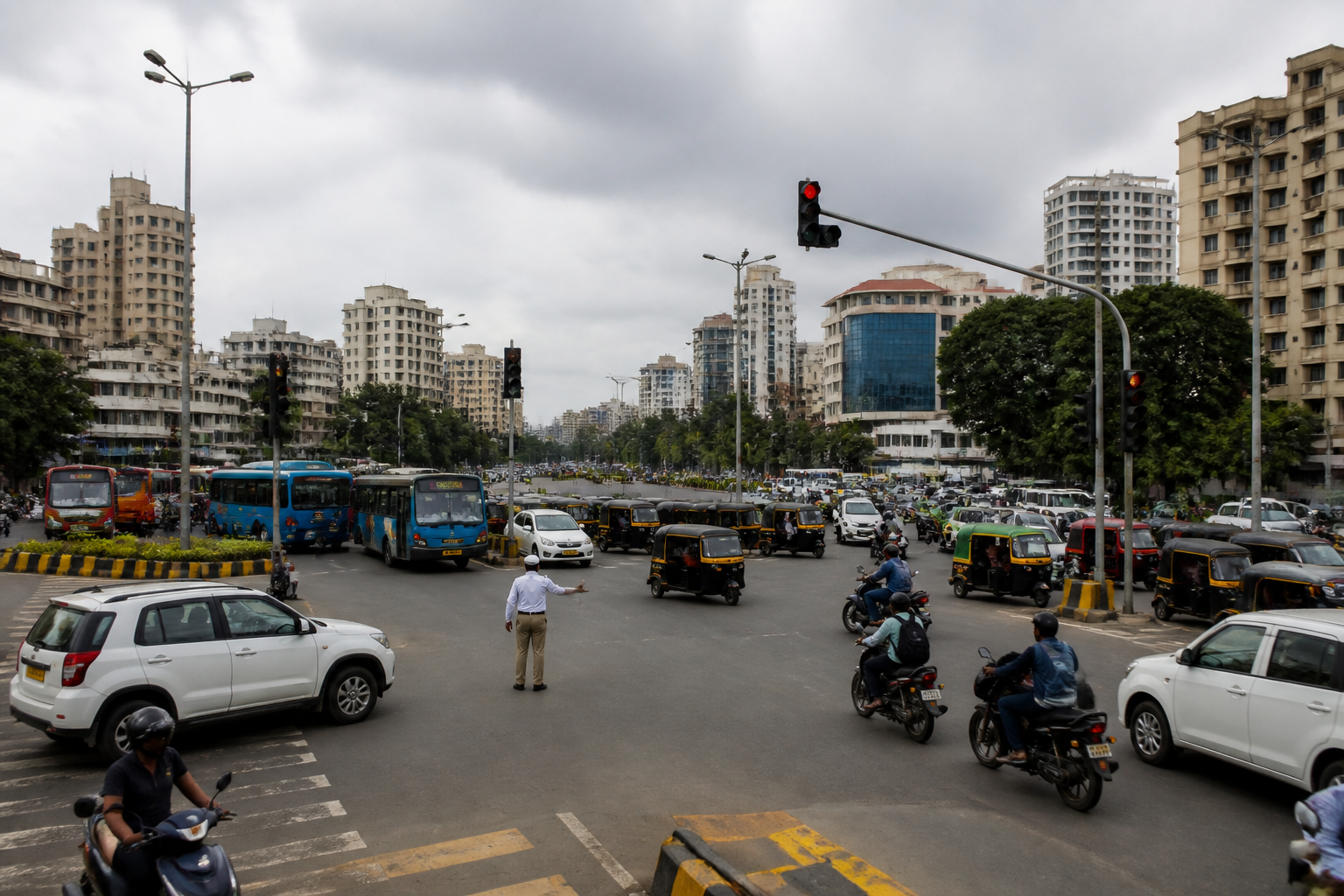
The Thane Majiwada signal system has begun operating on an experimental basis at one of the city’s busiest junctions, with traffic police set to review congestion and citizen feedback before adjusting signal timings.
The junction connects several major parts of Thane and carries traffic towards Ghodbunder Road, Kolshet, Court Naka and Thane railway station. Vehicles travelling towards Ghodbunder from the railway station also pass through the junction, making it a critical link in the city’s road network.
Traffic from Nashik, Bhiwandi and Kalyan uses the junction to reach Thane city and the Ghodbunder area. The junction also receives substantial traffic from the Vrindavan and Ritu Park areas. With nine roads converging at the same point, vehicles approach from multiple directions and compete for space, particularly during peak commuting hours.
According to the traffic police, the signal has been activated on a trial basis. Its timings will be changed if required after studying traffic congestion, feedback from citizens and other operational factors. The authorities have not announced a final signal schedule or a fixed date for completing the trial in the information currently available.
Majiwada has been identified as one of Thane’s major congestion points because traffic queues at the junction often extend to the roads connecting it. The increase in vehicle volumes during busy periods has placed pressure on the junction and affected movement on adjoining routes.
Before the experimental signal was introduced, traffic police personnel manually regulated vehicle movement at the junction. The absence of a signal system meant that officers had to intervene continuously as traffic arrived from different directions. The complex layout and rising number of vehicles increased the operational burden on traffic personnel, especially when congestion built up across several approaches at the same time.
The new system is therefore being tested not only as a traffic-control measure at Majiwada but also as a way to organise movement through a junction where nine roads meet. Its effectiveness will depend on how the signal phases correspond to traffic volumes on each approach and whether queues are contained within the junction’s connecting roads. The traffic police have said that the timings can be modified after observing conditions on the ground.
For commuters, the immediate outcome will be measured by changes in waiting time, the length of vehicle queues and the ease of movement towards Thane station, Ghodbunder Road, Kolshet, Court Naka, Nashik, Bhiwandi and Kalyan. Authorities are expected to continue assessing the trial and make necessary timing changes based on traffic conditions and public feedback.
