


Subheadline: In Delhi’s Nizamuddin Basti, a two-floor community space is using books, play, art and performance to create a different kind of learning environment for children.
Standfirst: Khwab Ghar began as an open-air library in a local park, moved through rented rooms and found a permanent home in 2023. Today, its Tuesday Open Library sessions bring around 30 to 40 children into a setting where reading is linked to drawing, theatre, music and play. The space does not operate like a school: there are no tests, marks, compulsory lessons or formal attendance registers. Its significance lies in the way it combines access to books with a welcoming physical environment and the freedom to learn at an individual pace. The experience described by children and organisers raises a broader urban question: what kinds of small, accessible neighbourhood spaces can support learning when the formal classroom is not enough?
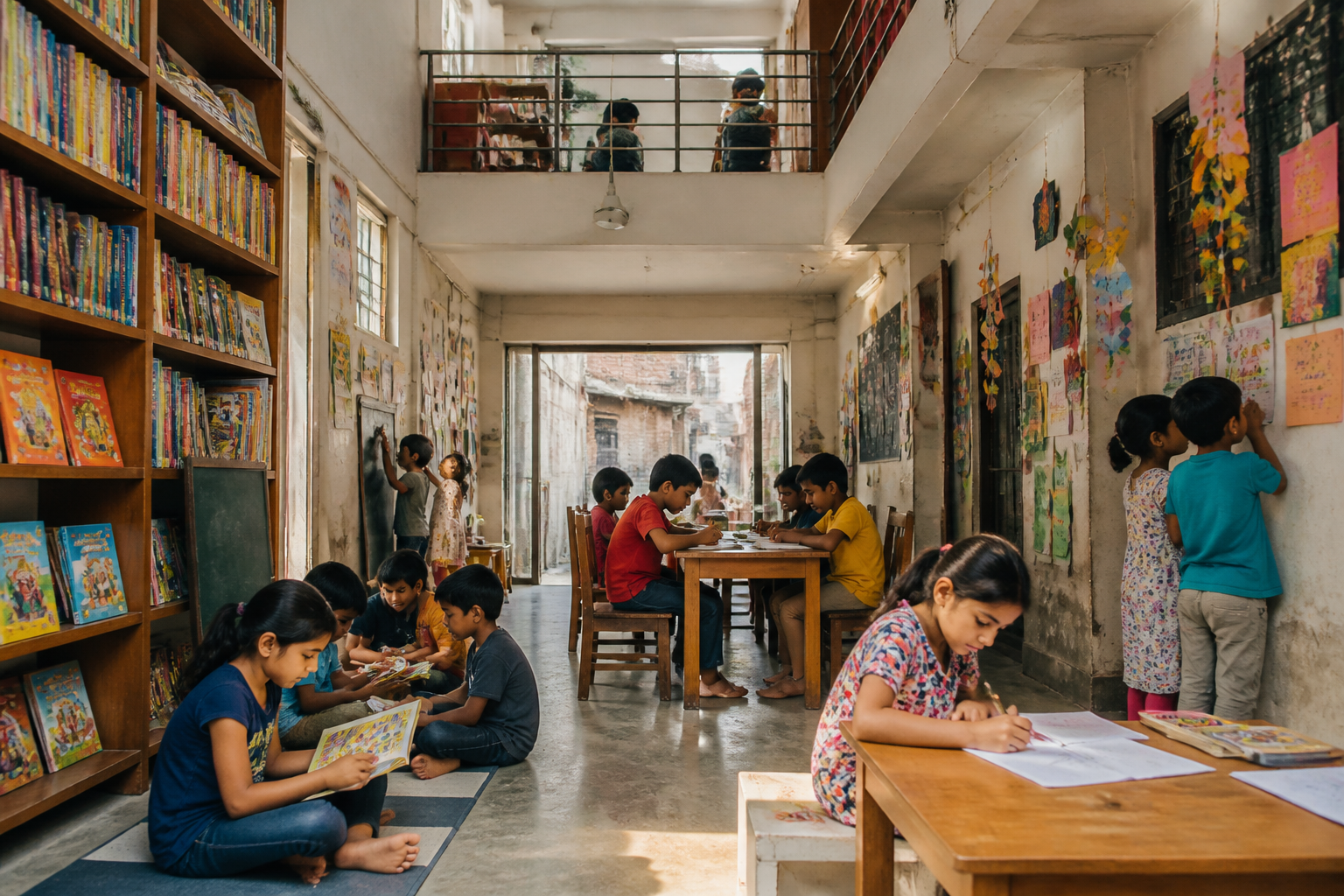
On Tuesdays, the narrow passages of Khwab Ghar in Nizamuddin Basti become part library, part studio and part performance space. Children read from colourful shelves, draw on blackboards, play games and take part in theatre and music activities. The two-floor facility is not presented as a conventional classroom. Instead, it is a neighbourhood space where reading provides the starting point for several forms of learning.
The space is run by Aagaaz Theatre Trust through its Open Library programme. According to the account of the programme, what began as an open-air library in a local park later shifted into small rented rooms before moving into a permanent two-floor home in 2023. That progression is important because it shows how the initiative’s physical setting changed alongside its activities. The library was not limited to storing books; it developed into a place where children could read, make, perform and spend time.
The built environment of Khwab Ghar is closely tied to the programme’s method. Children’s chalk drawings fill the narrow passages, and paper cut-outs made by participants hang around the space. Posters of poets share the walls with bookshelves. These details make the facility visibly different from a formal institutional setting, while also showing how the children’s own work becomes part of the space.
Reading is treated as an entry point rather than an endpoint. In one recent session, a reading of the book Power Cut developed into an activity on shadow puppetry. Children used their hands to create shadows on the walls, connecting the story to an activity that involved movement, imagination and shared participation. The supplied account also describes read-aloud sessions, art activities and games that bring stories into a wider set of experiences.
The programme’s organisers do not describe these activities as teaching. They use the term learning, with the expectation that it can happen through play, conversation and art. Programme director Alia says the aim is to help each child engage with books at their own pace. The collection is arranged for different reading levels, and children are not expected to arrive with a particular level of reading ability.
That approach changes the relationship between the child and the library. A formal lesson generally establishes a fixed task, a schedule and a method of assessment. At the Open Library, the reported structure is looser. Children can explore the shelves, join a read-aloud session, take part in an activity or move between forms of participation. The absence of marks and tests is not presented as an absence of learning; it is the basis for a different form of engagement.
The programme also illustrates how a small urban facility can combine multiple functions without requiring a large campus. Khwab Ghar accommodates books, creative work, games and performance activities across two floors. Its spaces are described through everyday details rather than specialised infrastructure: shelves, blackboards, passages and walls that can be used for drawing and shadow play. The account does not provide the facility’s floor area or a formal design brief, but it shows how the available interior is being adapted for children’s varied activities.
The most consistent measure of the programme’s reach in the supplied material is attendance. There are no strict roll calls or attendance registers, yet around 30 to 40 children reportedly arrive on a typical Tuesday. This figure does not establish the programme’s total coverage or long-term outcomes, but it does indicate repeated participation. The children return to a space that offers continuity without the compulsory structure of school.
For children in the basti, that distinction matters because the Open Library is described as markedly different from their regular school environment. Jasmine, a 10-year-old participant who attends with her younger sister Ilma, says that school involves fighting and disruption, while Khwab Ghar is a place to eat, play and dance. Her account is personal rather than a general assessment of the school system, but it shows how the space is experienced by at least one child: as an environment where participation feels safer and more enjoyable.
Jasmine and Ilma’s reported confidence in expressing themselves also connects the physical space to aspirations. The sisters now share a dream of becoming professional dancers. The article does not establish whether participation at Khwab Ghar directly caused that ambition, nor does it provide evidence about longer-term educational outcomes. It does, however, show that the programme creates opportunities for children to imagine themselves through stories, movement and performance rather than only through academic achievement.
The books themselves provide another layer of connection. One child favours The Tree in Me, while other children are drawn to stories about animals and books with a wide variety of characters. These preferences suggest that access is not only about the number of books available. It is also about whether children can find stories, characters and situations that they recognise or want to explore. The supplied report does not identify the size of the collection or its acquisition process, so the library’s scale cannot be assessed from the available evidence.
Khwab Ghar’s example points to a broader question about the kinds of social infrastructure available within dense neighbourhoods. A library that also accommodates art, play and performance is more than a book-distribution point. It creates a setting for repeated contact, informal conversation and collective activity. In this case, the space has evolved from an open-air initiative into a permanent facility, suggesting that continuity of place has become part of the programme’s identity.
The initiative also highlights the difference between access to education and access to learning environments. Schools remain the formal institutions responsible for education, but the experience described at Khwab Ghar occupies another space. It does not replicate the school’s curriculum, assessments or compulsory attendance. Instead, it offers an environment in which books can lead to creative and social activity. The distinction is particularly visible in the programme’s decision not to require a specific reading ability or formal participation pattern.
From an urban-planning perspective, the account is a reminder that neighbourhood facilities do not need to be large or single-purpose to have public value. Khwab Ghar’s functions overlap: it is a reading room, activity space, cultural venue and informal gathering place for children. Its significance comes from this combination and from its relationship with the surrounding basti. The supplied material does not establish whether similar spaces exist elsewhere in Delhi, how the facility is funded or whether the model can be replicated. Those questions remain open.
What the evidence does confirm is narrower but concrete. Aagaaz Theatre Trust’s Open Library has operated through several physical settings and has had a permanent home since 2023. Around 30 to 40 children attend the Tuesday sessions. Books are connected to art, games, theatre, music and conversation. The space is designed around voluntary participation rather than marks, tests or compulsory lessons, and children’s work is visible throughout the interior.
Khwab Ghar therefore offers a specific example of how a small community facility can widen the meaning of a library. Its story is not evidence that informal learning can replace school, nor does it establish measurable educational improvement. It does show how a stable, accessible and child-oriented place can make room for reading, play and self-expression within an urban neighbourhood. The developments worth monitoring are whether the programme continues in its permanent setting, how many children it reaches over time and whether its model of combining books with creative activity is adopted in other communities.
