


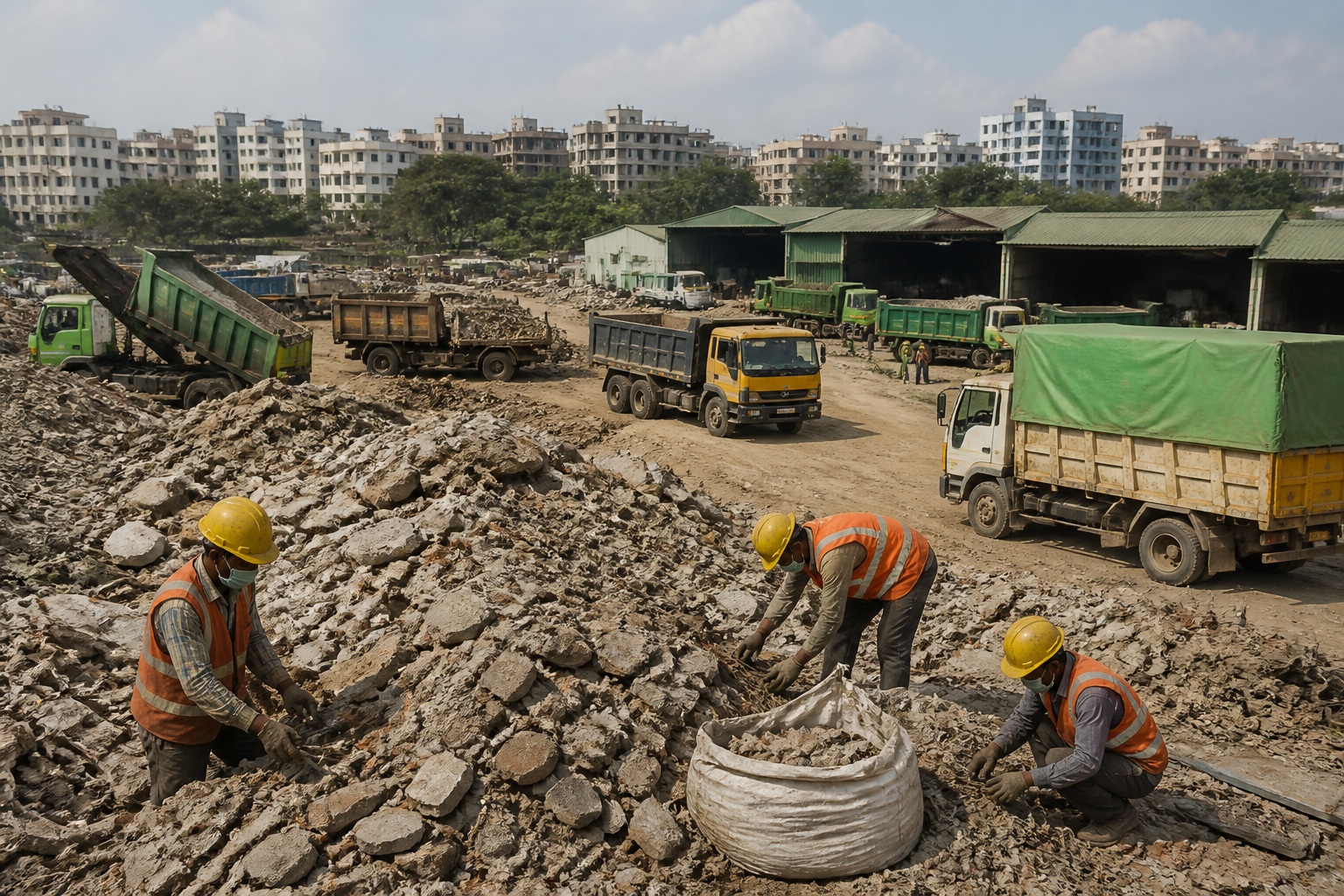
The Karnataka State Pollution Control Board’s submission to the National Green Tribunal has put Bengaluru’s construction and demolition waste system under renewed scrutiny. The board has pointed to possible gaps in public awareness, violations of the Construction and Demolition Waste Management Rules and illegal disposal. But the response from waste-management experts and civic activists suggests that the more persistent problem may be enforcement rather than information.
The issue is not new. The KSPCB’s report was filed in a suo motu case registered by the NGT after a news report published several years ago. What is new in the current account is the clarity with which the institutional responsibilities have been set out: the KSPCB is responsible for monitoring compliance, while the Greater Bengaluru Authority is responsible for ensuring that construction and demolition waste generated within its jurisdiction is disposed of according to the rules.
That distinction matters because construction and demolition waste is produced through a regulated economic activity, not primarily through everyday household behaviour. Bengaluru’s building activity generates debris from demolition, excavation, renovation and construction. If this material is dumped illegally or fails to reach authorised processing facilities, the problem is not only a question of public awareness. It is also a question of whether generators, transporters, civic agencies and processing units are operating within a system that is monitored and enforced.
The KSPCB has said that it has written to the GBA and Bengaluru Solid Waste Management Limited seeking strict implementation of the Environment (Construction & Demolition) Waste Management Rules, 2025. The board is also preparing instructions for relevant stakeholder departments. Under the 2025 rules, as described in the report, the KSPCB is responsible for monitoring the extended producer responsibility and waste-utilisation framework, coordinating implementation with other authorities, conducting awareness programmes with urban local bodies and stakeholders, and submitting an annual report to the Central Pollution Control Board.
These responsibilities create a layered governance structure. The state pollution-control agency monitors compliance and coordinates implementation. The city authority is responsible for ensuring that waste generated within its jurisdiction is disposed of properly. BSWML is among the city-level entities involved in the system. The effectiveness of the arrangement therefore depends on coordination rather than on the actions of a single agency.
The KSPCB has also referred to recommendations made by the Justice Subhash B Adi Committee. The committee was constituted after an NGT order concerning effective municipal solid-waste disposal and made recommendations to the GBA on construction and demolition waste. The KSPCB said that the civic authority needs to adopt and strictly implement those recommendations.
This places the current discussion within a broader administrative pattern: committees and rules may identify the responsibilities, but compliance depends on whether those responsibilities are converted into routine systems. The supplied report does not establish which recommendations have been adopted, which remain pending or what enforcement action has followed. It does, however, show that the question of implementation remains active at the level of the tribunal and the pollution-control authority.
The dispute over awareness is significant. The KSPCB has said that public awareness about appropriate disposal and whom to contact may be low. City-based solid-waste-management experts contest that assessment. One expert cited in the report said that awareness efforts have continued for about 10 years and that construction is carried out by industry rather than by the public. Civic activists similarly argued that stricter enforcement of solid-waste rules, rather than additional awareness efforts, is required.
Both positions point to different explanations for the same visible failure. If generators do not know how to dispose of construction waste, information and accessible collection channels are necessary. If regulated construction activity is already aware of the rules but continues to send material into unauthorised locations, the central failure is enforcement. The report does not provide enough evidence to determine the relative weight of each factor, but it does reveal a disagreement about where administrative attention should be concentrated.
The condition of Bengaluru’s processing infrastructure makes that disagreement more consequential. According to a source cited in the report, the two construction and demolition waste-processing units at Chikkajala and Kannur receive only minimal quantities of waste. The report also says that both facilities are on the verge of shutting down, while an attempt to contact the Kannur facility did not receive a response.
Those details raise a system-level question: why would authorised processing facilities receive limited quantities while illegal disposal remains an acknowledged concern? The supplied material does not provide data on the total volume generated in Bengaluru, the designed capacity of the two facilities, their utilisation rates, the number of registered waste generators or the quantity collected by authorised operators. Without those figures, it is not possible to measure the scale of the capacity gap.
Even so, the reported mismatch between available facilities and incoming waste is important. A processing unit cannot function as part of a citywide waste system unless waste generators can identify it, collection and transport arrangements are available, charges are workable and authorities can prevent diversion to illegal dumping sites. The rules may assign obligations, but those obligations must be connected to an operational chain from the construction site to the processing facility.
The distinction between monitoring and delivery is also central. The KSPCB has described its role as monitoring compliance, overseeing the framework created by the 2025 rules and coordinating with authorities. The GBA, meanwhile, is responsible for ensuring disposal within its jurisdiction. If waste is not reaching authorised facilities, the city administration must be able to identify generators, track movement and act against violations. The report does not specify how many inspections have taken place, how violations are recorded or what penalties have been imposed.
That missing information is not a minor administrative detail. It determines whether the city can move from a general commitment to measurable compliance. A functioning system would need a clear answer to basic questions: who generated the waste, where was it collected, which transporter moved it, which facility received it and what happened after processing? The supplied report does not establish whether such end-to-end tracking is currently in place.
The 2016 Construction and Demolition Waste Management Rules, as well as the amendments referred to in the report for 2025, provide the regulatory framework. The later rules expand the KSPCB’s described responsibilities around extended producer responsibility, utilisation, coordination and awareness. Yet regulatory expansion by itself does not demonstrate improved performance. The key issue for Bengaluru is whether the framework is being translated into compliance at construction sites and into reliable operations at processing facilities.
The NGT’s continuing involvement gives the matter a judicial oversight dimension. The case originated as a suo motu proceeding linked to an earlier news report, and the KSPCB’s submission is part of that process. The report does not state the tribunal’s next direction or prescribe a specific deadline for the GBA. The immediate institutional task identified in the material is for the GBA to address and implement the Justice Subhash B Adi Committee’s recommendations, while the KSPCB continues its coordination and monitoring functions.
Bengaluru’s construction-waste problem therefore reveals more than a failure to dispose of debris correctly. It exposes the difficulty of managing a waste stream that sits between environmental regulation, municipal administration and the construction industry. Awareness may be one part of the system, but the evidence available in the report also points to enforcement, accountability and facility viability as unresolved questions.
What is established is that the KSPCB has identified illegal disposal and rule violations, the GBA has the stated responsibility for ensuring compliant disposal, and the city’s two reported processing facilities may be receiving too little waste to remain viable. What remains uncertain is the volume of waste generated, the extent of non-compliance, the status of the committee’s recommendations and the reasons authorised facilities are underused. Those are the facts that future regulatory filings and civic disclosures will need to clarify.
