


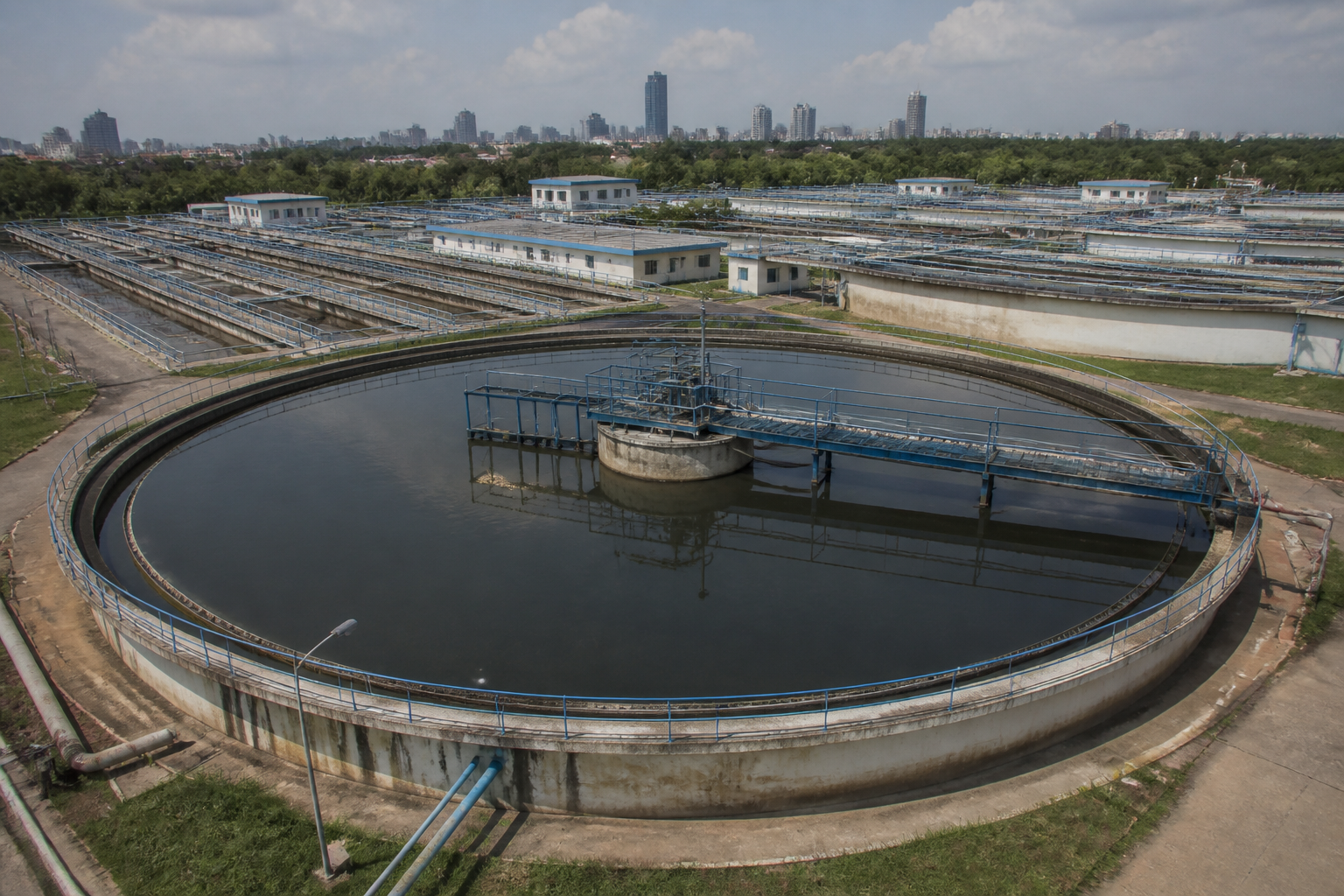
Bengaluru’s new sewage-treatment deadline is not simply a question of building more plants. It is a test of whether the city can convert announced capacity into reliable treatment, enforce standards across public and private facilities, and prevent untreated sewage from entering the drainage network. The Karnataka government has set December 2029 as the latest date by which Bengaluru should be prepared to treat all of the sewage it generates. The target follows earlier deadlines in 2020, 2023 and 2025 that were not achieved.
The scale of the challenge is defined by two figures reported after a review of the Bangalore Water Supply and Sewerage Board’s latest compliance report: Bengaluru generates about 2,580 million litres of sewage each day, while only around 50% is currently treated. Reaching full treatment would therefore require the city to double its effective treatment rate in a little over three years from the time of the latest roadmap. That makes the deadline a capacity-expansion programme, a regulatory-enforcement exercise and an administrative test at the same time.
The immediate concern is not only the amount of sewage that remains untreated. The report also points to treatment plants operated by BWSSB that are failing to meet standards prescribed by the National Green Tribunal and the Karnataka State Pollution Control Board. The state government has given the erring plants 30 days to comply. This creates a distinction that is often lost in infrastructure targets: installed treatment capacity is not the same as functioning, compliant treatment capacity.
A sewage-treatment plant can contribute to a city’s reported capacity only if it receives wastewater, operates consistently and produces treated water within prescribed limits. The material supplied in the report does not establish how much of Bengaluru’s planned or installed capacity is operational at any given time, nor does it provide plant-level performance data. It does, however, show that the government’s challenge extends beyond construction. Existing facilities are already facing compliance problems, and those failures raise questions about the quality of water released after treatment.
The state’s response has two parts. BWSSB is expected to prepare a phased plan to commission new sewage-treatment plants and upgrade existing facilities. At the same time, KSPCB has been directed to inspect private sewage-treatment plants operated by technology parks, hotels, educational institutions, commercial complexes and residential developments. These facilities form a parallel treatment network outside the immediately visible system of publicly operated plants. Their performance matters because the city’s sewage burden is distributed across different types of properties and treatment arrangements.
The proposed centralised dashboard is intended to address one of the most persistent problems in infrastructure regulation: the gap between periodic inspection and continuous oversight. Forest, environment and ecology minister Ramalinga Reddy said KSPCB had been directed to launch a dashboard showing, in real time, the quality of water treated by sewage-treatment plants. The stated purpose is to move away from a system that depends on officials visiting every facility and manually checking samples.
That proposal could improve transparency, but the report does not specify which parameters will be displayed, how often data will be updated, who will validate the readings or what enforcement action will follow a breach. A dashboard can make information more accessible only when the underlying measurements are standardised and independently credible. Without clarity on those safeguards, the platform risks becoming a reporting interface rather than a compliance mechanism. The distinction will become important as the 2029 deadline approaches and the city begins to measure progress against a single headline number.
The figures available in the report also reveal the difficulty of judging progress through treatment percentage alone. Bengaluru’s reported sewage generation is 2,580 MLD, but the city’s treatment requirement depends on the collection network, the amount of wastewater reaching plants, the capacity of individual facilities and the quality of treated discharge. The report does not provide a breakdown of these components. As a result, the current 50% figure indicates the size of the gap but does not explain whether the principal constraint is plant capacity, sewer connectivity, operations, maintenance, compliance or the diversion of sewage into other channels.
The government has specifically asked BWSSB to identify households and properties that divert sewage into stormwater drains despite having access to sewerage. Officials cited pro-rata charges and deposits as possible reasons some properties may avoid BWSSB connections. This introduces a network-governance problem into what might otherwise appear to be a plant-construction problem. If wastewater does not enter the sewer system, additional treatment capacity cannot by itself ensure that the city’s total sewage is treated.
The diversion of sewage into stormwater drains also complicates accountability. A treatment plant operator can be assessed for the water entering and leaving the facility, but untreated flows bypassing the network require action at the property and connection level. The available material does not quantify the number of such properties or the volume of sewage involved. It does establish that the state sees illegal or unauthorised connections as part of the treatment shortfall and has asked BWSSB to investigate them.
This is where the 2029 plan will be tested institutionally. BWSSB is responsible for expanding and upgrading the public treatment system and for identifying properties that are not using available sewerage connections. KSPCB is responsible for inspections and has been asked to monitor private facilities. The state government has set the deadline and directed corrective action. The arrangement creates a chain of responsibility, but the supplied report does not clarify how performance will be measured across agencies or how disputes over non-compliance will be resolved.
The earlier deadlines are significant because they show that the problem is not new. Targets were set for 2020, 2023 and 2025, yet the latest report still places treatment at about half of the city’s sewage generation. The repeated resetting of deadlines does not, by itself, explain why earlier targets failed. The available information does not provide a history of funding, land acquisition, tendering, construction delays, network expansion or plant operations. It does show that the current deadline inherits an implementation record in which announced milestones were not met.
The environmental stakes are reflected in the concern over polluted water flowing into the Cauvery river. The report does not quantify the pollution load or identify the specific locations and pathways involved. It does, however, connect Bengaluru’s treatment shortfall and plant-compliance failures with the quality of water reaching the wider river system. That connection makes sewage management a regional water-quality issue rather than a matter confined to city limits.
The policy challenge is therefore broader than achieving a 100% treatment label. The city must add and commission new capacity, bring existing plants within prescribed standards, inspect private facilities, improve sewer connections and monitor the quality of treated water. Each task has a different institutional owner and a different failure point. A plant may be delayed, a facility may operate below standards, a property may bypass the sewer network or a monitoring system may fail to trigger enforcement. The final outcome depends on all of these links functioning together.
The information currently available confirms the size of the reported gap and the government’s proposed response, but it leaves important questions unanswered. It is not clear how many new plants are planned, where they will be located, how much additional capacity each will provide, what upgrades are required at existing facilities or how the 30-day compliance order will be verified. The report also does not state the budget, procurement schedule or interim milestones leading to December 2029.
Those details will determine whether the latest deadline is a credible implementation plan or another administrative target. The most important indicators to monitor are not only the number of plants announced or commissioned, but the volume of sewage actually reaching treatment facilities, plant-level compliance, the performance of private STPs, the number of properties connected to the sewer network and the quality of treated water disclosed through the proposed dashboard.
Bengaluru’s sewage-treatment plan thus exposes two linked urban infrastructure deficits: insufficient treatment capacity and incomplete control over the wastewater network. The city’s 2029 commitment addresses the first in headline terms, while the government’s directions on compliance, private plants and stormwater diversions acknowledge the second. Whether the deadline produces a measurable improvement will depend on the publication of plant-level data, enforcement of standards and evidence that the sewage generated across the city is actually captured, treated and discharged within prescribed limits.
