


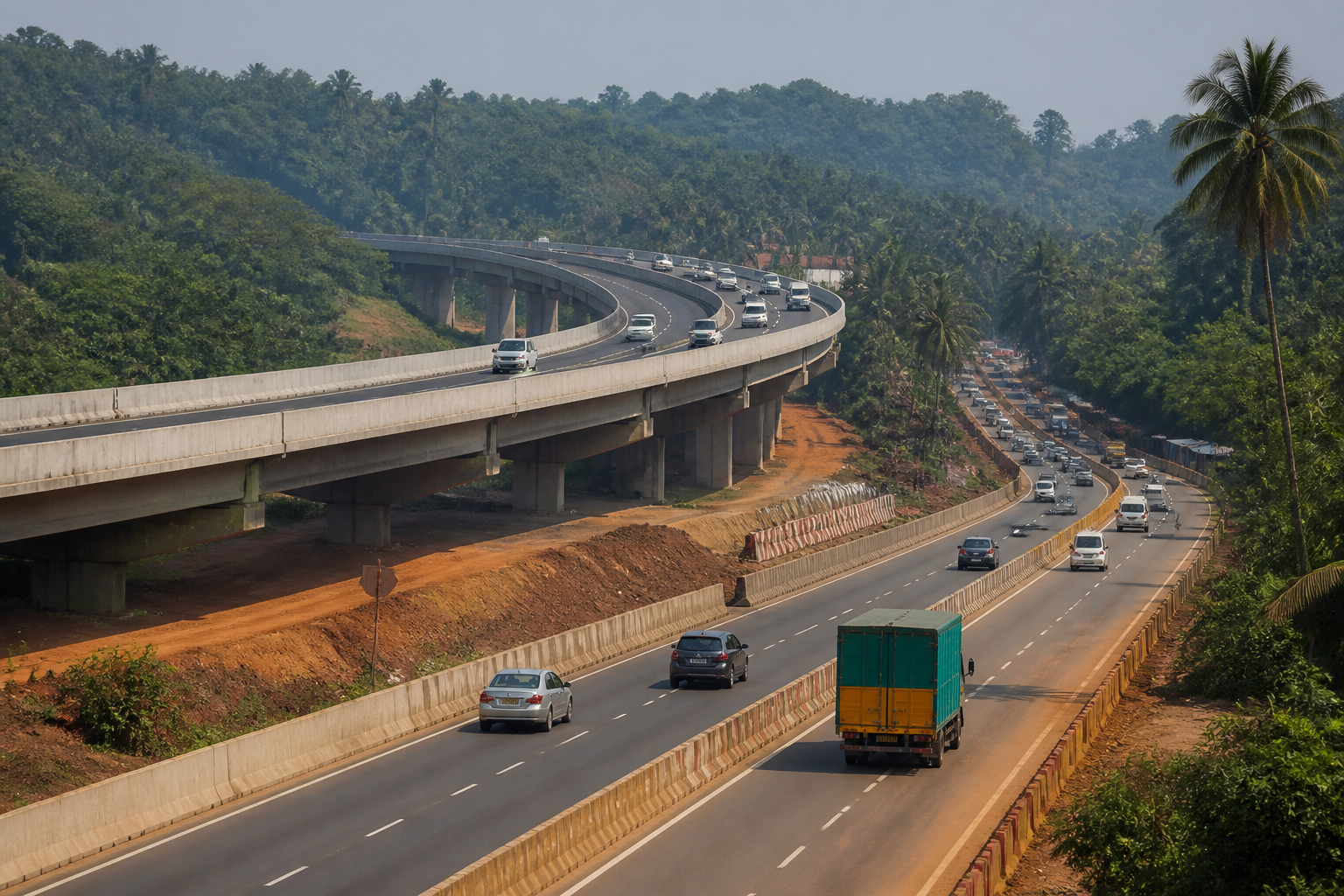
The Union road transport minister’s renewed criticism of delays on the Mumbai-Goa highway is more than a warning to contractors. It is an admission that a major public infrastructure project has become a test of how India assigns responsibility for time overruns, poor-quality execution and weak coordination between agencies.
Nitin Gadkari said he had earlier felt ashamed about the prolonged delay in widening the highway and now intends to travel from Mumbai to Goa in October to inspect the completed work personally. Speaking after inaugurating a six-lane elevated road corridor at Porvorim near Panaji, he said he wanted to set a record for blacklisting contractors responsible for poor work and suspending officials found accountable for delays or substandard execution.
The remarks place the Mumbai-Goa highway within a larger administrative problem: infrastructure delivery does not end when a project is sanctioned or a contract is awarded. It depends on the interaction between contractors, supervising officials, state agencies, local administrations and the ministry responsible for the corridor. When any part of that chain fails, the public experiences the result as longer travel times, unsafe or inconvenient journeys, repeated construction and uncertain completion dates.
The highway widening project runs through Maharashtra’s coastal Konkan region before reaching Goa. The source report says the work has been delayed repeatedly, but does not provide the original completion schedule, the revised deadlines, the number of contracts involved or the financial cost of the delay. Those missing details matter because the minister’s proposed response—blacklisting contractors and suspending officials—will need to be tied to specific findings, contractual obligations and documented failures.
Gadkari said officials held a meeting on the issue on Tuesday. He also said he would land at Mumbai airport in October and travel by road to Goa to determine whether the journey had become more convenient for travellers. That proposed inspection is significant because it shifts attention from administrative progress reports to the condition experienced by road users along the full route.
A highway can be described as complete in a project file while remaining difficult to use in practice. Surface quality, unfinished sections, junction design, traffic management, drainage, roadside safety and continuity between packages all shape the journey. The minister’s decision to review the corridor by road indicates that completion is being assessed not only through construction milestones but also through the quality and convenience of the operating route. The report, however, does not establish which sections remain incomplete or what specific defects have been identified.
The accountability question is central. Gadkari said the government would continue taking stringent action against contractors and officials responsible for delays and poor-quality infrastructure work. Blacklisting can prevent a contractor from receiving future government work, while suspension affects the officials responsible for oversight or administration. But the effectiveness of either measure depends on due process, evidence and clear assignment of responsibility. A delay may result from poor construction, inadequate supervision, land or approval issues, design changes, coordination failures or several causes at once. The supplied report does not identify the cause of each delayed section.
That distinction is important for public accountability. Punishing a contractor for defective work is different from penalising one for a delay caused by an unresolved clearance or an agency outside the contractor’s control. Similarly, officials may be responsible for inadequate monitoring, but the record would need to establish what authority they possessed and what action they failed to take. The minister’s remarks communicate an intention to act; they do not yet provide the findings or orders that would demonstrate how that intention will be implemented.
The Porvorim elevated corridor provides a contrasting example of the capacity expansion expected from urban and regional road projects. Gadkari said a road that originally had two-lane capacity now effectively provides capacity for ten lanes, combining four lanes at ground level with six lanes on the elevated section. The report does not provide traffic figures or before-and-after travel times, so the operational effect cannot be independently measured from the available material. It does show the government’s preference for a grade-separated solution at a location where congestion had become a concern.
The corridor also reveals how national highway construction intersects with local urban planning. Porvorim is near Panaji and functions within Goa’s tourism and settlement network. A highway passing through or near urban areas is not only a long-distance transport asset. It influences congestion, access to markets, development along the road and the experience of visitors entering the state. A project that improves vehicle capacity but leaves local junctions, markets, warehouses or bus facilities poorly organised may shift congestion rather than remove it.
Gadkari called on Goa to develop roadside amenities reflecting the state’s architecture, cuisine and handicraft traditions. He suggested that such facilities could offer travellers Goan food and local handloom and handicraft products. This proposal extends the highway’s role beyond movement. It treats the road as an economic and cultural interface, linking tourism, local livelihoods and public infrastructure. Yet the report does not specify which agency would plan, finance or operate these facilities, or how roadside commercial development would be regulated.
The minister also proposed adding facilities for biofuels, electric vehicles and other alternative fuels alongside existing petrol and diesel pumps. That suggestion connects highway planning with the transition in transport energy. For such facilities to function, however, the road network would need suitable sites, reliable power or fuel supply, safety standards and an operating model. The source material records the proposal but does not provide a timetable, location list or implementation framework.
Environmental planning was another part of the minister’s remarks. Gadkari said landscaping should be based on a scientific study rather than arbitrary tree planting by contractors. He called for an assessment of flowering trees and species that absorb more carbon dioxide and release oxygen, and urged Goa to support the development of a green highway, possibly along the lines of an oxygen park he said had been developed in Nagpur.
This argument identifies a recurring weakness in infrastructure projects: landscaping is often treated as a finishing activity rather than part of design and maintenance. The minister’s comments suggest that species selection, planting plans and environmental performance should be considered systematically. At the same time, the source does not provide an ecological assessment, a planting plan or evidence that a highway corridor can be evaluated through the oxygen-park model. Those details would be required before the proposal could be assessed beyond its stated intent.
Gadkari linked infrastructure quality to investment, employment and poverty reduction, and urged Goa to address water, air and noise pollution. He also said waste should not reach the sea. These concerns broaden the highway discussion into a question of regional infrastructure capacity. Roads do not operate separately from water supply, electricity, communication networks, waste systems and public transport. A better highway may increase access, but the benefits can be constrained if the surrounding urban systems cannot manage additional traffic, visitors, commercial activity and waste.
The minister proposed a review of traffic conditions in Goa, including market consolidation, relocating warehouses outside cities, upgrading bus depots and synchronising traffic movement. Each measure addresses a different source of congestion. Markets and warehouses generate freight and customer trips; bus depots affect public transport operations; synchronised traffic movement concerns the management of road capacity. The report does not say whether Goa has accepted these proposals or whether a formal traffic study has begun.
That uncertainty defines the present status of the announcement. The minister has stated an intention to inspect the Mumbai-Goa highway in October and has outlined possible disciplinary action against contractors and officials. He has also proposed roadside amenities, alternative-fuel facilities, green-highway landscaping and wider traffic reforms in Goa. What remains unknown is the administrative pathway: which authority will investigate the delayed packages, what standards will be applied, whether blacklisting or suspensions will follow, and how the proposed facilities will be funded and maintained.
The Mumbai-Goa highway episode therefore raises a basic governance question. Can infrastructure accountability be made visible before a project becomes a political embarrassment, rather than after years of delay? The answer depends on records that are not included in the source report: contract milestones, inspection findings, variation orders, safety audits, completion certificates and responsibility matrices. Until those documents are available, the minister’s statement is a strong signal of intended enforcement, but not evidence that enforcement has occurred.
The next significant development will be the minister’s proposed October road inspection and any formal action that follows. For travellers, contractors, officials and local governments, the relevant measure will be whether the corridor operates as a continuous, safe and convenient route, and whether the agencies responsible for delivering it publish a clear account of delays, defects and corrective action.
