


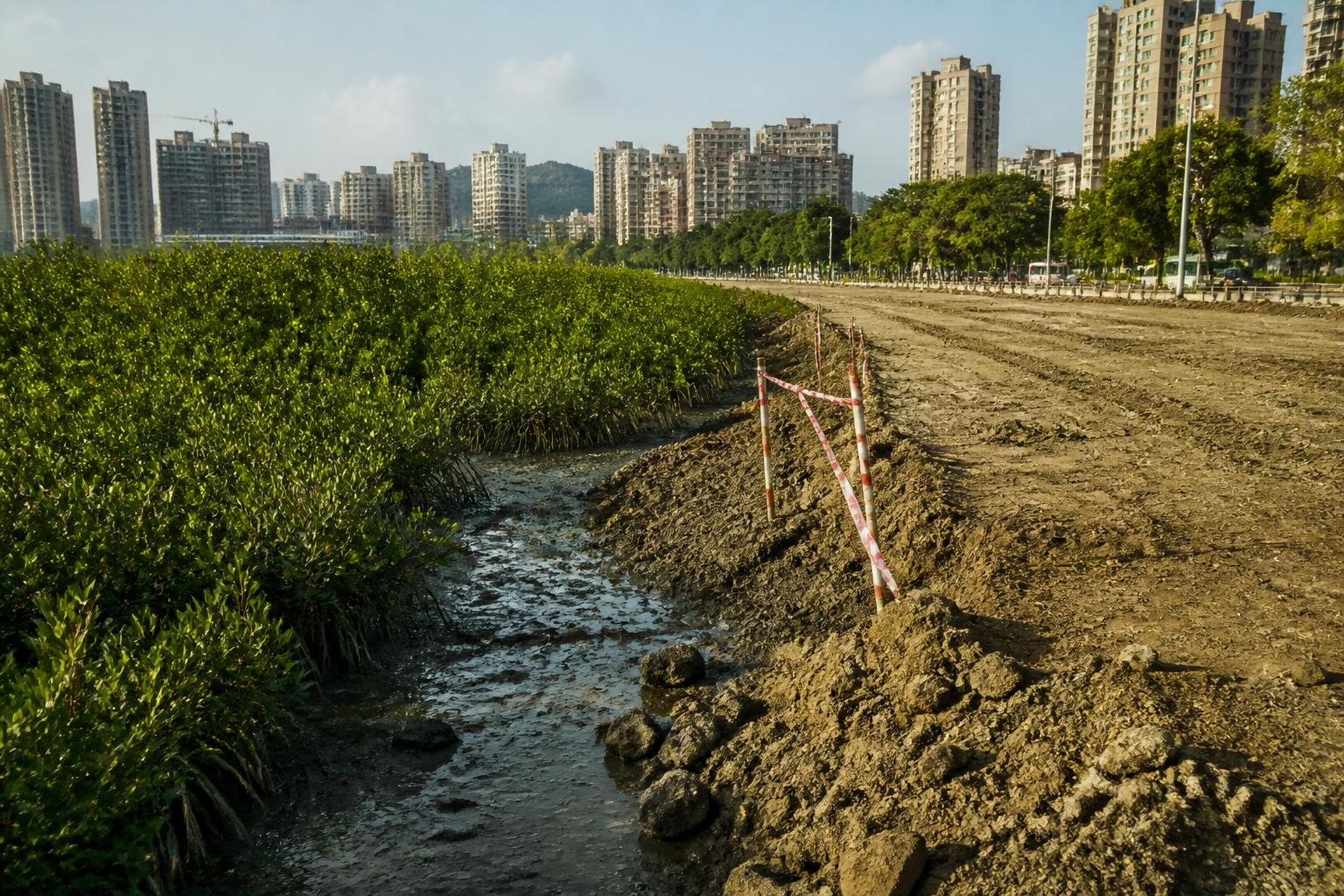
A National Green Tribunal order directing Thane police to stop filling work near mangroves at the Saket ground has brought an important urban contradiction into focus: a project presented as tree planting may itself threaten a coastal ecosystem if it depends on altering the land beneath it.
The reported order, issued after a September 3 hearing, concerns the Saket ground near the Rabodi-Saket road in Thane. According to the report, soil and manure were being brought to the site for a Miyawaki plantation project involving 9,000 saplings. Environmental petitioners argued that the site falls within 50 metres of mangroves and may be located in a Coastal Regulation Zone area where filling and construction are restricted. The tribunal reportedly found, at a preliminary level, that the location appeared to fall within CRZ-I (A), and directed the Thane city police commissioner not to permit further filling at the site until the next hearing.
The immediate dispute is therefore not simply about whether a plantation should be allowed. It is about whether an urban greening project can proceed by changing the physical character of land that may be protected under coastal and environmental regulation. The reported order does not determine the final legal status of the site, but it places the burden on the authorities to establish what the land is, which rules apply to it and whether the proposed activity is legally permissible.
That distinction matters because urban environmental conflicts often begin with the language of improvement. Filling land, levelling a site or adding soil can be described as preparation for landscaping, public use or ecological restoration. But the environmental consequences depend on the location, hydrology and legal status of the land. In a mangrove-adjacent area, the same material that supports planting in an ordinary urban plot may obstruct drainage, alter water movement or reduce the ecological space available to mangroves. The supplied report does not establish the full physical impact of the work, but it records the petitioners’ contention that filling for plantation could damage the mangrove area.
The case also raises a question about the meaning of urban greening. A Miyawaki plantation is generally understood as a dense planting method intended to create a compact urban forest. At the Saket ground, however, the tribunal’s reported concern is not the stated objective of planting trees but the method used to prepare the site. The proposed number—9,000 saplings—gives the project a substantial scale, yet the number of plants alone cannot establish whether the intervention is environmentally appropriate. The relevant questions are whether the land can legally be filled, whether the site is connected to a mangrove system, whether the planting design is compatible with its coastal setting and whether the required permissions were obtained.
This is where the conflict between project intent and regulatory process becomes visible. A public authority may identify a vacant or underused site and seek to improve it quickly. Environmental regulation, by contrast, requires the site to be classified before work begins. If the land falls within a protected coastal category, a positive objective such as tree planting does not automatically remove the need for prior scrutiny. The reported NGT direction effectively pauses the physical intervention while that scrutiny takes place.
The institutional structure described in the report is equally significant. The police commissioner is named as a respondent because the land is associated with the police’s Saket ground and because the filling work was reportedly being undertaken there. The Thane district collector is also a respondent. The Maharashtra Coastal Zone Management Authority is involved in the proceedings as the institution connected to coastal regulation. These roles are not interchangeable. The police may control or use the site, the district administration may have responsibilities relating to land and local administration, and the coastal authority may be responsible for applying the relevant coastal framework. The case shows how a single urban parcel can sit at the intersection of several administrative jurisdictions.
The tribunal reportedly expressed displeasure after the district collector’s office failed to appear despite adequate notice. It directed the office to send a representative and file a response at the next hearing. If that did not happen, the tribunal said the collector could be required to appear personally. This procedural development is important because environmental compliance depends not only on rules but also on institutional participation. A regulatory hearing cannot resolve competing claims about land classification, permissions and environmental impact if the relevant public authority does not place its position on record.
The reported dispute over legal representation adds another layer. The petitioners objected to the police commissioner and the Maharashtra Coastal Zone Management Authority, which they described as having opposing interests, being represented by the same lawyer. The tribunal reportedly directed that instructions be sought at the earliest on appointing a separate lawyer for the coastal authority. The issue is not merely administrative. Where one authority is accused of carrying out or permitting an activity and another is expected to regulate its legality, the clarity of each institution’s position becomes part of the accountability process.
The case also illustrates why coastal mapping and land records are central to urban development decisions. The petitioners relied on a letter from forest officials stating that the location was within 50 metres of mangroves. They further claimed that the site falls within a CRZ area. The tribunal’s preliminary observation, as reported, was that the land appeared to fall within CRZ-I (A). These are material assertions, but the supplied report does not include the underlying map, coordinates, survey records, boundary measurement or the complete tribunal order. The final determination will therefore depend on documentary evidence rather than on the stated purpose of the project alone.
That evidentiary gap is a reminder that environmental disputes are often decided through technical records that remain invisible in public communication. A project may be announced through a simple description—such as a plantation, landscaping work or ground improvement—while its legality depends on cadastral boundaries, coastal maps, forest records and permissions issued by different agencies. Without those documents, residents may know that work is taking place but not whether the work is compatible with the site’s legal and ecological status.
The Thane case also places public authorities under a higher standard of care. Private construction on environmentally sensitive land can be challenged as an unauthorised activity, but public projects can create a different perception: that government ownership or public purpose is sufficient justification. The reported NGT intervention indicates that public ownership and an environmental objective do not settle the question. The authority using the land must still demonstrate that the intervention complies with the applicable framework.
At the same time, the order should not be read as a final finding that the plantation project has permanently damaged mangroves or that the entire site is conclusively within the protected category. The report describes a direction to stop further filling until the next hearing and a preliminary observation about the site’s classification. It does not provide a final adjudication, a quantified assessment of damage or a final decision on the project’s future. Those distinctions are essential when reporting on an ongoing environmental proceeding.
What the proceedings have established, according to the available report, is narrower but consequential. Filling work near the Saket ground has been ordered to stop temporarily. The district administration has been asked to participate and respond. The status of the coastal authority’s legal representation has been questioned. And the site’s relationship to mangroves and CRZ-I (A) protections has become the central issue before the tribunal.
The larger urban question is whether cities treat ecological land as a constraint to be worked around or as infrastructure that must shape the project from the beginning. Mangroves are not simply undeveloped plots awaiting productive use. In a coastal city, the legal and ecological status of such land influences what can be built, filled, planted or publicly accessed. The supplied material does not provide a wider assessment of Thane’s mangrove network, but this case demonstrates how quickly a local greening project can become a test of that principle.
The next stage will depend on the responses filed by the district administration, the position taken by the coastal management authority and the documentary material placed before the tribunal. Until those records are examined, the facts support a pause in filling and a demand for institutional clarification—not a final conclusion about the plantation itself. The case will remain important because it asks a basic question with implications well beyond Saket: can an urban environmental project claim to be green if its first step is to alter protected coastal land?
