


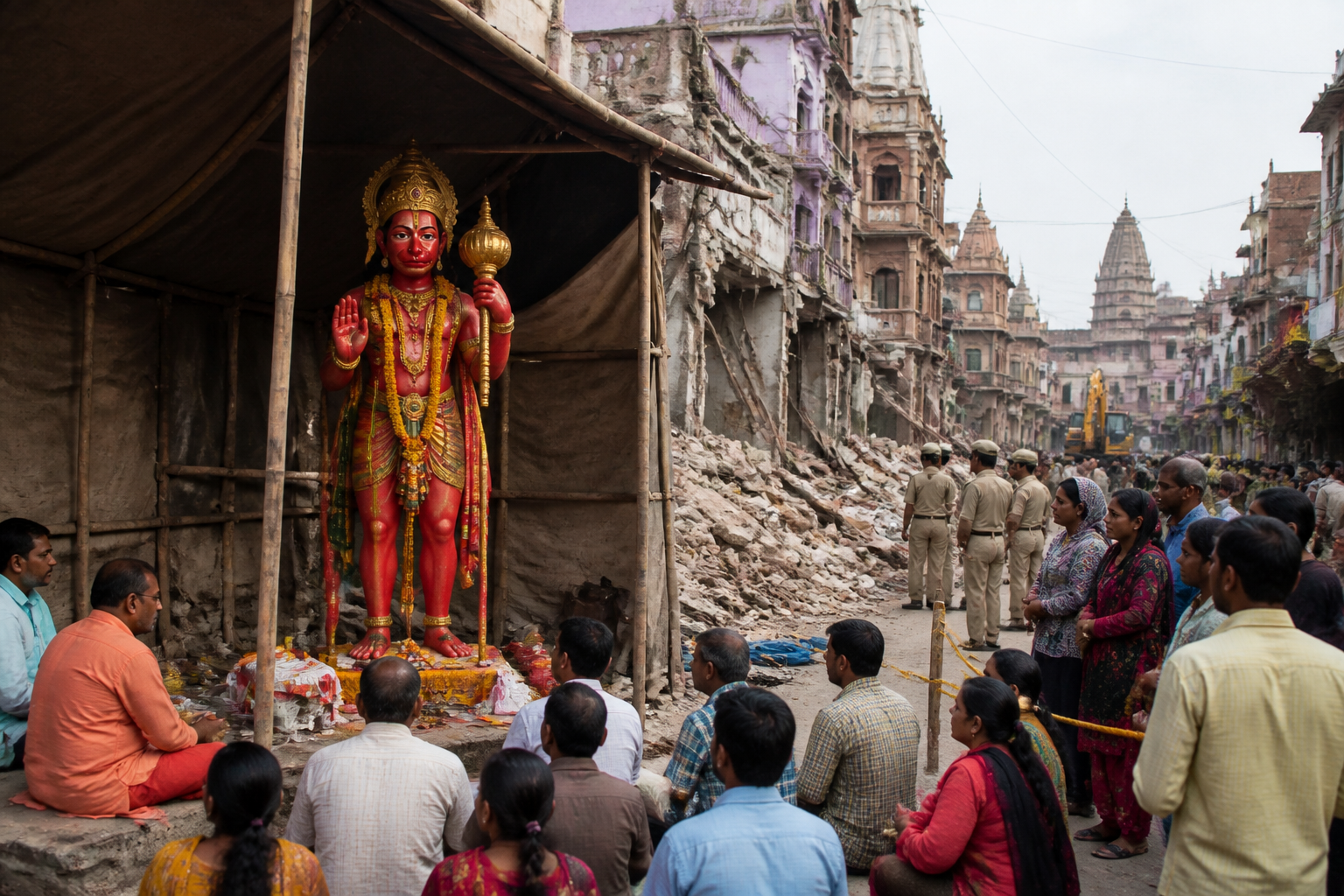
UJJAIN | September 10, 2026 — Authorities in Ujjain have called engineering and technical experts to assess an eight-foot Khade Hanuman idol that remains at its original location after the temple around it was dismantled for a road-widening project ahead of Simhastha 2028.
The idol stands under a waterproof tent in the Bada Sarafa market, along the 450-metre Kanthal–Gopal Mandir stretch. The road is planned to be widened from 9 metres to 15 metres to ease congestion during the major religious gathering. Four religious structures stand along the route, and officials have said that all have agreed to relocate. A Ganesha temple has already been shifted.
Ujjain officials said no attempt has been made to remove or relocate the Hanuman idol, either manually or with machinery. Sub-divisional magistrate LN Garg said misleading claims had circulated on social media about repeated efforts to move it.
The temple’s boundary wall and spire were dismantled four days before the report, following a final aarti attended by the priest and members of local Hindu organisations. Officials have identified a new site near an old water tank at Chhatri Chowk, where preparations for a new pedestal are under way. The priest is reported to have consented to the proposed relocation.
Additional municipal commissioner Santosh Tagore said technical teams from SGSITS Indore and IIT had been called to examine the idol and the structure beneath it. “Nothing further would be attempted until the situation is fully understood,” Tagore said, according to the report.
Officials are examining whether the idol may be connected to stones or a larger structure below ground. One possibility under consideration is that it was installed using an old interlocking technique. A detailed ground scan may be required to establish how deep the structure extends and how the idol is connected to it.
Archaeologist Raman Solanki, who visited the site in a personal capacity, identified the stone at the rear of the idol as Malwa basalt. He said it could potentially be as much as 1,000 years old and possibly date to the Parmar era. He also said that separating the stones beneath it could potentially free the idol without extensive damage, though this will have to be established through technical examination.
The administration has said the road work is important for preparations for Simhastha 2028 but that religious sentiment and heritage must also be protected. Garg said officials would seek a consensus-based solution through discussions with devotees, saints and experts.
Worship has continued at the site despite the demolition of the temple structure. The priest continues to perform morning prayers, devotees continue to arrive for darshan, and police personnel remain stationed nearby. Religious organisations have urged authorities to proceed cautiously and follow the relevant traditional and administrative processes.
The next decision will depend on the technical assessment by the SGSITS Indore and IIT teams. Until that examination is completed, the administration has said no further relocation attempt will be made.
