


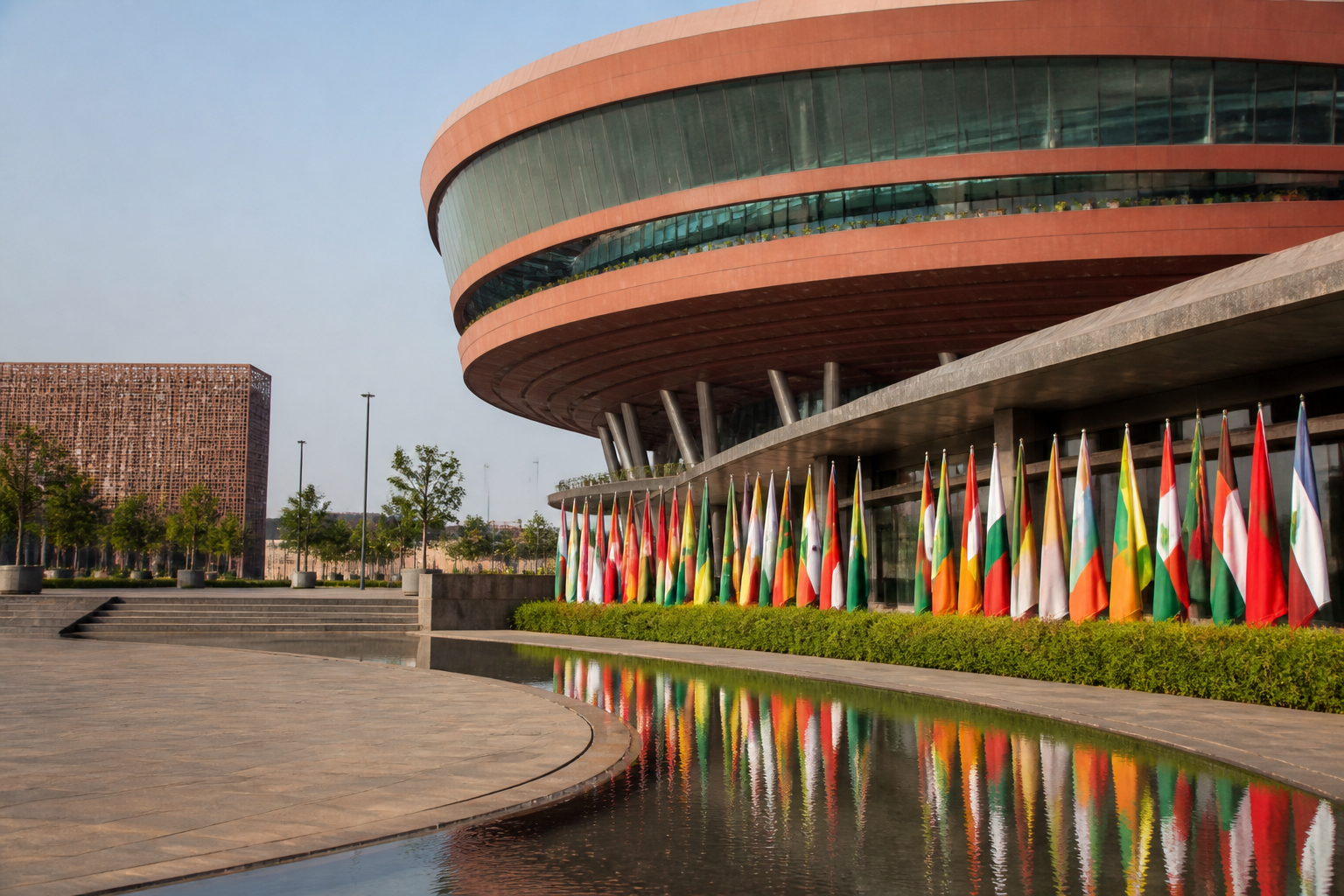
Subheadline: As BRICS expands to include 11 members, India’s New Delhi summit will test whether a diverse group can turn shared economic interests into workable cooperation.
Standfirst: India’s September 12-13 BRICS Summit comes at a moment when the grouping is larger, more economically significant and more politically divided than it was when the original BRIC countries began working together two decades ago. The bloc now brings together major energy producers, manufacturing economies, consumer markets and fast-growing developing countries. That diversity gives it influence across trade, payments, energy and supply chains, but also makes consensus more difficult. India’s presidency is seeking cooperation around resilience, innovation, cooperation and sustainability. The central question is whether New Delhi can use the summit to establish a practical agenda without allowing geopolitical disagreements to overwhelm the group’s economic purpose.
India’s upcoming BRICS Summit is less a test of whether the grouping can speak with one voice than of whether it can work effectively despite having several voices. The September 12-13 meeting in New Delhi marks 20 years of the grouping and comes after a major expansion that has changed both its economic weight and its internal politics.
The original BRIC grouping of Brazil, Russia, India and China was created to give emerging economies greater influence in global governance. South Africa joined in 2010, creating BRICS. Egypt, Ethiopia, Iran, Saudi Arabia and the United Arab Emirates joined in 2024, followed by Indonesia in 2025. The expanded group now has 11 full members, including major energy producers, large consumer markets, manufacturing economies and some of the world’s fastest-growing economies.
That expansion has made BRICS more consequential, but it has also made coordination more complicated. The members have different economic structures, strategic priorities and relationships with the existing global order. India has traditionally seen BRICS as a way to amplify the voice of emerging economies and press for more representative international institutions. At the same time, New Delhi has sought to prevent the grouping from becoming dominated by any one country’s strategic agenda.
The Delhi summit therefore carries two linked objectives. India wants to use BRICS to support a more multipolar global order, while also demonstrating that the enlarged bloc can deliver practical cooperation in areas where members’ interests overlap. The presidency’s four stated pillars are resilience, innovation, cooperation and sustainability, reflecting an attempt to connect diplomatic ambition with economic and technological priorities.
The timing gives that agenda greater urgency. Tariffs, wars and energy disruptions are putting pressure on trade and supply chains. Countries are looking to diversify markets and strengthen economic resilience, while governments are also trying to contain the effects of volatile energy prices and disruptions to transport routes. For India, BRICS provides a platform to discuss these pressures with China, Russia, the Gulf countries and other large emerging economies in the same forum.
The most immediate strategic importance of the summit is the opportunity it creates for India-China-Russia engagement. Chinese President Xi Jinping’s expected presence in Delhi would place India-China interaction at the centre of the meeting, alongside Russian President Vladimir Putin and leaders of the grouping’s newer members. India’s relationship with China remains affected by the border dispute, while Russia remains an important partner for New Delhi in energy, defence and trade.
BRICS cannot resolve those differences by itself. Its value is more limited and more practical: it gives India a setting in which several sensitive relationships can be managed at the same time. That was also visible during India’s first BRICS summit in 2012, when New Delhi helped advance the creation of the New Development Bank and pushed cooperation into areas such as counter-terrorism.
The bloc’s economic scale is its strongest argument for relevance. Collectively, BRICS members account for nearly half the world’s population and a substantial share of global output and trade, according to the supplied reporting. Their combined weight gives the group potential influence over energy, investment, trade, technology and supply chains. But size alone does not create an effective institution. The larger the membership, the greater the number of economic interests that must be reconciled before a common initiative can move forward.
Trade and financial connectivity are likely to be among the most important tests. New Delhi is examining ways to increase intra-BRICS trade, reduce transaction costs and simplify customs procedures. The grouping is also working on cooperation in global value chains through an Action Plan for 2026-30, including a technical council and a joint study.
The challenge is that the members occupy different positions within the same economic system. India and China compete in several sectors while continuing to trade heavily with each other. Gulf countries are major energy exporters, whereas India and China are among the largest energy consumers. Russia’s economy has been reshaped by Western sanctions and the war in Ukraine. These differences make a single economic strategy difficult, but they also create areas where cooperation could be mutually useful.
Payments are an especially sensitive part of that debate. India has distinguished between reducing the cost of cross-border transactions and pursuing an explicitly anti-dollar project. New Delhi supports greater use of national currencies for bilateral trade and more efficient payment mechanisms, but it does not support creating a common BRICS currency. Commerce and Industry Minister Piyush Goyal said in August that India was not in favour of a separate BRICS currency.
India’s approach instead focuses on local-currency settlement, payment interoperability and reducing dependence on costly dollar-based intermediaries. The Reserve Bank of India has also proposed linking the digital currencies of BRICS countries to facilitate cross-border trade and tourism payments. A high-level meeting is expected to examine possible mechanisms for using digital currencies and increasing trade through national currencies.
The practical obstacles are substantial. BRICS countries are at different stages of developing central bank digital currencies and have different technologies, regulatory systems and approaches to monetary policy. A cross-border system would require coordination on standards, settlement, regulation and the treatment of financial risk. The supplied report does not establish that these obstacles have been resolved, making the summit an important forum for discussion rather than evidence of an operational common payment system.
The political language around de-dollarisation also illustrates the differences within BRICS. China has sought to increase the international role of the yuan, while Russia’s position reflects its experience with sanctions and restrictions on the dollar-based financial system. Yet Kremlin spokesperson Dmitry Peskov said on September 8 that Russia did not seek “de-dollarisation” as a formal project and remained open to acceptable payment methods. He also said around 90% of transactions between Russia and BRICS countries were conducted in national currencies.
Energy may offer the clearest common ground. The expanded grouping includes Russia, Saudi Arabia, the United Arab Emirates and Iran, all major energy powers, alongside India and China, two of the world’s largest oil-consuming economies. Producers want reliable markets and investment. Consumers want affordable and secure supplies. Developing economies want access to energy without sacrificing growth, while all members face pressure to shift towards cleaner sources.
India’s energy agenda for BRICS combines energy security with sustainability, technology and innovation. The BRICS Energy Ministers’ Meeting in June discussed energy security, energy access and equity, as well as cooperation on smart grids, energy storage and hydrogen. These subjects are more likely to produce incremental technical cooperation than a single transformative agreement, but they also offer a way for members to work together without resolving their wider geopolitical disputes.
Energy security is particularly important for India because prolonged disruption to shipping through the Strait of Hormuz could increase energy costs, inflation and pressure on the country’s trade balance. The link between energy, transport routes and household economic pressures gives the summit a direct connection to India’s urban and industrial economy, even though the negotiations themselves are taking place at the diplomatic level.
The limits of political consensus were already visible in May, when the BRICS foreign ministers’ meeting in New Delhi failed to produce a joint statement because members could not agree on the conflict in West Asia. India subsequently issued a chair’s statement and outcome document. The episode showed that the expanded group may struggle to make unified political declarations on issues where its members have sharply conflicting interests.
That does not necessarily make BRICS ineffective. It suggests that the grouping’s strongest future may lie in selective cooperation rather than comprehensive alignment. A bloc does not need to resolve every geopolitical disagreement to improve payment systems, coordinate on energy technology, reduce trade frictions or discuss global value chains. But it does need clear priorities, workable institutions and realistic expectations about what consensus can deliver.
For India, the New Delhi summit is therefore a test of institutional design as much as diplomacy. New Delhi must manage its relationships with China and Russia, engage the Gulf energy powers and accommodate newer members while keeping the grouping focused on issues that can produce measurable progress. Its success will depend less on the breadth of the summit declaration than on whether technical discussions translate into implementation.
The evidence available before the meeting confirms both the opportunity and the constraint. BRICS has become larger and more economically important, but expansion has increased the distance between members’ political positions. Energy cooperation, national-currency payments, digital finance, customs procedures and supply-chain coordination offer areas of common interest. The failure to reach a joint statement in May shows that political unity cannot be assumed.
The developments to monitor in Delhi are therefore practical: whether members agree on mechanisms for increasing intra-BRICS trade, how far they advance payment interoperability, whether the 2026-30 global value-chain plan gains institutional shape, and whether energy cooperation produces defined next steps. The summit will show whether a bigger BRICS can convert its diversity into influence without requiring its members to become a unified geopolitical bloc.
