


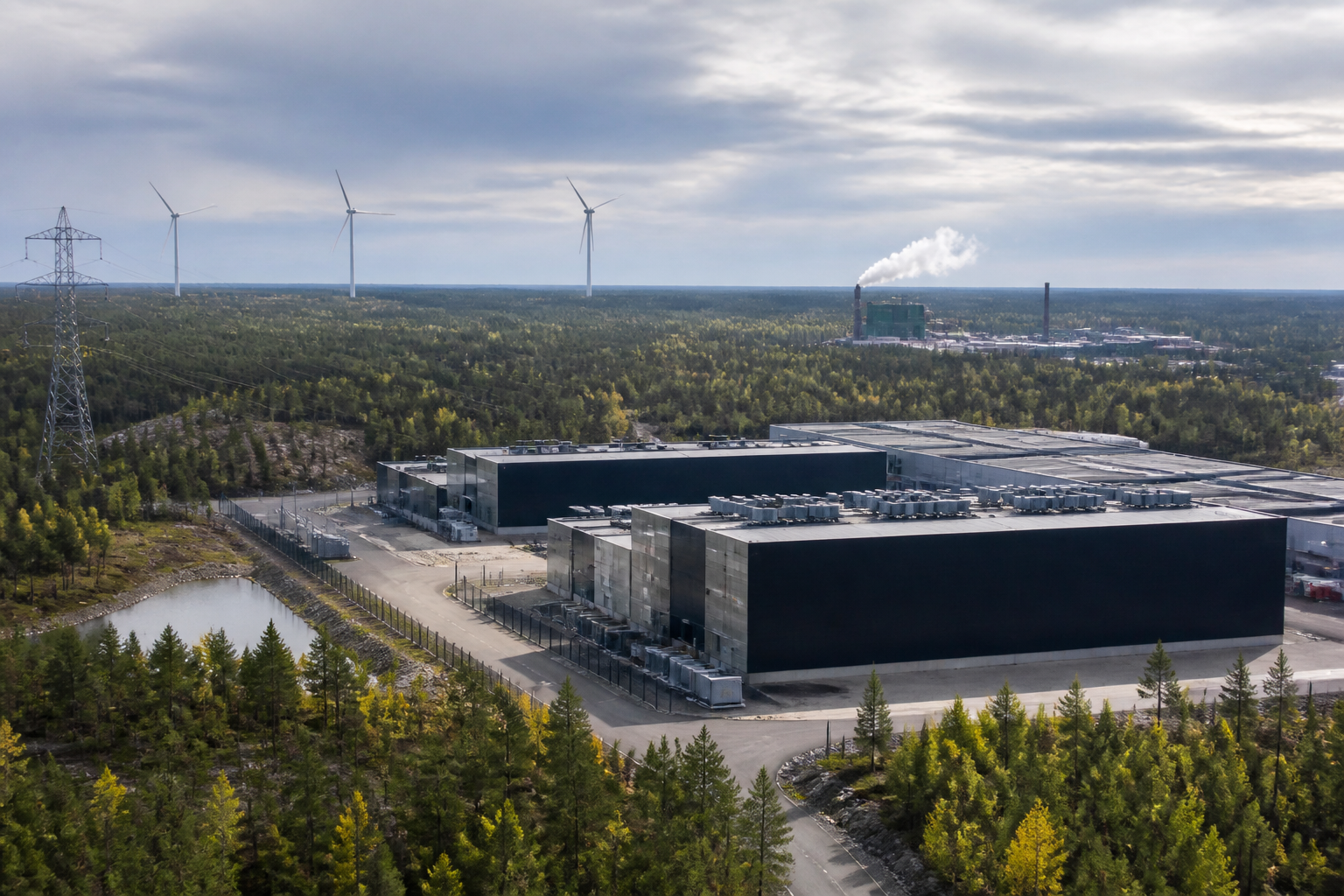
Google’s planned investment of €13 billion, or nearly $15.1 billion, in Finland over the next two years is more than a technology expansion. It is a large-scale infrastructure decision involving data centres, electricity generation, transmission capacity, water systems, construction employment and regional economic policy. The investment shows how the physical requirements of artificial intelligence are reshaping the competition for economic growth.
Google said the package would include three new data centres in Kajaani, Muhos and Vaala in northern Finland, along with an expansion of its existing site in Hamina in the southeast. The company also plans to support energy projects that will supply the facilities. The sites were selected, according to Google, because they are close to existing grid infrastructure and carbon-free energy sources.
That combination is central to the project. AI computing requires large concentrations of servers, which in turn require reliable electricity, cooling systems, land, fibre connectivity and industrial-scale buildings. The Finnish investment therefore places energy and urban infrastructure alongside computing capacity. It also illustrates why the location of data centres is increasingly determined by the availability and quality of public and private infrastructure rather than by proximity to a conventional commercial district.
Google described the investment as its largest single investment in Europe and said it reflected Finland’s position in building AI infrastructure. Finland’s Prime Minister Petteri Orpo called the decision a testament to the country’s strengths. The announcement comes as Finland seeks to revive economic growth amid weak demand, the collapse in trade with neighbouring Russia and fiscal tightening. The country’s unemployment rate has risen above 10 per cent, described in the supplied report as the highest in the European Union.
The project consequently has two connected dimensions. For Google, it is a capacity-building exercise in the global race to expand AI computing. For Finland, it is an attempt to turn energy assets, industrial land, technical expertise and regional infrastructure into a platform for new investment and employment. The same facilities are being presented as both digital infrastructure and an economic-development project.
The energy model is particularly important. Google has signed a 22-year contract with Finland’s state-owned Fortum to buy up to 50 per cent of the electricity output from the Loviisa nuclear power plant. The company is also expanding its energy arrangements through wind-power agreements and plans to install a 94-megawatt battery system at the Kajaani site. The battery is intended to help balance the grid.
These arrangements point to a data-centre model that depends on several layers of infrastructure at once. A facility may be built in one municipality, draw electricity produced at a nuclear plant elsewhere, depend on wind-power contracts and use batteries to manage fluctuations. The physical site is therefore only one part of the system. Its operation is linked to regional power generation, transmission networks, long-term contracts and the ability of the grid to absorb a major new load.
The investment also raises questions about how carbon-free electricity is defined and delivered in practice. The supplied report says nearly 96 per cent of Finland’s electricity is produced from nuclear or renewable sources. Google’s site-selection rationale refers to carbon-free energy, while its agreements cover nuclear power, wind power and battery storage. These details indicate that the company is seeking to align the expansion of computing capacity with a lower-carbon electricity system. The announcement, however, does not establish the project’s full future emissions profile, construction footprint or the precise amount of electricity each new facility will require.
Finland’s climate is another factor in the location decision. The country’s relatively cold conditions are preferred for data-centre operations because cooling is a major part of the infrastructure challenge. The report also says the facilities will reportedly have heat-recovery readiness, allowing server heat to be captured for warming homes. If implemented at scale, that arrangement would connect a highly specialised industrial facility to a local heating system and turn waste heat into a potential community resource.
Heat recovery is not simply a technical add-on. It requires a nearby demand source, suitable network connections, consistent operating conditions and an institutional arrangement between the data-centre operator and the local heating system. The supplied material does not state how many homes could be supplied, when the system would be operational or whether all the proposed facilities would participate. What it does establish is that the investment is being planned with the possibility of linking digital infrastructure to municipal or regional energy needs.
Water is another part of the infrastructure equation. Data centres need fresh water, including for cooling and associated operations. Finland has substantial water resources, and the report says the country has developed a closed-loop system intended to reduce water waste. This gives the project a different operating context from locations where data-centre growth is constrained by water scarcity.
The presence of water resources does not remove the need for management. A closed-loop system can reduce waste, but the announcement does not provide figures for water withdrawal, consumption, discharge or recycling at the proposed sites. Those measurements will be important as the facilities move from investment announcement to construction and operation. The broader issue for local authorities is that the environmental impact of digital infrastructure depends not only on the buildings themselves, but also on the water and energy systems that support them.
The employment projections are substantial. Google estimates that the project will support more than 37,000 jobs during the building phase, including around 16,000 construction jobs. After completion, the facilities are expected to support 7,000 jobs, including positions with suppliers and local services. These figures place construction at the centre of the immediate economic impact and suggest that the project will require a sizeable supply chain across engineering, civil works, electrical systems, logistics and facility services.
The difference between the construction and operational figures also matters. A large number of temporary jobs can support regional activity during the building phase, but the longer-term economic effect depends on the quality and durability of the jobs that remain after completion. Google’s estimate includes suppliers and local services in the operational figure, indicating that the facilities are expected to support employment beyond direct staffing. The supplied material does not identify the skills profile, wage levels or geographic distribution of these jobs, so those dimensions remain unestablished.
For Kajaani, Muhos and Vaala, the proposed facilities could make local infrastructure a central part of the region’s economic strategy. The investment is directed towards northern Finland, while the existing site being expanded is in Hamina in the southeast. This distribution suggests a model in which data-centre development is not concentrated solely in the largest metropolitan areas. Instead, smaller cities and regions with available land, power and cooling advantages can compete for major digital infrastructure projects.
That model changes the planning question. Local governments must consider not only how many workers a facility will employ, but also how the project will affect roads, housing, utilities, emergency services, construction capacity and local public finances. The supplied announcement does not provide details on municipal infrastructure spending, land arrangements or planning approvals. Those issues will become more important as the proposed sites move towards implementation.
The investment also forms part of Alphabet’s broader capital-spending strategy. The company raised its forecast for capital spending to as much as $205 billion for the year, according to the supplied report, as it competes with rivals to expand AI computing capacity. Finland’s project is therefore part of a wider corporate infrastructure race. The scale of that race is visible in the way a single investment links data-centre campuses, power contracts, renewable-energy agreements, battery storage and regional employment.
The policy landscape surrounding the project involves several institutions. Google is responsible for developing and operating the facilities and arranging power and energy agreements. Fortum, as Finland’s state-owned energy company, is involved through the long-term electricity contract connected to the Loviisa nuclear plant. National authorities are interested in investment and economic growth, while regional and local authorities will have responsibilities connected to land use, permits, utilities, transport and services.
The announcement does not specify the full approval process, construction schedule or individual milestones for the three new centres. It also does not establish whether the sites have received all necessary planning or environmental permissions. These omissions are significant because the infrastructure required by AI facilities must be coordinated across private operators, energy providers and public agencies. The investment’s success will depend not only on capital availability, but also on the alignment of those institutions.
Finland’s appeal in this case rests on a combination of conditions: a cold climate, access to carbon-free electricity, existing grid infrastructure, water availability, a nuclear power base, wind-power potential and industrial locations outside the largest cities. The project shows how these factors can be assembled into an investment proposition for advanced computing. It also shows that the next phase of digital infrastructure will be judged through the performance of physical systems that cities and regions have traditionally managed separately.
The evidence currently supports three conclusions. First, AI infrastructure is becoming a major consumer and organiser of land, electricity, water and construction capacity. Second, the ability to attract such facilities depends on coordinated energy and utility systems rather than on technology-sector branding alone. Third, the regional benefits of data-centre investment will need to be assessed through both construction activity and the long-term quality of jobs, services and infrastructure created around the facilities.
What remains uncertain is how the announced capacity will be delivered. The supplied material does not provide detailed site plans, energy-demand projections, water-use figures, construction dates or the division of investment between the facilities and supporting energy projects. Those details will determine the project’s actual effect on Finland’s regions. The next milestones to monitor are the planning and approval processes, construction timelines, energy infrastructure commitments and the implementation of the proposed heat-recovery and battery systems.
