


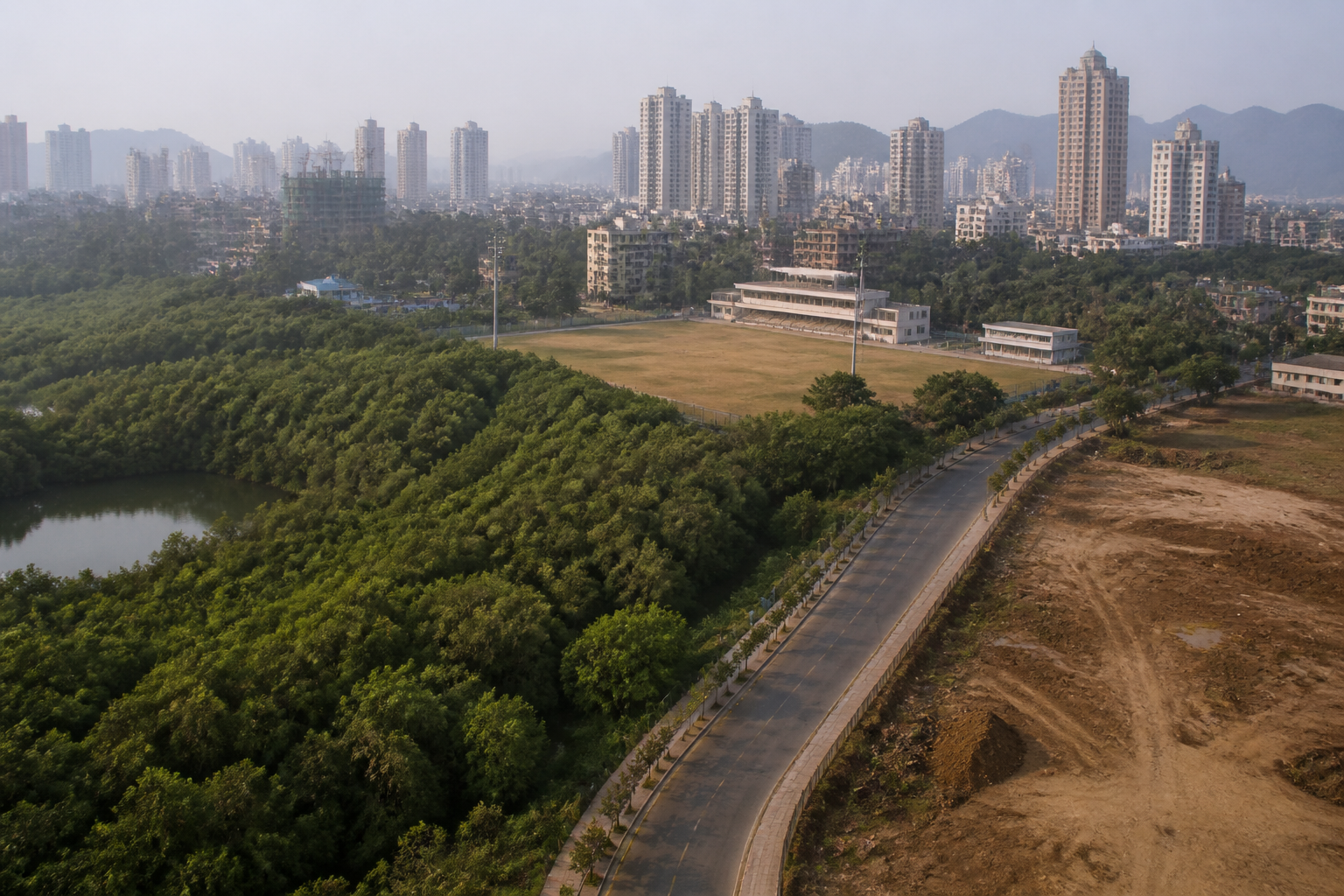
The National Green Tribunal’s direction to stop filling activity near Thane police’s Saket ground is, on the face of the reported proceedings, a narrow interim order. But the dispute exposes a recurring urban governance problem: how public agencies make decisions on land that sits at the intersection of environmental protection, public projects, coastal regulation and administrative accountability.
According to a report by Loksatta, the tribunal directed the Thane city police commissioner not to permit any further filling at the site near the Rabodi-Saket road until the next hearing. The matter concerns alleged unauthorised filling and construction near a mangrove area beside the police department’s Saket ground. The hearing referred to in the report took place on September 3.
The reported dispute began after soil and manure were brought to the site for a Miyawaki plantation project involving 9,000 saplings. Petitioners Rohit Joshi, an environmental activist from Thane, and Aakashganga Society argued that the activity would damage mangroves because the location was within 50 metres of the mangrove area. They also claimed that the site falls within a Coastal Regulation Zone area where filling and construction are prohibited.
The tribunal’s immediate intervention was not an order deciding the entire dispute. The reported direction prevents the police from carrying out filling for any purpose until the next hearing. The tribunal also recorded a prima facie view that the site appeared to fall within CRZ-I (A), a category associated with ecologically sensitive areas. The distinction between a prima facie observation and a final determination is important: the order places activity on hold while the relevant authorities respond.
The case therefore turns on the legal and physical status of the land. The source report says a Forest Department communication placed the area within 50 metres of mangroves. The petitioners relied on that communication to argue that the filling and proposed plantation could harm the mangrove ecosystem. The supplied material does not provide the underlying map, survey coordinates, approved site plan or the complete tribunal order. Those documents would be necessary to establish the precise boundary, the applicable coastal classification and whether any permission was obtained before the work began.
That evidentiary gap is central to understanding the dispute. A plantation can appear environmentally beneficial in general terms, but the ecological effect depends on where it is carried out and how the land is prepared. If soil and other material are placed over or close to a protected coastal ecosystem, the intervention itself can alter drainage, ground levels and the relationship between the mangrove area and surrounding land. The report does not provide technical findings on those effects, and they cannot be assumed from the existence of a Miyawaki proposal alone.
The reported proceedings also point to a problem of institutional coordination. The Thane district collector was listed as respondent number four, but no representative from the collector’s office appeared at the hearing despite what the tribunal considered sufficient notice. The tribunal directed the office to send a representative and file its response at the next hearing. It warned that, failing this, the collector could be directed to appear personally.
This aspect of the case matters because coastal and environmentally sensitive land is rarely governed by one agency alone. The police may control or use the site, the district administration may hold records or exercise administrative authority, the Forest Department may provide ecological information, and the Maharashtra Coastal Zone Management Authority may have responsibilities related to coastal regulation. When these roles are not clearly aligned before work begins, a project presented as greening or public improvement can become the subject of litigation.
The reported proceedings also raised questions about representation. The petitioners objected to the police commissioner and the Maharashtra Coastal Zone Management Authority being represented by the same lawyer, describing their interests as conflicting. The tribunal directed that instructions be obtained at the earliest on appointing a separate lawyer for the coastal authority. The source material does not record a final decision on that request, but the issue illustrates the importance of independent institutional positions in environmental cases.
The disagreement over the Saket ground is not simply about whether 9,000 saplings should be planted. It is about the sequence in which public agencies should act. A site needs to be identified, its environmental and regulatory status established, and the required permissions clarified before material is deposited or construction-related activity begins. If those checks are performed after work has started, a project can create irreversible or difficult-to-reverse changes before the responsible authorities have reached a common position.
The case also shows why the term “green project” cannot substitute for environmental compliance. Miyawaki plantations are often associated with dense urban planting and the creation of small wooded areas. But the reported dispute is not a general assessment of the Miyawaki method. It concerns whether filling and plantation activity are permissible at this particular location, given its reported proximity to mangroves and its alleged CRZ-I (A) status. The environmental value of a project depends not only on its stated objective but also on its location, design, permissions and effect on existing ecosystems.
For Thane, the issue has a wider planning significance. The city contains built-up corridors, transport routes, public institutions and ecologically sensitive areas within a tightly connected urban landscape. As available open land becomes contested, public agencies may seek to use institutional grounds or marginal parcels for plantations, amenities or other projects. That makes land-status verification more important, not less. A parcel that appears available for improvement may be subject to restrictions because of its relationship with wetlands, mangroves, flood pathways or coastal regulation boundaries.
The source report does not establish whether the police had obtained approval from the relevant coastal authority, whether a formal environmental assessment had been conducted, or whether the work was classified by the authorities as filling under the applicable rules. It also does not provide the district administration’s response or the position of the Maharashtra Coastal Zone Management Authority. These are the questions that the next stage of the proceedings is expected to address through responses and documentary material.
The tribunal’s intervention therefore has two immediate consequences. First, activity at the disputed site must remain halted in accordance with the reported interim direction. Second, the government respondents must clarify their positions before the tribunal. The collector’s office has been specifically directed to send a representative and file an answer, while the question of separate legal representation for the coastal authority remains pending.
What the proceedings establish so far is limited but consequential: the tribunal has ordered that no further filling take place at the Saket ground until the next hearing, after recording a prima facie view that the area appears to fall within CRZ-I (A). What remains to be established is the site’s exact legal and ecological status, the permissions obtained, and the factual basis for the proposed plantation. Those documents and the authorities’ responses will determine whether the dispute remains an interim regulatory issue or develops into a broader finding on unauthorised activity near Thane’s mangroves.
