


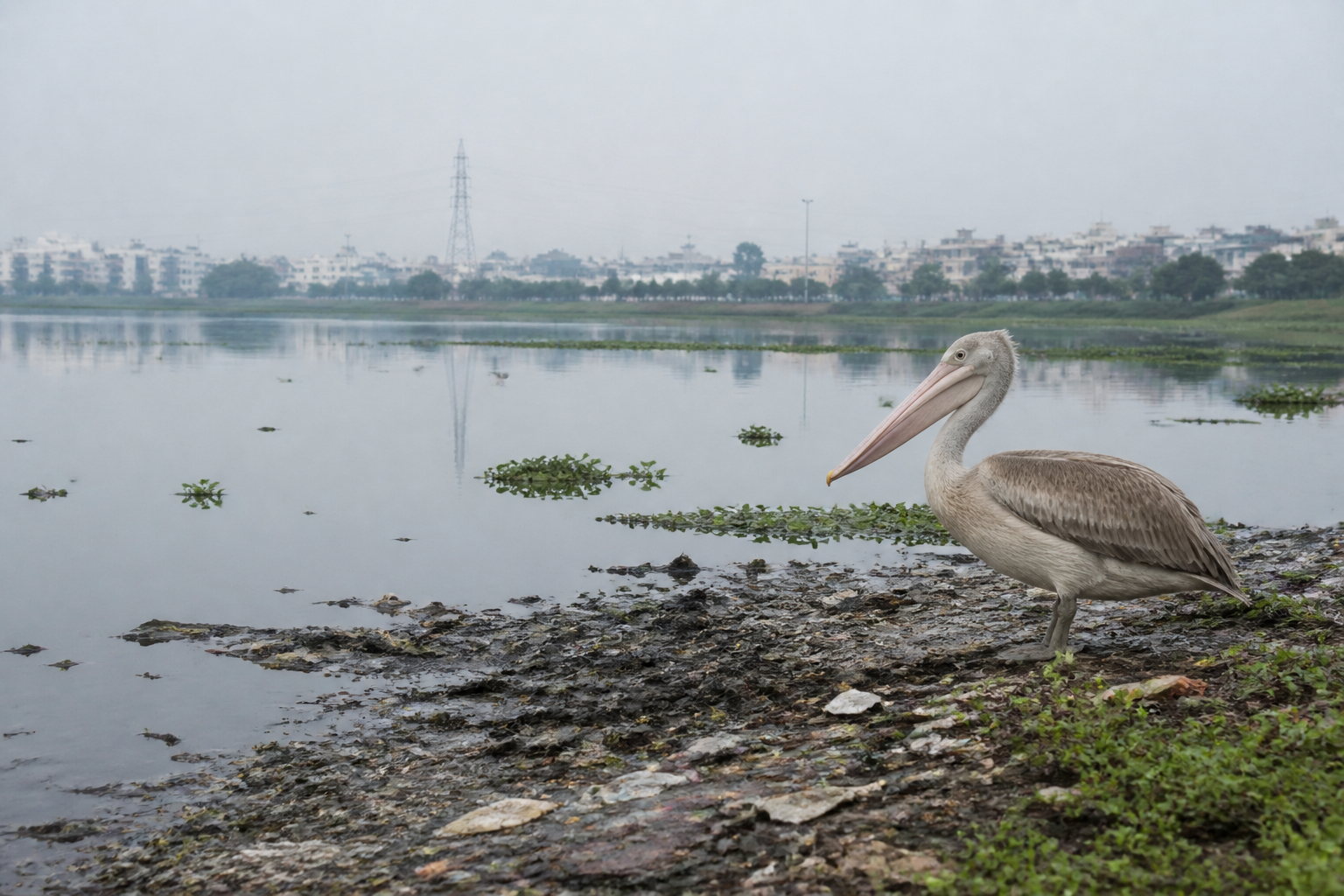
Korattur Lake Shows How Urban Waterbody Protection Is Failing
The discovery of pellets embedded in a spot-billed pelican at Chennai’s Korattur Lake has turned a wildlife rescue into a wider test of how the city protects its urban waterbodies. Two injured pelicans were found at the lake, one of which later died at Children’s Park in Guindy and the other at the Besant Memorial Animal Dispensary in Besant Nagar. An autopsy conducted by the dispensary found pellets in the second bird’s carcass, indicating that it had been shot.
The incident, reported by The Times of India, is not an isolated conservation concern in the account provided. It coincided with the discovery of a large number of dead fish in the same lake. Fisheries officials attributed the fish deaths to untreated sewage entering the waterbody along with increasing surface temperatures. Taken together, the two events point to a waterbody facing different forms of pressure at once: direct harm to wildlife, declining water quality and incomplete institutional protection.
The immediate facts remain limited but important. Waterbody conservationists reportedly spotted the two pelicans injured and struggling about ten days before publication and alerted forest officials. The birds were rescued and taken to separate facilities. One died on the day it reached Children’s Park. The other survived for a couple of days at the Besant Memorial Animal Dispensary before dying from its injuries. The autopsy of that bird found pellets embedded in its body. A senior wildlife official said the other carcass had been sent to Madras Veterinary College for examination, with the result still awaited.
That pending autopsy matters because it separates what has been established from what remains to be confirmed. The presence of pellets in one carcass provides evidence of shooting in at least one case. The report describes the two incidents as back-to-back poaching cases, but the second post-mortem result was not available in the supplied material. Any assessment of the scale of the poaching, the identity of those responsible or the method used would therefore require further investigation.
The authorities’ first response has been to increase vigilance at the lake in an effort to catch the alleged poachers. That response addresses the immediate enforcement gap, but the episode also raises a broader question: whether surveillance is being treated as a temporary reaction or as part of a permanent management system for a lake that attracts migratory birds.
## A lake carrying several urban pressures
Korattur Lake is described by local conservationists as a waterbody that has attracted migratory birds, including pelicans, over the past few years. S Sekharan, founder of the Korattur Aeri Padhukappu Makkal Iyakkam, said the birds’ presence represented a fragile ecological gain. His concern was that unchecked poaching could push them towards safer habitats and reverse that gain.
The phrase “fragile ecological gain” captures the central problem presented by the report. A bird habitat in a city is not protected only by the presence of water. It depends on water quality, food availability, safe nesting or resting conditions, control of disturbance and the ability of authorities to prevent deliberate harm. If any one of those conditions deteriorates, the ecological value of the lake can decline even while the waterbody remains physically present.
At Korattur, the reported threats are not occurring separately. KAPMI is already seeking action against the discharge of untreated sewage into the lake. The discovery of dead fish has added evidence of stress within the aquatic environment, although the supplied report does not establish the exact quantity of fish affected or identify the specific sewage inlets responsible. Fisheries officials linked the deaths to untreated sewage inflow combined with rising surface temperatures.
This combination is significant because it places the lake within two different administrative frames. Poaching is principally an enforcement and wildlife-protection issue. Sewage inflow is a utilities, pollution-control and municipal-management issue. Fish deaths may also require fisheries and environmental monitoring. When these problems appear in the same waterbody, responsibility is distributed across agencies, and the risk is that each authority addresses only the part that falls directly within its mandate.
## Protection status is more than a legal designation
KAPMI has renewed its demand that Korattur Lake be declared a protected area. The demand is based on the need to shield the lake’s fish, birds and wider ecology from further decline. The report does not specify the legal category being sought, the authority that would grant it or the management powers that would follow such a designation. Those details are essential to judging whether formal protection would produce stronger outcomes.
A protected status can establish a clearer conservation objective, but designation alone does not remove sewage outlets, create patrol capacity or ensure that violations are prosecuted. The effectiveness of any protection regime depends on how boundaries are defined, which agency is accountable, how monitoring is funded and what happens after an offence is detected. The pellet injuries make that implementation question concrete: the lake may be frequented by birds, but the available account does not indicate whether there is a regular patrol system, camera coverage or a documented wildlife-monitoring protocol.
The same issue applies to pollution control. Fisheries officials said authorities must act to plug sewage inlets and protect the lake. That statement identifies a necessary intervention but does not establish whether the inlets have been mapped, whether responsibility for each connection is known or whether a deadline has been set for stopping the discharge. Without those details, the response remains an instruction rather than an implementation plan.
The lake’s condition therefore cannot be assessed solely by asking whether authorities have increased vigilance after the pelican deaths. A fuller assessment would need to track at least three things: whether enforcement prevents further shooting, whether the sewage inflows are stopped and whether water and wildlife conditions improve afterward. The supplied report confirms the first response but does not yet provide evidence of progress on the other two fronts.
## What the evidence confirms—and what it does not
The strongest evidence in the report concerns the dead pelican examined by the Besant Memorial Animal Dispensary. Pellets were found embedded in its carcass. That finding supports the conclusion that the bird suffered a gunshot injury. The rescue of two injured pelicans from the same lake within a short period, followed by the discovery of pellets in one of them, is the basis for the reported concern over poaching.
The second bird’s autopsy remains an unresolved factual point. The carcass was sent to Madras Veterinary College, but the result was awaited. The final findings could clarify whether the injuries were similar and whether the incidents were connected. Until then, the report supports heightened concern but not a complete account of the perpetrators, frequency or organisation of the alleged poaching.
The fish deaths are also attributed rather than independently documented in the supplied material. Fisheries officials linked them to untreated sewage and increasing surface temperatures. That explanation identifies two reported stressors, but the account does not include water-quality measurements, laboratory results, the number of fish found dead or a comparison with previous fish mortality events. Those missing details do not negate the officials’ assessment; they show why continued monitoring is necessary before the lake’s ecological decline can be quantified.
The report also does not establish whether the sewage discharge is new or longstanding. KAPMI says it has been contending with untreated sewage pollution, suggesting that the problem predates the latest fish deaths. But the supplied material contains no timeline for the discharge, no record of previous remedial work and no information on whether any agency has issued notices or undertaken enforcement. The distinction matters because a recurring pollution source requires a different administrative response from a one-time incident.
## The larger urban question
Korattur Lake illustrates how urban ecology is governed through overlapping systems rather than a single conservation decision. Wildlife authorities can respond to injured birds, fisheries officials can assess fish deaths and municipal or utility agencies can address sewage. Yet the ecological condition of the lake depends on all of these functions working together. A gap in one area can undermine progress in another.
The birds also provide a visible measure of the lake’s condition. Their presence signals that the waterbody continues to have ecological value, while their injuries expose the limits of that value when safety and enforcement are weak. Fish deaths make the degradation more visible to nearby residents, but the underlying problem is not only what can be seen on the surface. It is whether the institutions responsible for the lake can identify pollution sources, maintain surveillance and act before damage becomes irreversible.
For now, the evidence confirms two immediate concerns: at least one pelican found at Korattur Lake had pellets in its body, and a large number of fish were found dead amid reported sewage pollution and rising surface temperatures. It does not yet establish the full scale of poaching, the final cause of both bird deaths or the precise source and extent of the fish mortality. The developments that warrant monitoring are the second autopsy, the outcome of the wildlife vigil, action on sewage inlets and any formal decision on protected status for Korattur Lake.
