


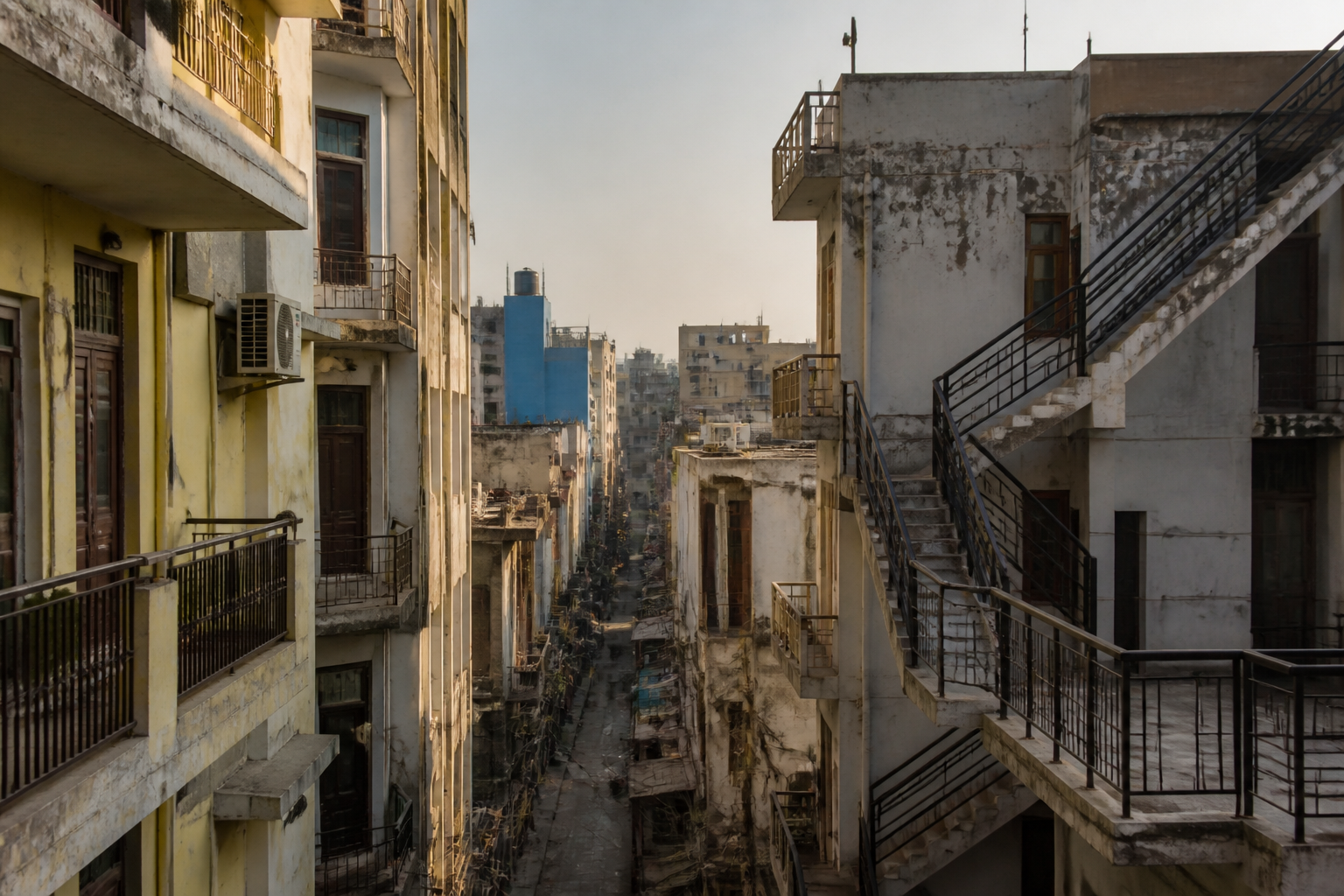
Two Delhi neighbourhoods are carrying the consequences of separate tragedies. In Hauz Rani, a fire at the Flourish Stay B&B killed 23 people, including 14 foreign nationals, on June 3. In Satya Niketan, the collapse of a five-storey paying guest accommodation killed seven people, including five students and two labourers. The immediate emergencies ended with rescue operations, but the urban disruption has continued in the form of empty buildings, departing students, sealed accommodation and a wider loss of trust in low-cost housing.
The events were different, but the conditions described in the report are closely related. Both neighbourhoods had become important because they offered accommodation close to essential urban destinations: hospitals in Hauz Rani and colleges in Satya Niketan. Both also served people who were highly dependent on affordable rooms. Medical tourists and their relatives needed short-term lodging near hospitals. Students arriving from other states needed relatively inexpensive rooms near university campuses. In each case, the demand for location and affordability appears to have outpaced the systems intended to ensure that buildings were safe.
That is the central urban question raised by the two tragedies. When accommodation is created through incremental additions, informal conversions and weak oversight, who is responsible for ensuring that a room can safely be occupied? The answer is not limited to the property owner. It involves licensing authorities, building officials, fire-safety agencies, local administration, landlords, colleges and the broader housing market that leaves residents with few affordable alternatives.
In Hauz Rani, the investigation into the fire described a sharp gap between the authorised use of the property and its reported operation. The B&B had a licence for six rooms but was allegedly running at least 25 rooms across four floors, a basement and an improvised rooftop facility. The property had also allegedly been expanded illegally, lacked a fire no-objection certificate and had no emergency fire exit. According to the Delhi Police chargesheet cited in the report, the fire began in the kitchen after an oil fryer was allegedly left unattended. Dense smoke travelled up the central staircase, trapping people on the upper floors.
The sequence of the response shows how building form and street conditions shaped the outcome. The first distress call came at 8.48am. Firefighters reached the site seven minutes later but faced difficulty moving through narrow and congested lanes. Between 9am and 11.30am, they rescued 48 people, and the fire was under control by noon. Twenty-three people nevertheless died. The chargesheet named the B&B owner, manager-cum-accountant and cook as accused, with investigators alleging that basic safety requirements had been disregarded as the property was expanded to increase commercial returns.
The consequences have extended beyond the building itself. Several homestays and B&Bs in the area were sealed after the fire, reducing the accommodation supply that had supported the local economy. Shopkeepers who depended on relatives of medical tourists lost customers, while residents in at least one nearby building reportedly left after the smoke spread and had not returned. The removal of police barricades allowed some activity to resume, but the neighbourhood has not simply returned to its earlier condition. Commercial recovery depends on visitors believing that the area is safe, while that confidence has been weakened by the incident and by the visible closures around it.
Satya Niketan presents a different version of the same housing problem. The collapsed PG building was reportedly around 40 to 50 years old, with additional floors added over time. Construction work had been under way for about two weeks before the collapse. The report also describes student concerns about adjoining structures, including poor ventilation, dangerous staircases and inadequate fire-safety provisions. One neighbouring building was being vacated for demolition, while other structures were identified as unsafe.
For students, the danger was not an abstract question of building regulation. It changed where they could sleep, study and store their belongings. Some moved to friends’ or relatives’ homes. Others spent nights inside college campuses after being forced out of their PGs. A student paying Rs 8,000 for accommodation was already paying what the report described as a relatively low rent for Delhi, while living in a room without ventilation or air conditioning. The family’s concern was therefore not solved simply by advising the student to find another room. Moving to a safer building could mean accepting a higher rent, a longer commute or an uncertain arrangement elsewhere.
This is where the student housing shortage becomes important. According to figures cited by officials in the report, around 71,600 new undergraduate students were admitted to Delhi University in 2026-27, while the university had approximately 7,000 hostel seats. The gap leaves thousands dependent on private accommodation clustered around college areas. These PGs are not a marginal part of the city’s housing system. They function as a parallel supply of rooms for students who cannot access institutional hostels and cannot afford conventional rental housing.
Yet the private accommodation market is often assessed through the room available rather than the building that contains it. A low rent and a short distance from campus may determine a student’s choice, but neither indicates whether the property has adequate exits, ventilation, structural stability or fire protection. The market rewards proximity and affordability immediately. Safety checks, when absent or irregular, remain invisible until an accident exposes the consequences.
The policy response described after the Satya Niketan collapse recognises this gap. Students demanded a dedicated portal requiring PG owners to disclose rents, facilities, meal plans and structural-safety information. They also sought pre-monsoon audits, structural certifications and regular fire-safety inspections. Delhi’s urban development minister, Ashish Sood, promised comprehensive legislation and regulations for PG accommodation within two months. The proposed framework was expected to include mandatory licences, zone-wise rent bands, structural and fire-safety audits and a central portal listing rents, amenities and compliance details.
Such a framework would create a formal administrative category for accommodation that currently sits between residential housing, commercial lodging and student services. That distinction matters because each category can attract different rules and different enforcement responsibilities. A building may begin as a residence, acquire additional floors, convert rooms into PG units and continue operating without a corresponding reassessment of its structural and fire-safety requirements. A B&B or homestay may similarly expand its commercial capacity without the licence, access arrangements or emergency infrastructure required for its actual occupancy.
The two cases also show why licensing alone may not be enough. In Hauz Rani, the problem described was not simply the absence of a licence but a substantial divergence between the licensed capacity and the reported operation. In Satya Niketan, the concerns involved age, additions, construction activity and the condition of surrounding structures. A regulatory system must therefore connect approvals to inspections, occupancy, structural changes and public disclosure. It must also establish what happens when a building is found unsafe, including where displaced residents or students can go.
The temporary use of Delhi University classrooms and other facilities as shelters illustrates that last problem. Colleges reportedly placed mattresses in health centres, staff rooms and guest rooms, and arranged food and counselling while student volunteers tried to identify those who may have been living in the collapsed building. This offered immediate relief, but it also demonstrated that the city’s formal housing and emergency systems were not designed to absorb a sudden displacement of students at neighbourhood scale.
The available evidence does not establish how many buildings in Hauz Rani or Satya Niketan face similar risks, how many PGs operate without valid permissions, or whether proposed inspections have been completed. It also does not establish the final legal outcome of the fire investigation or the administrative findings concerning the collapse. Those gaps are important. The two tragedies provide strong evidence of the consequences of unsafe accommodation, but they do not by themselves measure the full scale of the problem across Delhi.
What they do establish is the link between housing affordability and safety. In both neighbourhoods, people chose accommodation because it was connected to a necessary urban function and within reach of their budgets. When safety failed, the alternatives were limited. Hauz Rani’s businesses lost the visitors on whom they depended. Satya Niketan’s students lost rooms they could afford and were pushed toward more expensive or temporary arrangements. The physical incidents were local, but the housing pressures that shaped them are common across the city.
Delhi’s challenge is therefore not only to respond after a fire or collapse. It is to identify accommodation that has changed use, expanded beyond approved capacity or deteriorated without inspection, while ensuring that compliance does not simply remove low-cost rooms from the market. The policy debate will need to track both safety and availability: which buildings are safe, how residents can verify that information, who enforces the rules and what affordable options remain when unsafe properties are closed.
The evidence from Hauz Rani and Satya Niketan confirms that the effects of urban tragedies continue long after rescue operations end. The remaining questions concern the reach of the proposed PG regulations, the inspection of adjoining buildings, the legal findings in both cases and the capacity of Delhi’s institutions to provide safer affordable accommodation. Until those questions are answered, a cheap room near a hospital or college will remain not only a housing choice, but also a test of how the city governs its built environment.
