


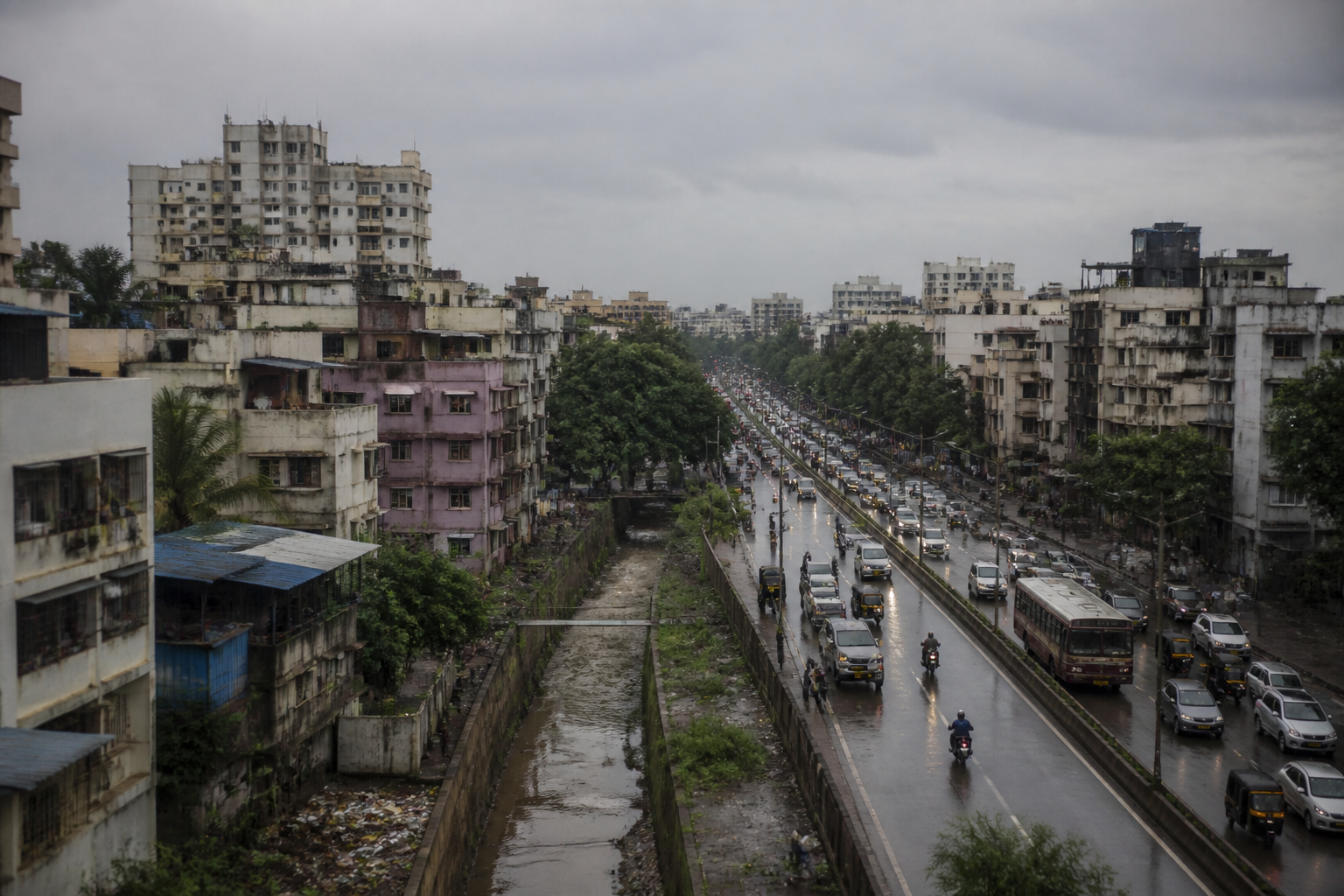
Urban climate resilience is no longer only a question of flood control, heat management or environmental protection. It is increasingly tied to whether Indian cities can remain productive, liveable and economically competitive as urbanisation accelerates. That was the central warning delivered by former civil servant and urban administration expert Dr Ramnath Jha at a lecture in Pune on the crisis facing metropolitan regions.
Speaking at the Dr P. R. Dubhashi Lecture at the Gokhale Institute of Politics and Economics, Jha argued that uncontrolled construction, inadequate housing, shrinking green areas and weak civic infrastructure were increasing the vulnerability of cities. He said the deterioration of urban living standards could have consequences far beyond the municipal boundary, including wider economic effects and a possible outflow of young people and capital in search of better infrastructure, public services and quality of life.
The argument places the urban climate question inside a broader governance problem. Climate change may intensify heat, alter rainfall patterns and increase the risk of sudden flooding, but the severity of those impacts depends heavily on how cities are planned and built. Where green areas decline, drainage and water absorption can weaken. Where construction expands without adequate infrastructure, more residents and assets are exposed to disruptions. Where housing supply is insufficient, pressure on land and services can produce unsafe or poorly serviced urban growth.
Jha’s remarks, as reported by Loksatta, bring these pressures together rather than treating them as separate policy failures. Unauthorised and unregulated construction, inadequate housing, declining air quality, insufficient sewage treatment, poor roads, weak pedestrian facilities, traffic congestion and inadequate public transport were identified as interconnected challenges facing Indian cities. Each problem affects a different part of daily life, but together they shape the quality and resilience of the urban system.
That connection is important because infrastructure capacity does not automatically keep pace with population growth. Jha said that more than 550 million people live in 80 major cities and that these urban centres have become principal engines of the country’s economic development. At the same time, he argued that civic infrastructure and public services in many cities have not expanded at the same speed as urbanisation. The figures were presented during the lecture and are reported here as claims attributed to him.
The underlying issue is not simply that cities need more projects. It is that urban expansion requires coordination between land use, housing, mobility, public health, water management and climate preparedness. A road widening project, for example, cannot by itself resolve congestion if public transport remains inadequate or if pedestrian access is neglected. Similarly, construction activity cannot be assessed only through the number of homes or commercial buildings added; it must also be considered alongside drainage, sewage treatment, open space and access to public services.
Housing is central to this question. The source report identifies inadequate housing as one of the concerns raised by Jha, but it does not provide a quantified estimate of the shortage or describe a specific housing programme. Even so, the relationship between housing and resilience is clear within the framework of the lecture: when formal housing does not meet urban demand, growth can move into areas or forms that are less secure, less serviced or more exposed to climate-related risks. The challenge is therefore not only to build more homes, but to ensure that housing is connected to functioning infrastructure and public services.
The decline of green areas was also linked to rising heat and changing rainfall conditions. The report does not identify particular locations, measure the loss of green cover or provide temperature data. It does, however, establish the concern raised by the speaker: changes in the urban landscape can amplify the effects of climate-related events. This makes green infrastructure part of the city’s protective system, rather than an optional aesthetic feature.
Flooding illustrates the same relationship between natural processes and urban decisions. Jha referred to sudden floods among the risks confronting metropolitan regions. The supplied report does not specify a particular flood event, drainage project or rainfall threshold. It therefore cannot establish the causes of flooding in any individual city. What it does show is that flood risk was presented as part of a wider pattern in which changing rainfall and urban development are increasing vulnerability.
Air quality and public health add another layer to the economic argument. The report says Jha highlighted deteriorating air quality and its effect on public health, but supplies no pollution readings or health statistics. The significance of the point lies in how environmental conditions influence the daily functioning of a city. If residents face worsening public health conditions, the consequences extend beyond individual households to workplaces, schools, transport systems and the public agencies responsible for responding to those pressures.
Mobility was another major gap identified in the lecture. Jha said only 17 cities in the country currently have metro rail services and argued that stronger urban transport systems are needed. Metro rail is only one form of public transport, and the source does not compare metro availability with bus networks, commuter rail or non-motorised transport. Still, the observation highlights a wider institutional challenge: urban transport capacity must be planned against the scale and distribution of demand, while roads, footpaths and public transport are developed as parts of one system.
The limitations of the available evidence are also significant. The report records a public lecture and the claims made during it, but does not provide a government notification, technical assessment, city-level dataset or independent expert response. It does not identify which 80 cities were included in the population estimate, explain how the 550 million figure was calculated, or detail the basis for the count of 17 cities with metro services. Those claims require separate verification before they can support more precise comparisons or policy conclusions.
That distinction matters for urban governance. General warnings can establish the scale and direction of a problem, but implementation depends on specific responsibilities. Metropolitan planning bodies, municipal corporations, transport agencies, housing authorities, water and sewage utilities, and state governments often control different parts of the urban system. The source report does not describe a proposed administrative reform or funding model. It does, however, frame metropolitan reform as urgent and suggests that fragmented responses may not match the combined nature of the risks.
The lecture’s title, “Crisis Facing Metropolises: The Imperative of Reform”, captures that institutional concern. Reform, in this context, cannot be reduced to a single infrastructure intervention. The issues described require cities to align development decisions with service capacity and climate exposure. They also require public agencies to consider living standards as an economic factor, not merely as a welfare outcome.
This is where the warning about young people and capital becomes relevant. Jha’s claim is not supported in the supplied report by migration data, investment figures or a comparative study of cities. It should therefore be treated as an argument rather than an established trend. Its policy significance, however, is clear: if cities fail to provide reliable services, mobility, housing and environmental conditions, their ability to attract and retain residents, workers and investment may be affected.
The evidence available from the lecture confirms a broad diagnosis rather than a city-specific action plan. Indian metropolitan regions are expanding, but the report says that infrastructure and civic services have not always kept pace. At the same time, climate pressures are making heat, changing rainfall and sudden flooding more consequential. The unresolved question is how each city will translate that diagnosis into measurable plans for housing, drainage, green areas, public transport, sewage treatment and pedestrian infrastructure.
For urban policymakers, the next stage is therefore not simply to acknowledge vulnerability, but to establish which risks are increasing, which agencies are responsible and what capacity exists to respond. The source material does not provide those answers. It does show why urban climate resilience must be considered alongside economic performance and living standards. As metropolitan regions become more important to national growth, the quality of their planning and public services will increasingly determine how securely that growth is sustained.
