


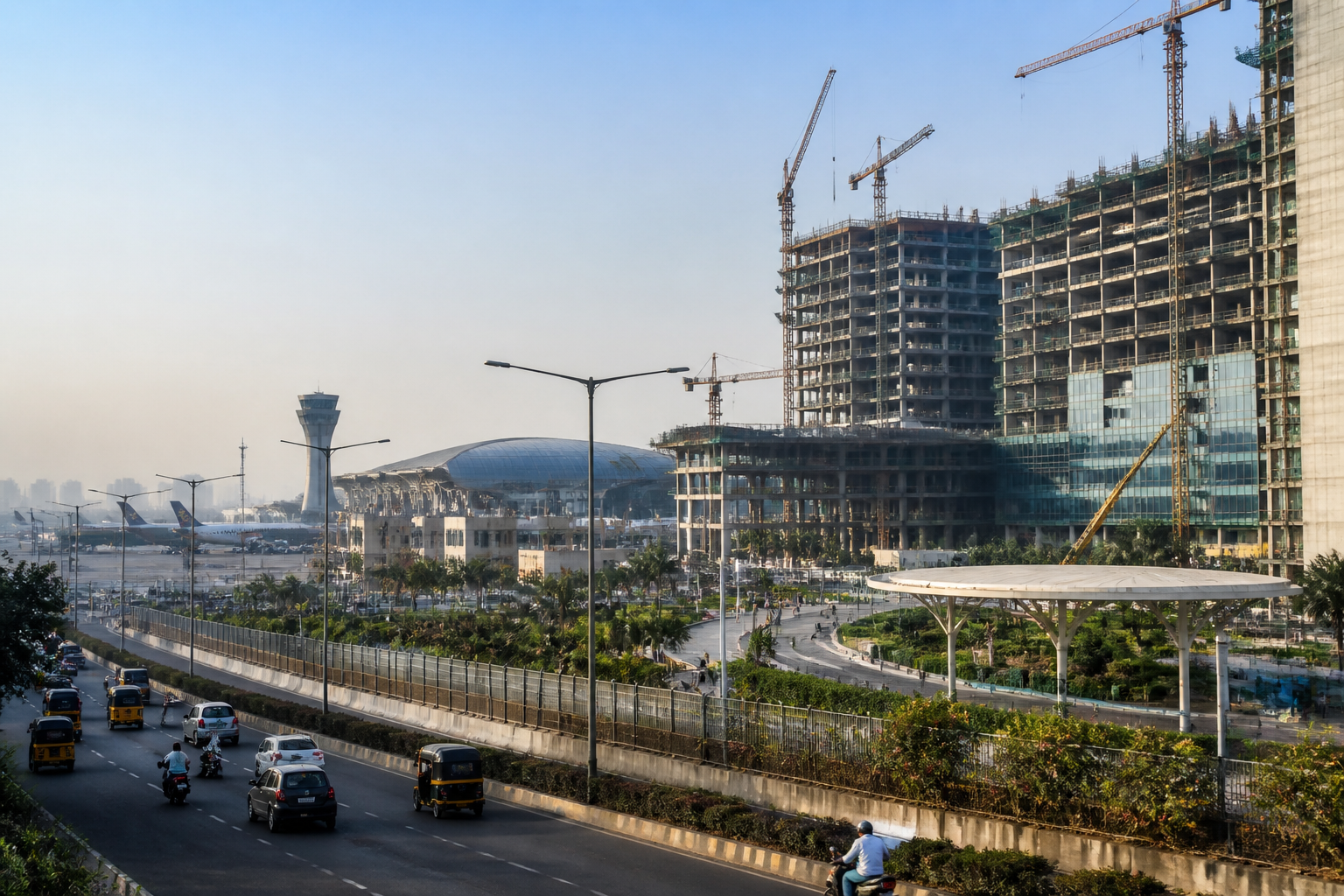
Adani Airports’ proposed USD 1 billion fundraise is more than a capital-markets transaction. It is a fresh signal that India’s largest airport platforms are increasingly being built as urban development ecosystems, combining aviation infrastructure with offices, retail, hospitality and other mixed-use projects around airport land. Adani Airport Holdings Ltd (AAHL) said on Wednesday that it would raise the money from a consortium including Alpha Wave Global, Premji Invest, Temasek and funds managed by BlackRock. The transaction values the company at a pre-money equity valuation of around USD 18 billion and would give the investors a collective 5.54 per cent stake after three tranches are completed.
The funding is significant because AAHL’s stated growth plan links two forms of expansion that have traditionally been treated separately: the expansion of passenger-handling capacity and the commercial development of the areas surrounding airports. The company said the proceeds would be used to expand and modernise airport infrastructure, develop integrated airport-city ecosystems and scale passenger-facing and other non-aeronautical businesses. The final tranche is expected to be completed by July 2027, subject to customary conditions, including applicable approvals.
The announcement places airport infrastructure at the centre of a broader urban growth model. An airport is no longer being presented only as a terminal, runway and access road. In AAHL’s plan, it is also a platform for mixed-use development and economic activity on the city side. The company said it plans to develop around 22 million square feet of mixed-use projects in the first phase of its Adani Airport City developments around its airports. It also expects the investments to take the platform’s annual passenger-handling capacity to around 200 million.
That combination changes the scale of the infrastructure question. A larger terminal can increase the number of passengers an airport processes, but an airport-city project also creates new demands for roads, public transport, utilities, parking, pedestrian access, land management and municipal coordination. The supplied announcement does not provide project-wise details for the 22 million square feet, including locations, development timelines, transport plans or the division between commercial, hospitality and other uses. Those details will be important in determining how the proposed expansion interacts with the cities in which AAHL operates.
AAHL currently manages eight airports across India and serves more than 23 per cent of the country’s total passenger traffic, according to the company. Its platform covers aeronautical operations, passenger-facing non-aeronautical businesses and city-side development. This structure gives the company a footprint that extends beyond airport operations. It also means that decisions on investment and expansion can influence the urban economies around the airports, although the announcement does not quantify the expected employment, property development or local government revenue effects.
The company’s argument is built around the relationship between air connectivity and economic activity. Jeet Adani, Non-Executive Director of AAHL, described aviation as a multiplier of gross domestic product growth and said that expansion in air connectivity could support trade, tourism, employment and regional development. Arun Bansal, CEO of AAHL, said the company’s city-side developments were being positioned as economic catalysts in major urban centres. These are company statements rather than independent assessments, but they reveal the strategic logic behind the fundraise: passenger growth is being treated as the anchor for a larger portfolio of airport-linked businesses.
The proposed investment also illustrates how airport infrastructure is becoming more dependent on institutional capital. The participating investors include global and domestic financial institutions, and AAHL described the transaction as one of the largest primary equity investments by financial institutions in India’s airport infrastructure sector. Unlike a secondary share sale, a primary equity transaction raises new capital for the company. In this case, AAHL said the funds would be directed towards expansion and modernisation rather than simply changing the ownership of existing shares.
The company’s pre-money valuation of around USD 18 billion provides the market’s stated valuation context for the transaction, while the 5.54 per cent collective stake indicates the proportion the investors are expected to hold once all three tranches are completed. The staged structure is also important. Since the final tranche is expected only by July 2027, the full investment is not an immediate infusion available on the day of the announcement. Completion will depend on the stated conditions precedent and applicable approvals.
The raise follows Adani Enterprises’ Rs 15,000-crore qualified institutional placement in July, which the company described as the largest QIP by a non-financial corporate in India. Together, the two transactions point to a wider effort to mobilise institutional capital for expansion. However, the supplied material does not state how much of the airport fundraise will be allocated to individual airports, how the money will be divided between airside and city-side projects, or whether the planned mixed-use development will be financed entirely by AAHL or through additional partnerships.
The capacity target offers another measure of the proposed expansion. AAHL currently serves more than 23 per cent of India’s total passenger traffic and manages eight airports. It expects the investment to take annual passenger-handling capacity across its platform to around 200 million. The announcement does not provide the current combined capacity, airport-wise traffic figures or the time period within which the target will be achieved. Without those figures, it is not possible to assess the exact scale of the increase or compare the proposed capacity with current demand at each location. The target nevertheless indicates that the company is planning for growth across a multi-airport network rather than for an isolated terminal upgrade.
This matters for city governments because airport expansion can move pressure beyond the airport boundary. More passengers may require better road and public transport connections, while mixed-use development can generate travel demand throughout the day rather than only during flight peaks. The announcement refers to integrated airport-city ecosystems, but it does not identify the institutional framework through which airports, municipal bodies, transport agencies and utility providers will coordinate. That gap is central to assessing whether the planned developments will function as connected urban districts or as privately managed enclaves with limited integration into surrounding neighbourhoods.
The same question applies to the non-aeronautical businesses that AAHL plans to scale. Retail, hospitality, commercial development and other passenger-facing activities can diversify airport revenues beyond aeronautical charges. They can also change the role of airport land within the urban economy. The source material does not provide revenue shares, tenant details, land-use plans or pricing information, so the financial contribution of these businesses cannot yet be independently assessed. What is clear is that AAHL considers them a core part of the airport platform rather than an incidental addition to terminal operations.
The proposed 22 million square feet of mixed-use development makes land-use planning especially important. The announcement describes this as the first phase of Adani Airport City developments, but does not specify the sites or the approvals required for each project. The scale will ultimately need to be understood alongside access infrastructure, water and power supply, waste management, emergency services and public transport. Those requirements are not simply construction issues. They determine how airport-led growth affects the wider urban system and who bears the cost of connecting new development to existing city infrastructure.
The institutional responsibilities are also distributed. AAHL is responsible for its airport platform and has entered into a Share Subscription Agreement and a Shareholders’ Agreement with the incoming investors. Regulatory and other applicable approvals remain part of the transaction process. Local and regional authorities would be relevant to land use, access, utilities and construction approvals, although the supplied announcement does not identify specific agencies or permissions. The transaction therefore creates a clear corporate plan but does not yet provide a complete public implementation framework.
The announcement confirms three immediate facts: AAHL intends to raise about USD 1 billion in primary equity; the investors are expected to acquire approximately 5.54 per cent after three tranches; and the funds are intended for airport modernisation, capacity expansion, airport-city development and non-aeronautical businesses. It also confirms a longer-term ambition to operate a platform handling around 200 million passengers annually and to develop around 22 million square feet in the first phase of its airport-city plans.
What remains uncertain is equally important. The source does not establish the project-wise timeline, the location and composition of the mixed-use developments, the current baseline for passenger capacity, the funding split between aviation and city-side assets, or the arrangements for transport and municipal integration. The transaction itself is subject to approvals, and the final tranche is expected by July 2027. The next stage of scrutiny will therefore involve the completion of those tranches, the applicable approvals and the release of more detailed plans for how airport expansion will connect with the cities around it.
