


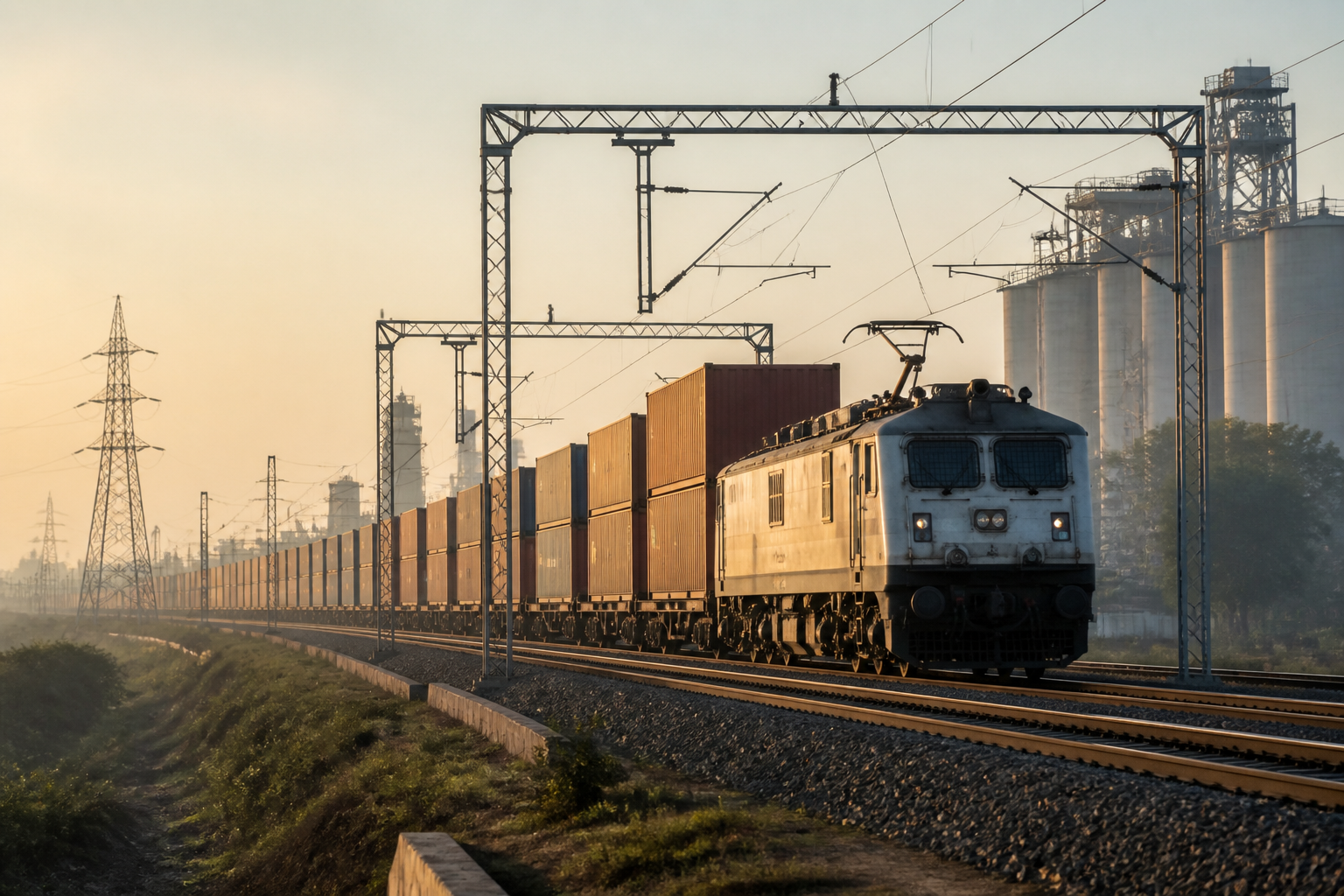
India’s Dedicated Freight Corridors have moved from an infrastructure promise to an operational network, with the 2,843-km Eastern and Western corridors now providing freight trains with dedicated high-capacity routes across two of the country’s most important economic axes. The immediate gain is faster and more predictable cargo movement. The larger question is whether this railway network can change where factories locate, how ports serve the hinterland and how much capital Indian businesses must lock into inventory.
The Western Dedicated Freight Corridor, running 1,506 km from Dadri in Uttar Pradesh to Jawaharlal Nehru Port near Mumbai, is now fully operational. The 1,337-km Eastern corridor connects Ludhiana in Punjab with Sonnagar in Bihar. Together, the corridors pass through manufacturing, agricultural, mineral and consumption belts and were carrying 443 freight trains a day when the final Western sections were inaugurated, according to the supplied report.
That operational milestone matters because India’s conventional railway network has long had to accommodate both passenger and freight traffic on the same tracks. As passenger demand and freight volumes increased, goods trains were often held up by passenger services. The congestion also limited the ability of the railway system to run longer and heavier trains efficiently. The DFC model separates the two forms of traffic on important routes rather than trying to extract more capacity from the same infrastructure.
The corridors are not simply passenger-free railway lines. They have double tracks, automatic signalling, stronger infrastructure, higher axle-load capability and the ability to run double-stack container trains. On the Western corridor, high-clearance overhead electrification allows containers to be placed one above another. Indian Railways estimates that the DFCs can handle more than 120 trains in each direction.
The operational advantage is visible in transit times. Container trains on the DFCs take about 2.44 hours to cover 100 km, compared with 5.25 hours on the conventional network, according to the figures cited in the report. For coal trains, the corresponding figures are approximately 3.15 hours and 6.48 hours. These differences are significant not only because they reduce the time a train spends in transit, but because they make the movement of goods easier to plan.
For businesses, predictability can be as valuable as speed. Manufacturers carry safety stock when deliveries are uncertain. Retailers may hold additional inventory to protect against delays. Exporters often move containers to ports well before a ship’s departure because an unreliable inland journey can jeopardise the sailing schedule. A dependable freight corridor can reduce some of that buffer, lowering the amount of working capital tied up in goods on the move or waiting for movement.
The broader logistics-cost picture also explains why the DFCs are important beyond the railway sector. A 2025 DPIIT-NCAER assessment cited in the report estimated India’s logistics costs at 7.97% of GDP in 2023-24. It placed rail logistics costs at about Rs 1.96 per tonne-km, compared with Rs 11.03 for road. Rail cannot serve every shipment: high-value, small consignments will continue to rely on roads and air. But for heavy, long-distance cargo, dedicated rail capacity can alter the economics of the entire supply chain.
The Western corridor’s connection between the northern manufacturing belt and western ports gives it particular importance for India’s export ambitions. Dadri’s inland container depot handled more than 1.7 lakh TEUs of exports in 2025-26, including garments, food products, tractor parts, tyres, auto components and furniture, while also handling more than 1.5 lakh TEUs of imports, according to the supplied report. A direct high-capacity rail route towards Jawaharlal Nehru Port and the Gujarat port system can make inland production centres more closely integrated with maritime trade.
This could gradually change the geography of exporting. Industrial production does not necessarily have to be located next to a seaport if a factory has a dependable connection to ports and logistics facilities. For northern India, where manufacturing clusters can be hundreds of kilometres from the coast, the quality of that connection becomes part of the location decision. The DFC does not eliminate the importance of roads, ports or warehouses, but it strengthens the inland link between them.
The same logic applies to manufacturing more broadly. High transport costs and uncertain delivery times have historically encouraged industrial activity to concentrate around ports, large cities and established markets. The Western corridor connects the northern hinterland with industrial centres and ports in Gujarat and Maharashtra. The Eastern corridor links the industrial north with parts of the mineral and energy economy. If logistics parks, freight terminals and industrial corridors develop alongside the railway, smaller industrial towns could gain access to a more efficient national supply chain.
That possibility is not automatic. A freight railway becomes economically useful only when cargo can enter and leave it efficiently. Ports, inland container depots, warehouses, industrial parks and ordinary railway lines must work as a connected system. First-mile and last-mile road transport also remains essential. The difference between the capacity visible on the tracks and the economic benefit experienced by businesses will therefore depend on the quality of these connections.
The Eastern corridor has a distinct role because of its relationship with coal, steel, cement, fertiliser and other bulk commodities. Indian Railways moves large quantities of coal from eastern and central India to power plants and industrial centres. A dedicated heavy-haul network can move larger loads without the same level of conflict with passenger traffic. Lower transport costs for coal and other raw materials can influence power generation and industrial production, with possible effects further down the chain, including on construction inputs.
Agriculture is another important use case. Food grains, fertilisers and agricultural commodities move between production and consumption regions across India. Faster and more predictable rail movement can reduce one layer of friction in that supply chain, particularly when commodities must travel long distances. The report does not suggest that the DFCs can resolve food inflation: weather, crop yields, storage and global commodity prices remain important variables. Their contribution is narrower but still relevant—reducing the cost and uncertainty of moving goods between surplus and deficit markets.
The corridors may also create capacity outside their own tracks. Once freight is shifted from congested conventional routes, Indian Railways can use released capacity for additional passenger services and for freight that is not suited to the DFCs. In this sense, the investment can add capacity to two railway systems at once: the dedicated freight network and the conventional network that it partly relieves.
A similar effect could occur on highways if rail becomes competitive for long-distance bulk and container traffic. Some freight could move from trucks to trains, potentially reducing pressure on road infrastructure. The environmental case is linked to this modal shift. The official Indian Railways assessment cited in the report estimates that the two corridors could save about 457 million tonnes of carbon dioxide emissions over 30 years. Their electrification also reduces the freight system’s dependence on diesel, although the ultimate environmental outcome will depend on actual utilisation and the wider energy system.
Early commercial use suggests that the network is beginning to attract new operating models. Amazon started a daily service on the Western DFC in August, linking its logistics network across Delhi, Ahmedabad and Surat with onward connections towards Pune, Mumbai and Goa, according to the report. This is an individual example rather than proof of a completed market shift, but it illustrates how businesses can begin designing supply chains around dedicated rail rather than treating it only as a backup to road transport.
The DFCs therefore represent more than a railway construction project. They are an attempt to reorganise the relationship between freight, passenger mobility, ports, industrial centres and inland markets. Their success will not be measured only by the number of trains running on the corridors or by the revenue earned by the railway. It will also appear in transit reliability, inventory requirements, factory locations, port connectivity, highway demand and the cost of moving raw materials.
The evidence currently confirms that India has completed a major freight-capacity intervention with faster operating times, higher loading potential and dedicated routes across significant economic regions. What remains to be established is the scale of the network’s wider economic effect. That will depend on utilisation, integration with logistics facilities and the ability of manufacturers, exporters, commodity users and logistics companies to build their operations around the corridors. The next phase is therefore not the construction of the tracks, but the conversion of railway capacity into a functioning national supply-chain system.
