


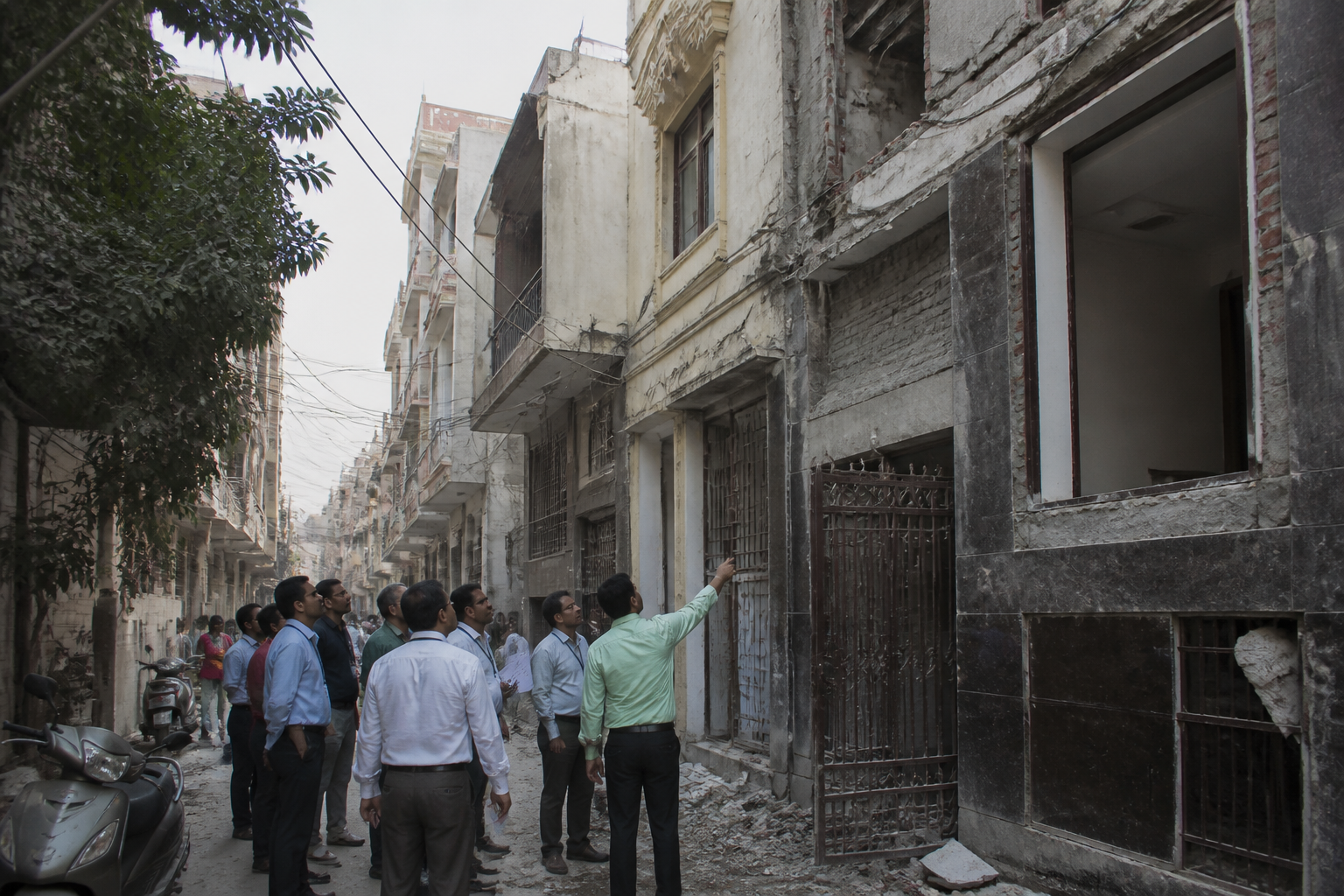
Two Delhi tragedies are forcing a larger question about building safety, inspections and accountability: can a structure be altered, commercialised and occupied for years without any agency being clearly responsible for stopping it?
A five-storey building collapse in Satya Niketan killed seven people, including five students and two labourers, roughly three months after a fire at a bed-and-breakfast property in Malviya Nagar’s Hauz Rani killed 23 people. The incidents involved different immediate hazards—a structural collapse and a fire—but the available evidence points to a similar urban governance problem. Buildings were allegedly modified, expanded or used in ways that raised safety concerns, while enforcement action came only after people died.
The question is not limited to whether individual owners, operators or contractors broke rules. The deeper issue is how a city’s regulatory system identifies risk, shares information and acts before a building becomes dangerous. The Hauz Rani inquiry and the early investigation into Satya Niketan show how responsibility can move across owners, tenants, municipal departments, police, licensing authorities and utility providers, leaving accountability dispersed until after a disaster.
The Hauz Rani fire offers the clearest documented example of that chain. The property had reportedly been licensed as a six-room bed-and-breakfast but was allegedly expanded into a 25-room hotel across four floors, a basement and an improvised rooftop facility. Investigators found a single entry and exit point, a locked terrace and an absence of basic fire-safety systems. The chargesheet filed by Delhi Police alleged that the accused disregarded safety norms and expanded the property to maximise commercial returns.
The physical configuration turned a regulatory violation into a deadly trap. When the fire began at about 8.35am, sleeping guests on upper floors had limited means of escape. Combustible material contributed to the spread of flames, while dense smoke travelled up the central staircase, which was also the building’s principal passage. The June 3 fire killed 23 people, including foreign nationals and members of an Indian family, and injured 20 others.
A later magisterial inquiry widened the focus beyond the property’s owner and management. It identified alleged lapses involving the Municipal Corporation of Delhi, Delhi Police, the tourism department and BSES Rajdhani Power Ltd. The inquiry said the MCD had issued stop-work notices and sought police assistance, while also asking the power company to disconnect electricity. The report alleged that the construction continued, that police did not act effectively on the notices and that the tourism department granted a licence despite deficiencies that should have been visible during inspection.
The inquiry also alleged that inspectors failed to properly record the building’s configuration, overlooked the absence of a fire no-objection certificate and did not flag inadequate ventilation in several rooms. BRPL was criticised for not acting on the request to disconnect power. These findings do not eliminate the alleged responsibility of the owner or operators. They show instead how a building can pass through several administrative checkpoints without any one institution stopping the risk.
Satya Niketan presents a different but related case. According to the FIR, the owners allegedly added four floors to an ageing structure despite knowing that its foundation could not bear the additional load. The building, officials said, dated from the 1970s, with some repairs undertaken in 1990. It stood on a 55-square-yard plot and had been converted into student accommodation with about 15 rooms and roughly 45 residents. The property reportedly generated more than Rs 4 lakh a month in rent.
Investigators are examining construction and repair work in the basement and on the ground floor. Mahesh Gupta, who managed the property, reportedly told investigators that basement work had continued for eight to 10 days because of waste and rainwater accumulation during the monsoon. Civic officials said the basement, constructed around 2007, had no reinforced-concrete pillar and relied on load-bearing walls. Investigators are examining whether work affecting such a wall contributed to the collapse.
The available material does not establish the final technical cause of the collapse. That distinction matters. The MCD mayor said the building had not been classified as dangerous, while the MCD commissioner said there was no confirmation of construction activity at that stage and that officials had been suspended because of local allegations and the ongoing inquiry. At the same time, the FIR and police investigation have focused on alleged additions, structural weakness and ongoing work.
Five MCD South Zone officials were suspended after the collapse: Deputy Commissioner Rakesh Kumar, Superintending Engineer Ranvir Singh, Executive Engineer (Building) Lalit Kumar Goel, Assistant Engineer (Building) Sunil Chauhan and Junior Engineer (Building) Ashish Kumar. Three of them had been posted in the South Zone when the Hauz Rani fire occurred. The timing has raised a central accountability question: if officials connected to an earlier enforcement environment remained in place, why did action follow only after another fatal incident?
The answer cannot be found only in the number of inspections. The MCD said it had surveyed more than 30 lakh houses across Delhi by the end of June as part of a pre-monsoon exercise. Only 51 structures were declared dangerous. Yet Satya Niketan, Hauz Rani and Said-ul-Ajaib—areas that experienced fatal fires or collapses—had not been declared dangerous during earlier surveys.
The corporation says these surveys are based on visual inspections and complaints. Once a building is identified as dangerous, officials can serve a vacation notice and proceed towards demolition. But the incidents raise a limitation in that model: structural risk may emerge not only from age or visible deterioration, but also from incremental changes in use, illegal additions, altered load paths, unauthorised basements and intensified occupancy.
This is particularly important in neighbourhoods where residential plots are converted into paying guest accommodation or other commercial uses. Satya Niketan’s property reportedly housed three students to a room, while the wider policy response focused on inspecting other PG facilities. The Delhi government ordered inspections of PG accommodation and action against illegal construction. On September 8, the civic body surveyed 1,150 PG accommodations housing about 20,000 people, examining structural and fire-safety concerns.
The response also exposed a policy tension. Authorities discussed sealing buildings with unauthorised fifth floors and completing structural audits in major PG hubs within a week. At the same time, Lieutenant Governor T S Sandhu cautioned against indiscriminate sealing because it could leave students without accommodation. A committee was asked to contact students, hear their grievances and prepare a database. The government also considered alternative accommodation through universities, the MCD and the Delhi Development Authority, including vacant buildings owned by the agencies.
These measures show that enforcement is not a simple choice between action and inaction. Sealing an unsafe building may protect occupants, but without an alternative it can transfer risk to another unregulated property. Conversely, delaying action because a building houses tenants allows a known hazard to continue. The policy challenge is to connect building enforcement with housing capacity, tenant information and emergency preparedness rather than treating each as a separate administrative file.
The regulatory framework itself is not absent. Officials said basement construction must comply with the applicable Master Plan and building regulations, while sanctioned plans, structural safety and fire requirements apply depending on the nature of the work. For plots up to 500 square metres, empanelled professionals have certification and inspection responsibilities, while the civic body retains a statutory monitoring role. Construction or modification that violates a sanctioned plan can invite action.
The unresolved question is therefore institutional rather than purely legal: who checks whether an approved plan remains the actual building? A sanctioned plan records an intended structure, but the risk develops when additional rooms, floors, basements or commercial uses are added over time. The Hauz Rani inquiry suggests that different agencies may each possess part of the warning—an inspection deficiency, a stop-work notice, a licensing problem or a power disconnection request—without a shared mechanism that converts those warnings into timely action.
The available data indicate that the problem extends beyond the two buildings. Delhi Fire Service records cited in the report show more than 330 building-related calls between January 1 and September 6 this year, resulting in 30 deaths and 120 injuries. During the corresponding period last year, 446 such calls were recorded, with 46 deaths or fatal incidents and 155 injuries. The category includes major collapses as well as complaints and precautionary calls involving cracks, falling bricks and roof collapses.
Delhi also witnessed the Said-ul-Ajaib collapse on May 30, which killed six people, along with building collapses in Malka Ganj’s Sabzi Mandi area and Karawal Nagar in June. Government data cited in the report show that nearly 33,000 people died across India between 2020 and 2024 in incidents involving building collapses, fires and falls into pits and manholes. The figures cover multiple types of incidents, but they place Delhi’s recent tragedies within a broader national pattern of urban maintenance and enforcement failures.
Experts cited in the report said the problem is not necessarily a lack of rules or personnel. Former urban development secretary M Ramachandran said accountability must exist across political and administrative levels. PSN Rao, dean of the School of Planning and Architecture, said municipal authorities already had laws and rules that needed enforcement and that regular inspections of potentially dangerous buildings were a basic municipal responsibility.
Another dispute concerns redevelopment policy in resettlement colonies. MCD officials argued that the absence of a clear redevelopment framework had encouraged unauthorised vertical expansion in areas such as Satya Niketan and other colonies. They said narrow plots, load-bearing walls and increased commercial use made such additions particularly risky. The DDA rejected the suggestion that the lack of a policy explained the problem, pointing to a redevelopment provision in MPD-2047 while also acknowledging that every construction project still requires approval from the concerned local body.
That disagreement is significant because it separates two questions that are often merged after a disaster. The first is whether existing buildings need a viable route for lawful redevelopment. The second is whether construction can proceed without sanctioned plans or structural verification while that policy is being debated. A redevelopment gap may explain pressure for additions; it does not by itself establish permission for unsafe construction.
What the evidence confirms is that Delhi’s building safety problem is not only about ageing structures. It involves changing land use, unauthorised expansion, dense occupancy, fragmented enforcement and inspections that may not capture gradual changes. What remains uncertain is the final technical cause of the Satya Niketan collapse and the extent of responsibility among the owners, operators, contractors and agencies involved.
The developments that warrant monitoring are the technical investigation, the status of the suspended officials, the structural audits of PG accommodations, enforcement against unauthorised additions and the implementation of any redevelopment or alternative-accommodation framework. The central test is whether these actions continue after public attention moves on—or whether, as in earlier cases, accountability begins only after the next building fails.
