


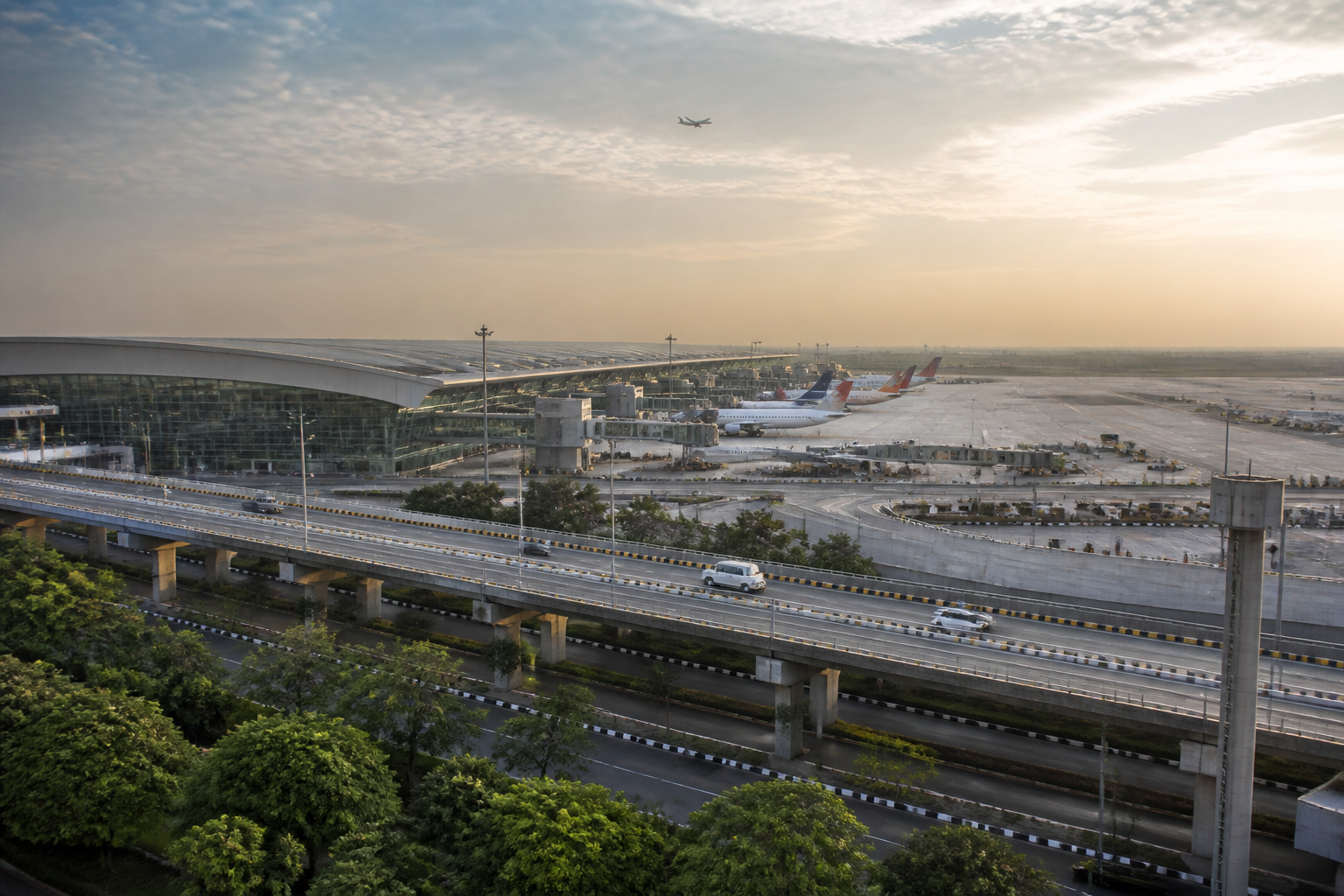
Delhi’s Indira Gandhi International Airport is preparing for a substantial increase in international capacity by 2030, according to details of a new 10-year master plan shared by Delhi International Airport Ltd at a stakeholder consultation on August 16. The plan proposes a new international pier at Terminal 3, limited internal changes at Terminal 1 and a longer-term decision on Terminal 2.
The immediate question is not simply how many passengers IGIA will be able to process. It is how Delhi-NCR’s airport system will distribute future demand between its established primary hub and the newer airport in Greater Noida. The expansion plan shows that IGIA remains the centre of the region’s aviation network, even as a secondary airport has entered the system and is yet to build comparable flight and passenger volumes.
DIAL’s proposals would take IGIA’s overall stated capacity from 10.4 crore passengers per annum to more than 12.5 crore by early 2030. The existing figure is spread across Terminal 1, with a capacity of 4 crore passengers, Terminal 2, with 1.4 crore, and Terminal 3, with 5 crore. T3 currently handles both domestic and international traffic, with 3 crore passengers of its stated capacity assigned to international operations and 2 crore to domestic operations.
The largest planned intervention is a new international pier, identified as Pier E, at Terminal 3. The pier is expected to add capacity of 1.6 crore passengers per annum. Once the expansion is completed, T3’s total capacity is projected to reach 6.6 crore passengers annually. Within that figure, international capacity would rise to 4.6 crore, while domestic capacity would remain at 2 crore.
That distribution is significant because the plan is not presented as a uniform expansion across all terminals. Instead, it prioritises international traffic at T3 while making a relatively modest adjustment to domestic capacity at T1. DIAL plans to add check-in and security counters at Terminal 1, increasing its capacity from 4 crore to 4.5 crore passengers per annum without changing the terminal’s basic structure.
The proposed arrangement indicates that the airport’s existing terminal network is being used selectively. T3 would absorb most of the planned international growth, while T1 would receive operational additions aimed at raising domestic throughput. Terminal 2, meanwhile, would continue in its current form for some years, according to the report, before potentially being demolished and replaced by a larger Terminal 4.
The timing of a future Terminal 4 is expected to depend on demand. The plan does not establish a fixed construction schedule for that replacement. Instead, the decision has been linked to how passenger volumes develop over the next decade. This makes the master plan both an expansion programme and a sequencing exercise: capacity is being added now, while a larger terminal intervention remains conditional on future requirements.
The plan’s international focus reflects the changing role assigned to IGIA within the region’s airport system. The report describes the airport as India’s busiest and identifies international traffic as the principal area of expansion. By increasing international capacity at T3 from 3 crore to 4.6 crore passengers per annum, DIAL is preparing the existing hub to handle a larger share of cross-border traffic.
At the same time, Delhi-NCR has acquired a second airport in Greater Noida. The Times of India report says that the airport is struggling to attract flights and passenger footfalls in the shadow of IGIA. The contrast creates a planning challenge. Additional capacity at the established airport may help meet demand where airlines and passengers are already concentrated, but it can also make it harder for the newer airport to develop an independent operating base.
The supplied material does not establish how flights would be allocated between the two airports, whether particular airlines would be shifted, or whether regulatory authorities have adopted a formal traffic-distribution policy. It does, however, show that the two-airport question is now embedded in the timing of IGIA’s future expansion. DIAL’s decision to defer a larger Terminal 4 until demand becomes clearer leaves room for the regional system to evolve before a more permanent terminal structure is built.
The current plan also illustrates the importance of capacity definitions in airport expansion. The figures are not limited to runway movements or aircraft stands. They are expressed in crore passengers per annum and are distributed across terminals and traffic categories. The proposed rise from 10.4 crore to more than 12.5 crore represents an overall increase of more than 2.1 crore passengers in stated annual capacity. Within that total, the most substantial change is the 1.6-crore addition for international operations at T3.
Terminal 1’s proposed increase, by comparison, is 0.5 crore passengers per annum. That addition would come through more check-in and security counters rather than a structural rebuild. The difference between the two interventions suggests that DIAL is using different methods for different demand segments: an additional pier for international growth and internal processing improvements for domestic traffic.
The plan’s institutional status is also important. DIAL shared the details at a consultation with stakeholders, and the master plan was still being finalised. It was expected to be submitted to the aviation ministry in September, after which the ministry would examine the proposal. The supplied report ends before detailing the ministry’s subsequent process or decision, so the final approval position is not established in the available material.
This means the reported capacity figures should be understood as planned outcomes rather than completed infrastructure. The new pier, the Terminal 1 modifications and the eventual replacement of Terminal 2 are all at different stages of certainty. Pier E and the T1 changes form the near-term expansion package described by DIAL, while Terminal 4 remains a possible longer-term response to demand.
The phasing matters because airport capacity cannot be assessed only through terminal floor area. The plan specifically refers to check-in and security counters at T1, indicating that passenger-processing systems are part of the capacity calculation. At T3, the proposed international pier would alter how passengers are handled within the terminal complex. The supplied material does not provide details on construction cost, project contracts, aircraft stands, baggage systems, immigration facilities or construction timelines, and those elements cannot be assumed from the capacity figures alone.
The plan therefore offers a clear picture of intended capacity allocation but only a partial picture of implementation. It confirms the scale of the proposed increase, the terminals involved and the sequence under consideration. It does not yet establish the final design, investment structure, construction milestones or operating arrangements between IGIA and the Greater Noida airport.
For Delhi-NCR, the larger urban question is how infrastructure planning responds when an established hub and a new regional asset operate within the same metropolitan economy. IGIA’s proposed expansion gives the region additional processing capacity and prioritises international traffic at an airport with an existing terminal network. Greater Noida’s airport introduces another potential node, but the available report indicates that its ability to attract flights and passengers remains limited.
The master plan consequently places demand forecasting at the centre of airport policy. DIAL’s decision to link a future Terminal 4 to demand suggests that the next major capital investment will depend on how quickly passenger volumes grow and how effectively the region’s airports share traffic. Until the plan is finalised and reviewed by the aviation ministry, the precise relationship between the two airports remains unresolved.
What the available evidence confirms is that IGIA is preparing for more than 12.5 crore passengers per annum by early 2030, with international capacity at T3 rising to 4.6 crore through a new Pier E. Terminal 1 would receive a smaller capacity increase, while Terminal 2 would continue operating before a potential replacement by Terminal 4. The developments to monitor are the ministry’s response to the submitted master plan, the implementation schedule for Pier E and T1, and the extent to which Greater Noida airport begins to attract flights and passenger traffic.
