


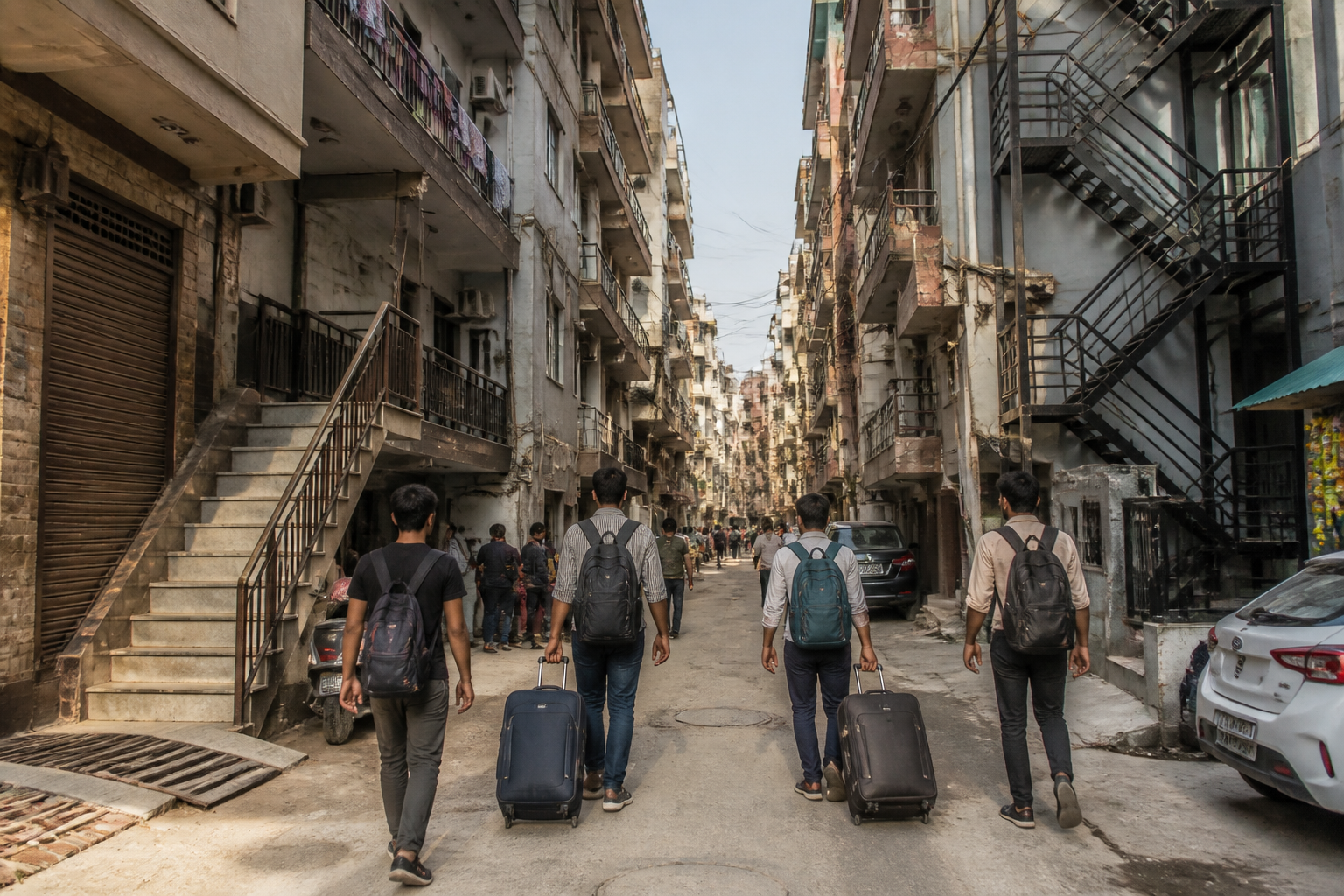
The two Delhi neighbourhoods are dealing with different aftermaths. In Hauz Rani, foreign visitors and medical-tourism customers have disappeared from lanes that once depended on budget bed-and-breakfast facilities. In Satya Niketan, students are leaving private paying-guest accommodation after the collapse of a five-storey building killed seven people. The incidents were separate, but their consequences point to the same urban fault line: affordable accommodation is expanding faster than safety oversight.
The June 3 fire at the Flourish Stay B&B in Hauz Rani killed 23 people, including 14 foreign nationals. Three months later, the market around the property is slowly regaining activity, but several nearby accommodation facilities remain sealed and some residents have not returned to buildings affected by smoke and fear. In Satya Niketan, the collapse of a PG building killed five students and two labourers. The uncertainty has spread beyond the collapsed structure, with students questioning the safety of neighbouring buildings and reconsidering whether they can continue living in the area.
These are not simply stories about two dangerous properties. They reveal how Delhi’s demand for low-cost rooms, close to hospitals and colleges, has created a large private accommodation network in neighbourhoods where the regulatory system appears unable to keep pace with commercial use, construction changes and population pressure.
In Hauz Rani, the fire investigation described a facility operating far beyond the terms of its licence. The B&B was licensed for six rooms but was allegedly running at least 25 rooms across four floors, a basement and an improvised rooftop facility. The property allegedly had no fire no-objection certificate and no emergency fire exit. According to the Delhi Police chargesheet cited in the report, the fire began in the kitchen after an oil fryer was allegedly left unattended. Smoke travelled through the central staircase, trapping guests on upper floors.
The first distress call was made at 8.48am. Firefighters reached the location seven minutes later, but narrow and congested lanes made access difficult. Between 9am and 11.30am, 48 people were rescued. By noon, the fire was under control, but 23 people had died. The chargesheet names B&B owner Lovkesh Bajaj, manager-cum-accountant Jay Mishra and cook Kesar Negi as accused. Investigators alleged that basic safety requirements had been disregarded while the property was expanded to maximise commercial returns.
The physical and economic effects extended beyond the building. A structure opposite the B&B was found deserted, with flats locked from outside. Shopkeepers lost footfall while police barricades kept people away from the site. Auto-rickshaw drivers and local businesses depended on customers connected to the accommodation facilities, including relatives of medical tourists who used nearby shops and transport services. Even after barricades were removed, the market’s recovery remained uncertain because several homestays and B&Bs had been sealed.
The Hauz Rani episode shows how a single accommodation facility can become part of a wider neighbourhood economy without the surrounding area receiving a corresponding safety assessment. The commercial use of buildings brings customers, workers and income, but it also increases the consequences of overcrowding, unauthorised expansion and inadequate emergency access. In a dense lane, a building-level violation can quickly become a neighbourhood-level emergency.
Satya Niketan presents a different version of the same problem. The collapse involved a building estimated by sources to be 40 to 50 years old. Additional floors had been added over time, and construction work had reportedly been under way for about two weeks before the collapse. Students said that neighbouring structures also had poor ventilation, dangerous staircases and inadequate fire-safety arrangements. One adjoining building was being vacated for demolition, while others were identified as unsafe.
For students, the danger is inseparable from the cost and location of housing. Rahul, a third-year student cited in the report, pays Rs 8,000 for accommodation, already considered low for Delhi. His room has neither ventilation nor air conditioning. After the collapse, his parents wanted him to move. Other students left for friends’ or relatives’ homes, while some spent nights inside college campuses after being forced out of their PGs.
The shortage of institutional accommodation makes private PGs essential rather than optional for many students. Around 71,600 new undergraduate students were admitted to Delhi University in 2026-27, while the university has around 7,000 hostel seats, according to figures cited by officials. The gap leaves thousands dependent on private rooms around college clusters. Satya Niketan’s accommodation market exists because students need to live near educational institutions and because formal hostel capacity cannot absorb demand.
This is where the two neighbourhoods converge. Hauz Rani served people seeking inexpensive lodging near hospitals. Satya Niketan serves students seeking inexpensive lodging near colleges. In both cases, location and affordability shape the housing decision. Safety becomes a secondary question because the alternatives are limited, expensive or too far from the institution that brought residents to the area.
That imbalance also changes the relationship between tenants and building owners. Students or medical visitors may not know whether a property has been structurally assessed, whether its room count matches its licence or whether it has adequate fire exits. The report does not establish a citywide compliance rate, but the two cases show how difficult it can be for occupants to assess risk before moving into low-cost accommodation.
The administrative response is now moving towards a dedicated regulatory framework for PG accommodation. Students have demanded a web portal requiring owners to disclose rents, facilities, meal plans and structural-safety details. They have also sought pre-monsoon audits, structural certifications and regular fire-safety inspections. Urban development minister Ashish Sood has promised comprehensive legislation and regulations within two months. The proposed framework is expected to include mandatory licences, zone-wise rent bands, structural and fire-safety audits, and a central portal listing rents, amenities and compliance details.
Each element addresses a specific weakness exposed by the two incidents. Mandatory licensing could bring private accommodation into a clearer administrative register. A public portal could allow students and families to compare basic information before renting. Structural certifications could identify risks associated with ageing buildings, added floors and ongoing construction. Fire-safety inspections could address blocked exits, inadequate escape routes and the absence of required equipment. Zone-wise rent bands could also make prices more visible, although the supplied report does not establish how such bands would be enforced or whether they would increase safe accommodation supply.
The immediate response at Delhi University colleges demonstrates the scale of the displacement. Classrooms and other facilities were converted into temporary shelters, with mattresses placed in health centres, staff rooms and guest rooms. Colleges arranged food and counselling, while student volunteers searched for classmates who might have been living in the collapsed building. These measures provided short-term relief, but they did not solve the shortage that had pushed students into private PGs in the first place.
The numbers contained in the report frame the structural mismatch. One accommodation facility was allegedly licensed for six rooms but operated at least 25. Delhi University had around 7,000 hostel seats for approximately 71,600 new undergraduate admissions. The figures describe two different forms of excess: commercial accommodation expanding beyond its authorised capacity, and student demand expanding beyond the capacity of formal housing. In both cases, the gap is filled by private buildings whose condition and compliance may not be transparent to occupants.
The longer-term question is therefore not only whether a particular building was unsafe. It is whether Delhi’s institutions can identify, register and inspect the thousands of rooms that function as housing for students, patients’ relatives, workers and other temporary residents. The report records proposed legislation, but it does not yet establish the framework’s final provisions, enforcement capacity, inspection schedule or implementation date.
The neighbourhood aftermath also shows why urban safety cannot be measured only by whether a fire is extinguished or rubble is cleared. Hauz Rani’s shops lost customers and residents left nearby flats. Satya Niketan’s students lost rooms, routines and confidence in the buildings around them. Colleges became emergency shelters because the private accommodation market had no immediate alternative for those displaced.
What the evidence confirms is a clear connection between affordability, location and risk. Where people need to live near hospitals or colleges, demand can make even poorly regulated buildings economically viable. What remains uncertain is whether the proposed regulatory system will create a reliable, publicly accessible record of accommodation conditions and whether authorities will have the capacity to inspect and enforce it. The next significant developments will be the promised PG legislation, the proposed compliance portal and the measures taken to assess buildings in and around affected neighbourhoods.
